
Updated: August 30, 2026
Mortgage default insurance is normally required when you buy a home with a down payment of less than 20%. It protects the lender if the mortgage goes into default. It does not pay your mortgage for you and it does not remove your obligation to repay the loan.
The buyer usually pays the insurance premium. In most cases, the premium is added to the mortgage rather than paid entirely in cash at closing. In Ontario, you should also budget for 8% provincial Retail Sales Tax on the premium.
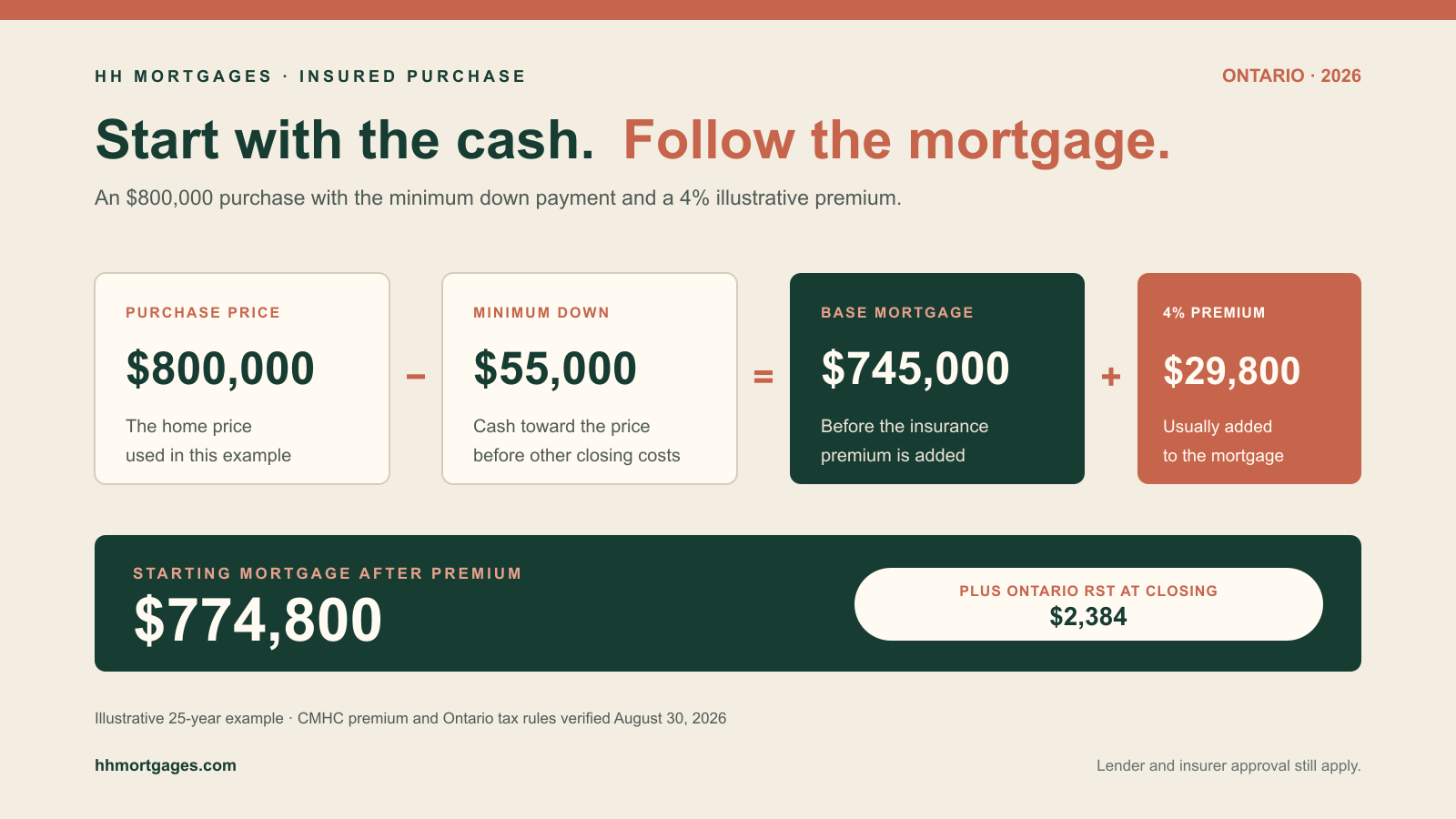
Here is the part that surprises people: a $745,000 mortgage with a 4% insurance premium becomes a $774,800 mortgage before interest.
What mortgage default insurance actually does
Mortgage default insurance, also called mortgage loan insurance, lets an eligible buyer purchase a home with less than 20% down. The insurance reduces the lender's risk if the borrower stops making payments.
Canada has more than one mortgage insurer. CMHC is the best-known public provider, while private insurers also operate in the market. The lender normally arranges the insurance as part of the mortgage application.
The insurer reviews both the borrower and the property. Having the minimum down payment does not guarantee that the mortgage or insurance application will be approved.
When is mortgage default insurance required?
For a typical owner-occupied purchase, mortgage default insurance is normally required when:
- the down payment is less than 20%
- the mortgage and property meet an insurer's eligibility rules
- the purchase price is below $1.5 million
A home priced at $1.5 million or more is not eligible for high-ratio mortgage insurance under the current federal limit, so at least 20% down is required.
For homes priced below $1.5 million, the current minimum down payment is:
- 5% of the first $500,000
- 10% of the portion above $500,000
If the resulting down payment is still below 20%, the mortgage will normally need default insurance.
For the complete purchase-price calculation, see how much down payment you need in Ontario.
How the premium is calculated
The premium is based mainly on the mortgage amount before the insurance premium is added and the loan-to-value ratio.
Loan-to-value, or LTV, is the mortgage amount divided by the property's lending value. A smaller down payment creates a higher LTV and usually a higher premium rate.
CMHC currently publishes premium rates ranging from 0.6% to 4.5%, depending on the application. A common standard premium rate for a purchase with more than 90% and up to 95% LTV is 4%.
The basic calculation is:
Base mortgage amount × applicable premium rate = insurance premium
The insurer's current schedule and the details of the application determine the actual rate. Do not assume every insured mortgage will use 4%.
A realistic $800,000 Ontario example
Suppose you are buying an $800,000 home with the minimum down payment and a 25-year amortization.
First, calculate the down payment:
| Down-payment calculation | Amount |
|---|---|
| 5% of the first $500,000 | $25,000 |
| 10% of the remaining $300,000 | $30,000 |
| Minimum down payment | $55,000 |
Now calculate the mortgage insurance:
| Mortgage calculation | Amount |
|---|---|
| Purchase price | $800,000 |
| Less down payment | $55,000 |
| Base mortgage before insurance | $745,000 |
| Illustrative CMHC premium at 4% | $29,800 |
| Mortgage after adding the premium | $774,800 |
The premium calculation is:
$745,000 × 4% = $29,800
In Ontario, 8% Retail Sales Tax on a $29,800 premium is $2,384.
For planning purposes, treat that tax as part of the cash needed for closing. It is separate from the $55,000 down payment and other costs such as legal fees, title insurance, adjustments and land transfer tax. Your lender or lawyer can confirm the amount due for your transaction.
The example is illustrative and uses a standard 25-year CMHC premium rate. The lender and insurer must confirm the actual mortgage amount, premium, tax and eligibility.
What changes with a 30-year amortization?
Insured mortgages can currently have an amortization of up to 30 years if at least one borrower is a first-time homebuyer or the home is a new build, subject to the program rules.
A longer amortization can lower the required monthly payment, but it generally increases the total interest paid. CMHC also applies an additional premium charge to eligible 30-year insured mortgages, so the 25-year example above should not be reused without recalculating it.
Is mortgage default insurance the same as mortgage life insurance?
No. The names sound similar, but the products have different purposes.
| Product | Who it primarily protects | Is it normally required? |
|---|---|---|
| Mortgage default insurance | The lender if the borrower defaults | Normally required with less than 20% down on an eligible purchase |
| Mortgage life, disability or critical illness insurance | May help the borrower or estate under the policy terms | Optional |
Optional mortgage insurance products may be offered by a lender, but you do not have to buy them to obtain a mortgage. Review the coverage, exclusions, beneficiary and cost before deciding.
Is putting 20% down always the better choice?
Not automatically.
On an $800,000 purchase, 20% down is $160,000. That is $105,000 more than the $55,000 minimum in the example.
Putting 20% down removes the usual need for default insurance and produces a smaller mortgage. But using most of your available cash to reach 20% can leave too little for closing costs, repairs, emergencies or other priorities.
Insured mortgages may also be priced differently from uninsured mortgages because the lender has insurance protection. That does not mean the insured option is always cheaper. Compare the down payment, premium, interest rate, payment, cash remaining and total borrowing cost together.
What I would pay attention to
First, I would separate the three numbers people often mix together: the down payment, the insurance premium and the Ontario tax on that premium. They affect your cash and mortgage differently.
Second, I would ask for the starting mortgage amount after the premium is added. That is the balance on which interest may be charged, not just the purchase price minus the down payment.
Finally, I would compare more than two round numbers such as 10% versus 20% down. Sometimes a different down payment amount leaves a healthier emergency reserve while still improving the premium or monthly payment. The useful comparison is the complete mortgage plan, not one percentage by itself.
Bottom line
Mortgage default insurance helps an eligible buyer purchase with less than 20% down, but it protects the lender. The premium is usually added to the mortgage, and Ontario buyers should also plan for 8% provincial tax on that premium.
Before relying on a purchase budget, calculate the minimum down payment, premium, tax, closing costs and qualifying mortgage payment together.
Not sure what your mortgage would look like after the insurance premium is added? Send me a message or book a call and we can go through the numbers together.
This article provides general information, not personalized financial, tax or insurance advice. Mortgage insurance eligibility, premiums, taxes, qualification and product availability depend on the borrower, property, lender, insurer and current rules.