
Updated: August 18, 2026
Under the current Canadian minimum down-payment rules, here’s the simple version:
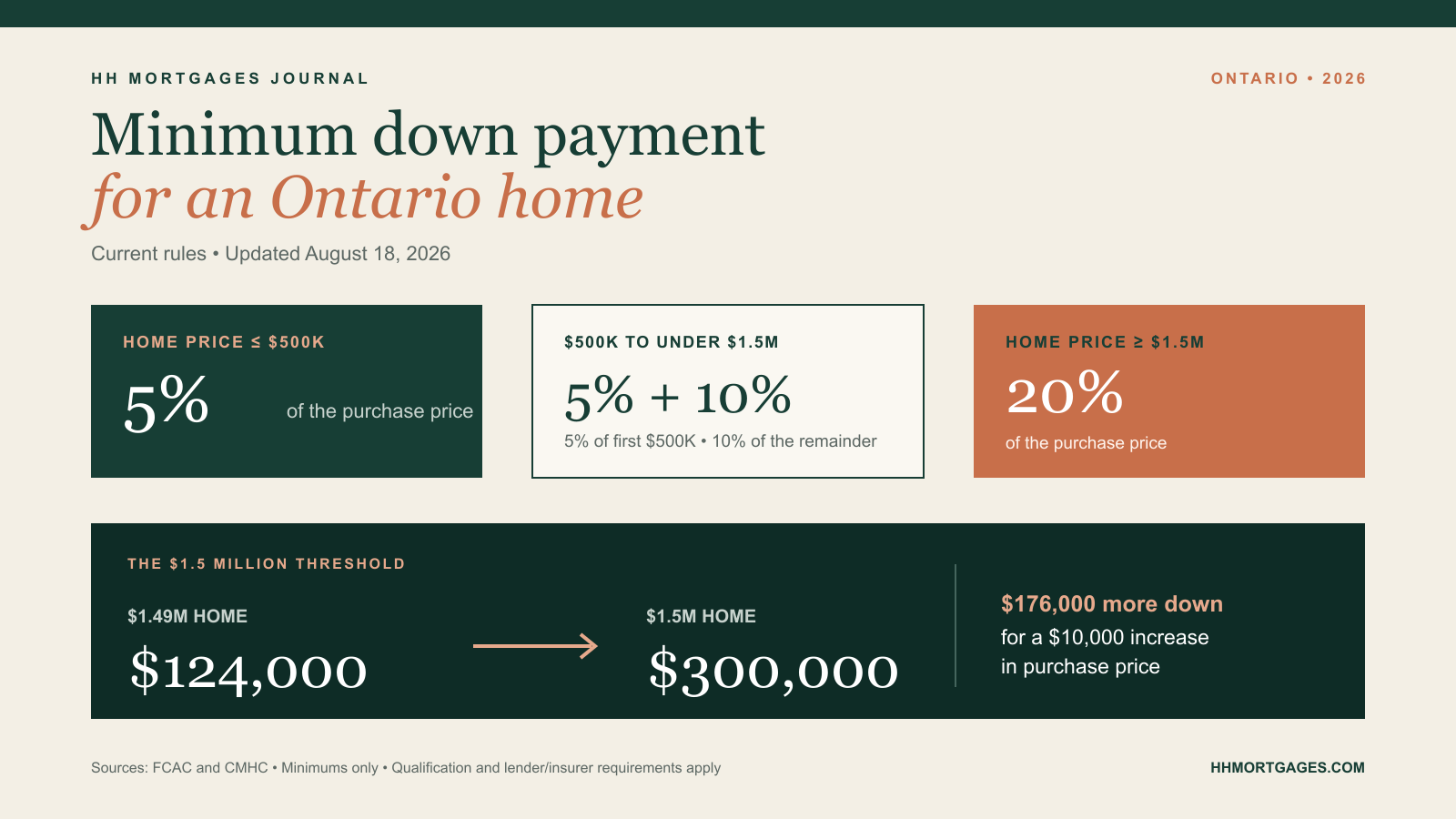
- For a home priced at $500,000 or less, the minimum down payment is 5%.
- For a home priced above $500,000 but below $1.5 million, it is 5% of the first $500,000, plus 10% of the amount above $500,000.
- At $1.5 million or more, the minimum down payment is 20%.
Those are the federal minimums. They do not guarantee mortgage approval, and a lender may require more depending on the property, your credit, income, debts, and the mortgage product.
The $1.5 million line is especially important in parts of Oakville, Burlington, Mississauga, Hamilton, and the GTA. A small difference in purchase price near that threshold can create a very large difference in the cash you need.
How the minimum down payment is calculated
For homes up to $500,000, the calculation is straightforward:
Purchase price × 5%
For homes above $500,000 and below $1.5 million, split the price into two parts:
- Calculate 5% of the first $500,000. That is always $25,000.
- Calculate 10% of the amount above $500,000.
- Add the two amounts together.
Here are a few examples:
| Home price | Minimum down payment | Calculation |
|---|---|---|
| $500,000 | $25,000 | 5% of $500,000 |
| $700,000 | $45,000 | $25,000 + 10% of $200,000 |
| $900,000 | $65,000 | $25,000 + 10% of $400,000 |
| $1,200,000 | $95,000 | $25,000 + 10% of $700,000 |
| $1,490,000 | $124,000 | $25,000 + 10% of $990,000 |
| $1,500,000 | $300,000 | 20% of $1,500,000 |
That last step is the one people often miss. The minimum on a $1.49 million home is $124,000. At exactly $1.5 million, the minimum becomes $300,000.
That is a $176,000 increase in required down payment for a $10,000 increase in purchase price.
A $900,000 Ontario example
Let’s say you are buying a $900,000 home.
- First $500,000 × 5% = $25,000
- Remaining $400,000 × 10% = $40,000
- Minimum down payment = $65,000
- Base mortgage before mortgage-insurance costs = $835,000
Because $65,000 is less than 20% of the purchase price, mortgage default insurance would normally be required. This insurance protects the lender, not the buyer.
The insurance premium can usually be added to the mortgage. In Ontario, the provincial sales tax charged on that premium cannot be added to the mortgage, so it is another amount that must be paid separately.
Minimum down payment does not mean minimum cash needed
The down payment is only one part of the cash plan.
You may also need money for:
- the deposit submitted with your offer
- Ontario land transfer tax and, for Toronto properties, municipal land transfer tax
- legal fees and title insurance
- home inspection or appraisal costs, where applicable
- property-tax and utility adjustments
- moving, immediate repairs, and an emergency reserve
- provincial sales tax on a mortgage default insurance premium, if applicable
The deposit and down payment are connected, but they are not the same step. Your deposit is paid according to the agreement of purchase and sale, often well before closing. At closing, it is credited toward your total down payment.
This timing matters. Having enough money overall is not helpful if the funds are not available when your deposit or closing amount is due.
Can first-time buyers use an FHSA and the Home Buyers’ Plan?
Potentially, yes.
A qualifying first-time buyer can use a First Home Savings Account (FHSA) to save for a qualifying home. Current FHSA participation room starts at $8,000 in the first year the account is opened, with a $40,000 lifetime participation limit.
The Home Buyers’ Plan (HBP) may also allow an eligible buyer to withdraw up to $60,000 from RRSPs. HBP withdrawals generally have to be repaid over 15 years.
If you meet the conditions for both programs, you may be able to use an FHSA withdrawal and an HBP withdrawal for the same purchase. The eligibility rules and timing are different, so check them before moving or withdrawing funds.
Eligible first-time buyers may also qualify for an Ontario land transfer tax refund. That can help with closing costs, but it does not reduce the minimum down payment required by the lender.
Should you put down more than the minimum?
Sometimes. A larger down payment can reduce the mortgage amount and the interest you pay. Reaching 20% may also remove the usual need for mortgage default insurance.
But putting every available dollar into the down payment is not automatically the best decision. You still need enough cash for closing, moving, repairs, and normal life after you get the keys.
This is where I would look at the whole plan:
- How much can you put down without emptying your savings?
- Would reaching 20% materially improve the mortgage structure?
- Is the purchase price close to the $1.5 million threshold?
- How much room is left for closing costs and unexpected expenses?
- Does the payment still feel comfortable after property taxes, utilities, and other debts?
The best down payment is not simply the largest number you can produce. It is the amount that supports a mortgage you can qualify for and a home budget you can live with.
Frequently asked questions
Can I buy a home in Ontario with 5% down?
Yes, if the purchase price is $500,000 or less and you meet the lender and mortgage insurer’s requirements. Above $500,000 and below $1.5 million, the minimum is a blended calculation, not a flat 5%.
Do I always need 20% down?
No. A purchase below $1.5 million may be possible with less than 20% down if the mortgage qualifies for default insurance. A home priced at $1.5 million or more requires at least 20% down.
Is my offer deposit extra on top of the down payment?
No. The deposit is normally credited toward the down payment on closing. The practical issue is timing because the deposit is usually due much earlier.
Can a lender ask for more than the federal minimum?
Yes. The minimum is only a starting point. The lender may require a larger down payment based on the borrower, property, income documentation, credit, or mortgage type.
Bottom line
For an Ontario home below $1.5 million, the minimum down payment may be much less than 20%. At $1.5 million or more, you need at least 20%.
Before you make an offer, calculate the down payment, deposit timing, closing costs, and qualification together. That gives you a more realistic purchase budget than looking at the down payment alone.
Not sure how the numbers apply to a property you are considering? Send me a message or book a call and we can go through them together.
This article provides general information. Mortgage qualification, insurance eligibility, rates, and product availability depend on the borrower, property, lender, and insurer requirements.