
Updated: September 7, 2026
To apply for a mortgage in Canada, start with identification, proof of income, records showing where your down payment comes from, and details of your debts. Once you have a property under contract, you will also need the purchase documents.
The exact list depends on your lender, income and purchase. A salaried employee using savings will not have the same document requests as a business owner receiving a family gift.
My advice is to organize the file around the questions it needs to answer: what do you earn, what do you owe, and where is the purchase money coming from? That makes a mortgage documents checklist much easier to use.
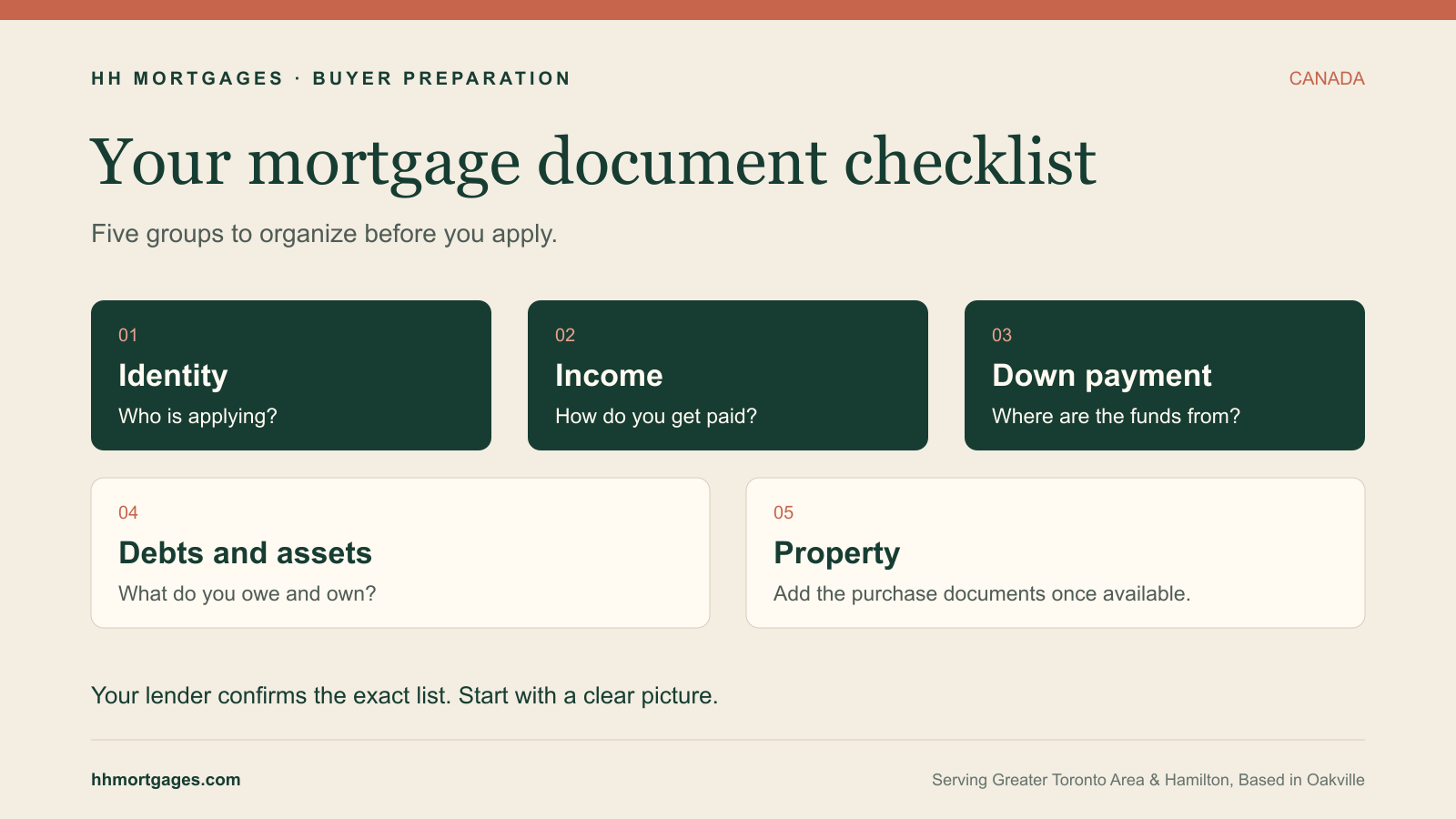
Start with these five groups
- Identity: valid identification and your current address.
- Income: recent pay records, employment details and tax documents where requested.
- Down payment: statements and records for each source of funds, plus money for closing costs.
- Debts and assets: current balances and payment information.
- Property: the signed purchase agreement and property details once available.
The Financial Consumer Agency of Canada's preapproval guidance sets out the main financial information lenders review. Use the list here to get organized, then ask for the requirements specific to your application.
Match the income documents to how you get paid
If you receive a salary or hourly pay
Have a recent pay stub ready and ask whether an employment letter is needed. A useful letter confirms your position, start date and current salary or hourly pay. Your lender may also ask for tax slips or other income records.
Before requesting the letter, confirm how recent it must be and what it should include. That can save a second trip to your employer's HR department.
If your pay includes overtime, commissions or bonuses, explain that at the start. Ask which records are needed to assess those earnings rather than assuming your best pay period will represent your qualifying income.
If you are self-employed
Expect the income conversation to take a little more preparation. For example, TD's Canadian homebuyer application checklist lists the most recent two years of T1 General tax returns and corresponding Notices of Assessment for self-employed applicants. It also says additional proof of self-employment may be needed.
A T1 General is your personal income tax return. A Notice of Assessment, often called an NOA, is the CRA's assessment of that return. They serve different purposes, so do not assume one replaces the other.
That is a lender example, not a universal checklist for every business owner. Ask which personal and business records your lender needs before sending a large folder of unrelated documents.
If you cannot find an NOA, the CRA explains how to obtain a copy online or by mail. Download it yourself through your CRA account. You should not need to give anyone your CRA password.
Show the source of your down payment
A balance tells the lender how much is in an account. Supporting records help explain where the money came from.
Depending on your funding plan, you may be asked for savings or investment statements, a gift letter, or documents from selling another property. CIBC's mortgage document checklist includes these examples and notes that additional information may be requested.
Ask for the exact statement date range. CIBC's checklist refers to savings or investment statements from within the last 90 days; that wording should not be treated as a rule that every buyer must move all their money into one account and wait 90 days.
If you transfer money between your own accounts, keep the records linking those accounts. Before moving funds simply to make the file look tidier, ask whether leaving them where they are would be easier to document.
An $80,000 down-payment example
Suppose you plan to use $50,000 from savings, $20,000 from an investment account and a $10,000 family gift. That adds up to $80,000 from three sources.
I would make a short note beside each amount: which account holds it, whether it has moved, and which supporting document is still missing. Ask which gift form and transfer evidence the lender needs, and confirm how the gift must be documented as non-repayable.
If the family money is actually a loan, say so. Do not describe money you must repay as a gift.
This example is about documenting funds, not calculating your required down payment or confirming that a lender will accept them. You also need a separate plan for closing costs in Ontario.
Include debts and the other borrower
Prepare current statements for credit cards, loans, lines of credit and any existing mortgage. Include financial obligations such as support payments where applicable.
If you are applying with someone else, plan for their financial information too. TD's preapproval meeting checklist specifically includes co-borrower information and recent debt statements.
Tell your mortgage professional about a balance you intend to pay off. Ask what evidence will be needed and when. A plan to clear a debt and confirmation that it has been cleared are different things.
Add the property documents after your offer is accepted
Have the signed purchase agreement, any amendments and the property listing available. Your mortgage professional may also need property-tax information, condo fees where relevant, and your lawyer's contact details. CIBC includes property and lawyer information in its checklist.
You do not need an accepted offer just to begin a mortgage conversation. The property paperwork belongs to the next stage of the file.
For the distinction between reviewing your finances and approving a particular home, see mortgage pre-approval versus final approval.
How I would organize the file
Create one folder for each applicant's income records and another for the down payment. Keep the purchase documents together once you have them.
Use clear filenames such as Employment-letter-September.pdf. Download full statements where available, check that every requested page is included, and open each file before submitting it. A cropped screenshot can leave out the name, date or transaction that explains the document.
For anything missing, keep a simple note: what is needed, who is providing it and when you expect it. Tell me about that gap early. You do not have to wait for a perfect folder before asking a question.
Use the secure document-submission method provided for your application. Keep IDs, tax returns, banking documents and account credentials out of the blog inquiry form, live chat and social messages. If a document request seems unusual, verify it with your mortgage professional before uploading anything.
The most useful starting point is a clear picture of your income and purchase funds. From there, we can identify the documents that actually matter to your file.
Not sure what to prepare for your situation? Book a conversation with me and we can work through the list together.
General educational information. Document requirements and mortgage approval depend on the borrower, property, lender and insurer where applicable. A complete document package is not a guarantee of approval.