
Updated: August 20, 2026
A mortgage pre-approval is useful, but it is not a promise that the lender will fund any home you decide to buy.
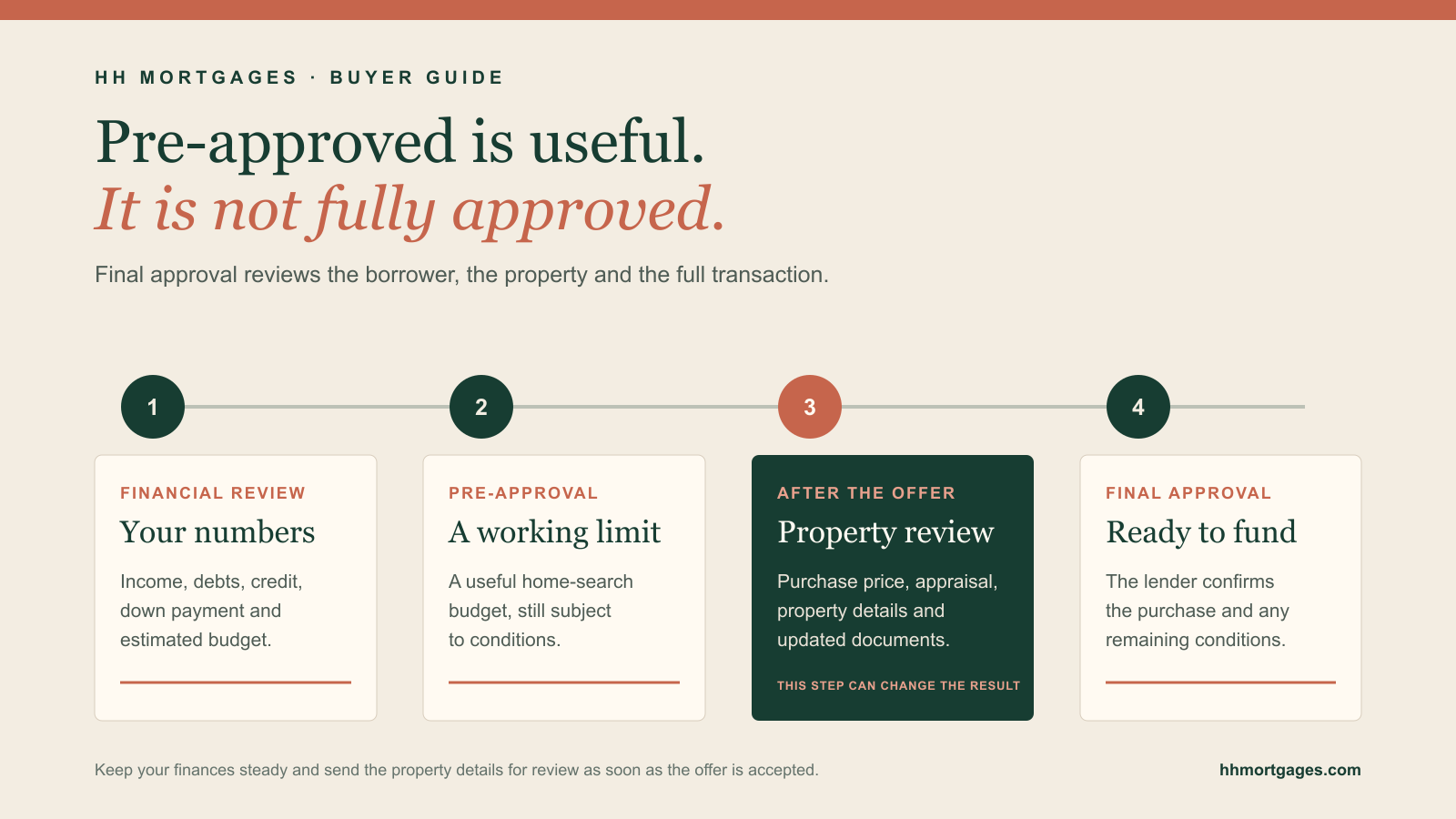
Here is the simple version. A pre-approval mainly looks at you: your income, debts, credit, down payment and estimated budget. Final approval looks at you again, then also reviews the actual property, purchase price, documents and closing details.
That is why a buyer can be pre-approved and still have a mortgage declined, reduced or approved with conditions after an offer is accepted.
Pre-qualification, pre-approval and final approval are not the same
Lenders do not always use these terms in exactly the same way. The Financial Consumer Agency of Canada notes that the process may be divided into different steps and may be called pre-qualification, pre-approval or pre-authorization.
The most important question is not the label. Ask what was actually reviewed.
| Stage | What usually happens | What it tells you |
|---|---|---|
| Pre-qualification | A quick estimate based mostly on information you provide | A rough starting budget |
| Pre-approval | Income, assets, debts, down payment and credit are reviewed in more detail | The maximum mortgage you may qualify for, subject to conditions |
| Final approval | The lender reviews the full borrower file and the specific property | Whether the lender is prepared to fund this purchase under stated conditions |
If your “pre-approval” was based on a short online form with no documents or credit review, treat it as an early estimate rather than a fully reviewed file.
What a proper mortgage pre-approval should review
A meaningful pre-approval usually includes:
- identification
- employment and income documents
- current debts and monthly obligations
- credit history
- the source and amount of the down payment
- proof that you have money for closing costs
- the expected purchase price, property taxes and condo fees, if applicable
The lender also checks whether the mortgage fits its qualification rules. For most newly underwritten uninsured mortgages at federally regulated lenders, the current stress-test rate is the greater of the contract rate plus 2% or 5.25%, according to OSFI.
Passing that calculation is important, but it still does not approve a property that has not been selected yet.
What changes after your offer is accepted?
Once there is a signed purchase agreement, the lender can review the real transaction instead of an estimate.
The property must be acceptable
The lender may review the property type, location, condition, marketability, zoning and intended use. A standard condo in Oakville is not assessed the same way as a rural property with unusual features or a building with commercial use.
The lender may also require an appraisal. CMHC explains that property value is key to the mortgage amount offered. If the appraisal does not support the purchase price, the buyer may need a larger down payment, a lower purchase price or a different financing plan.
Your financial information may be checked again
The lender can ask for updated pay stubs, bank statements, employment confirmation or proof of down payment. It may also re-check credit before closing.
This is why taking on a car loan, increasing credit-card balances, changing jobs or moving the down-payment money between accounts can create extra questions after pre-approval.
The down payment must be documented
Having the money is only one part of the review. The lender may need to see where it came from and how long it has been in the account. Gifted funds, investment withdrawals, proceeds from another property and money arriving from outside Canada can require additional documents.
If your down payment is below 20%, the mortgage will normally require mortgage default insurance. The insurer must also accept the borrower and property under its rules.
If you are still planning the cash side of the purchase, start with the current minimum down-payment rules in Ontario.
The mortgage conditions must be satisfied
An approval may still include conditions such as an appraisal, proof of income, proof of insurance, updated down-payment statements or confirmation that a debt will be paid before closing.
Final approval is only truly useful when you understand every condition and have a realistic plan to satisfy it on time.
A simple example of an appraisal shortfall
Let’s say you agree to buy a home for $800,000 and plan to put down 10%, or $80,000. Your planned mortgage before any default-insurance premium is $720,000.
Now assume the appraisal supports a value of only $760,000. For this illustration, assume the lender is prepared to finance up to 90% of the supported value.
| Item | Amount |
|---|---|
| Purchase price | $800,000 |
| Planned down payment | $80,000 |
| Planned base mortgage | $720,000 |
| Supported value | $760,000 |
| 90% of supported value | $684,000 |
| Potential cash gap | $36,000 |
The pre-approval may have shown that your income could support a $720,000 mortgage. The issue is now the property value, not necessarily your income.
This does not mean every low appraisal produces the same result. Lender and insurer decisions vary, and buyers may have options. The example shows why approval of the borrower and approval of the property are separate steps.
What should you avoid after getting pre-approved?
Until the mortgage closes, try not to make financial changes without discussing them first.
- Do not finance a car, furniture or appliances before checking the impact.
- Do not apply for several new credit products.
- Do not increase credit-card or line-of-credit balances.
- Do not change jobs, reduce hours or move to self-employment without telling your mortgage professional.
- Do not move large amounts of money without keeping a clear paper trail.
- Do not assume a rate hold guarantees approval or guarantees that every product feature will remain available.
Life changes happen. The important part is to raise them early, not a few days before closing.
Should your offer include a financing condition?
CMHC says that even with a pre-approved mortgage certificate, a buyer still needs final mortgage approval during the conditional-offer period.
A financing condition can provide time for the lender to review the property and complete the file. Whether a condition is appropriate, and how it should be written, is a decision to discuss with your real estate agent and lawyer based on the transaction. A pre-approval alone should not be treated as a reason to waive protection without understanding the risk.
What I would pay attention to
First, I would confirm how complete the pre-approval really is. Were the income and down-payment documents reviewed? Was credit checked? Were property taxes, condo fees and existing debts included?
Second, I would keep the home-search budget below the absolute maximum when possible. The maximum mortgage a lender may approve is not automatically the payment a household will feel comfortable carrying.
Third, I would send the signed offer and property details for review as soon as the offer is accepted. Waiting until the financing deadline is almost over leaves less time to solve an appraisal, document or lender-policy issue.
Bottom line
A mortgage pre-approval gives you a useful budget and helps you prepare to shop. Final approval confirms whether the lender will finance a specific purchase.
Keep your finances steady, document your down payment, allow time for the property review and do not treat the pre-approved amount as guaranteed funding.
Not sure how strong your pre-approval is, or what still needs to be checked before you make an offer? Send me a message or book a call and we can go through the file together.
This article provides general information, not personalized financial or legal advice. Mortgage approval, rates, products and conditions depend on the borrower, property, insurer and lender requirements.