
Yes, rental income may help you qualify for a mortgage in Canada. But the rent advertised for a basement apartment is not automatically added, dollar for dollar, to your salary. The answer depends on the property, the mortgage product, the evidence for the rent and the lender's calculation.
This question comes up when someone buys a home with a legal second unit, keeps a rental property while buying another home, or purchases a small investment property. Those are different applications. I would sort out which one you have before estimating a budget.
The first question: are you going to live in the property?
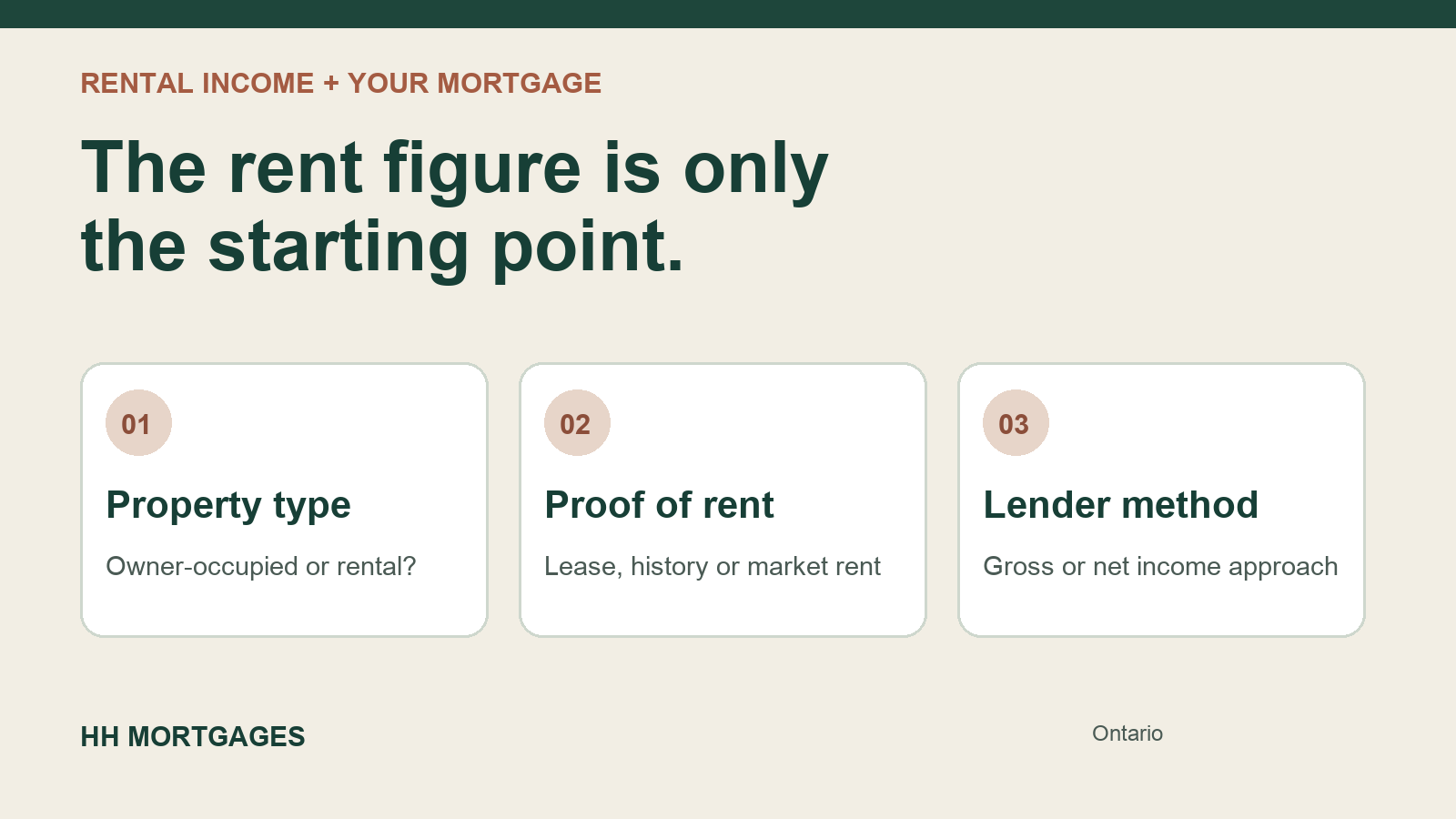
An owner-occupied home with a secondary suite is different from a property bought entirely to rent out. Under CMHC's rental-income guidance, an owner-occupied two-unit property that is the subject of a mortgage loan insurance application may use up to 100% of gross rent from the other unit in one qualification approach. For a three- or four-unit owner-occupied property, CMHC describes other approaches, including up to 50% of gross rent or net rental income. A non-owner-occupied property has a different treatment again.
Those are CMHC insurance guidelines, not a promise that every lender will accept the maximum or that every purchase qualifies for CMHC insurance. Lenders can have their own documentation and underwriting requirements. Before you rely on rent to make a purchase work, ask for a calculation based on the actual property and the lender being considered.
Gross rent is not the same as spendable income
Suppose a separate unit is expected to rent for $2,000 a month. That is $24,000 a year in gross rent before vacancy, repairs, insurance, utilities and other ownership costs. In a qualifying scenario where CMHC's owner-occupied two-unit gross-rent approach is available, a lender may consider up to the full gross amount in its debt-service calculation. It does not mean the owner keeps $2,000 every month, or that the mortgage amount rises by $24,000.
The lender still assesses the mortgage payment, other debts, credit, down payment and property. Different rental-income approaches can produce different results, even with the same rent. For a home you already own and rent out, CMHC also describes a net-rental-income approach that accounts for operating expenses and the property's financing costs. The FCAC's mortgage preparation guide explains how housing costs and other debts fit into affordability ratios.
My practical rule is to make two budgets: the lender's qualification calculation and your own monthly cash-flow plan. The first tells you whether financing may be available. The second asks whether the home remains comfortable if a tenant leaves or a repair arrives.
What if the suite has no tenant yet?
An expected rent is less straightforward than a documented rent. A lender may ask for a current lease, evidence of deposits, prior rental history or an opinion of market rent. The exact evidence varies with the lender, insurer and whether the unit exists and can legally be rented. Do not assume an online listing or a verbal estimate will be enough.
If a proposed suite still needs construction or approvals, tell your mortgage professional before making an offer. The lender may not treat a future, uncompleted unit like an existing rentable unit. Confirm the unit's permitted use with the appropriate municipality and your lawyer or real-estate professional; a mortgage preapproval is not a zoning review.
What if you already own a rental property?
Give the lender the whole picture: current mortgage statement, lease, rent received, property taxes, insurance, condo fees if relevant, and the latest tax returns or rental statement if requested. The rent and the property's costs need to be considered together. CMHC's guidance distinguishes income from a property that is the subject of the new insurance application from income on another property.
Tax reporting is related but separate. The Canada Revenue Agency's rental-income guide explains gross rents and the rental-income statement. A tax return can document history; it does not, by itself, determine the amount a mortgage lender will accept. If you need tax advice, ask a qualified tax professional.
What I would check before you make an offer
- Confirm the property type. Will you live there? How many units are there now, and is the rental use permitted?
- Gather evidence of the rent. Bring the lease or proposed rental details, existing receipts and any lender-requested market-rent evidence.
- List the property's real costs. Include the mortgage, taxes, insurance, utilities, maintenance and a vacancy reserve in your own budget.
- Ask which rental-income method applies. Get the lender's actual qualifying figure rather than using the full advertised rent in an online calculator.
- Keep a financing buffer. Preapproval is not a guarantee; the lender still has to review the property and final application. If a purchase is already in progress, discuss financing-condition deadlines with your real-estate professional and lawyer.
Rental income can strengthen an application, especially when a documented second unit fits the chosen lender and insurance program. The useful number is the one the lender can support, not the most optimistic rent estimate. If you are comparing a home with a suite to one without, send me the property details and we can work through the mortgage side together.
General information only. Mortgage eligibility, rental-income treatment and required documents vary by lender and insurer. This is not tax or legal advice. Hanif Hosseini, Mortgage Agent Level 1, M26001653, Mortgage Architects #12728. Serving Ontario, based in Oakville.