
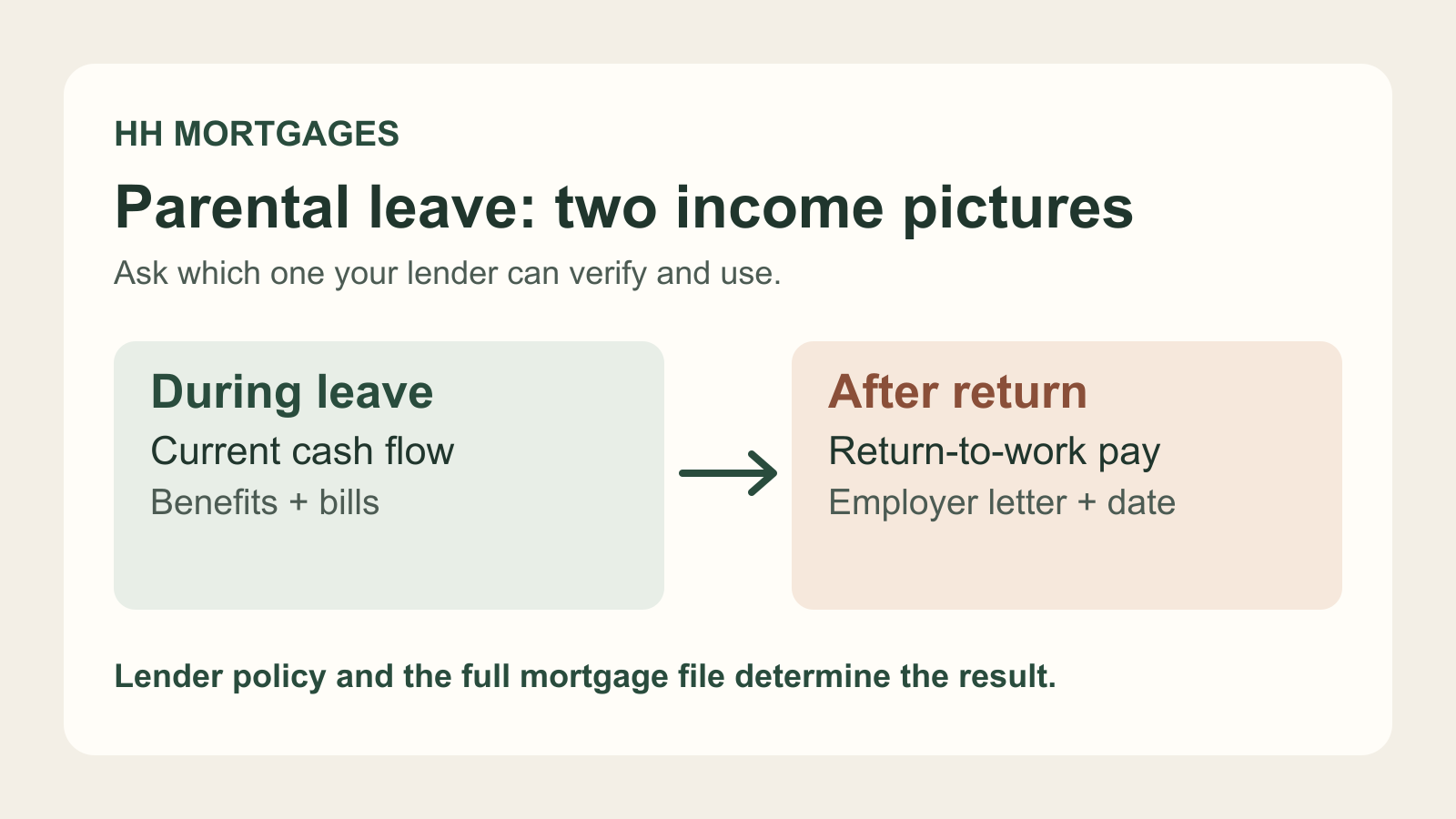
You can apply for a mortgage while on maternity or parental leave. The leave itself does not decide the answer. What matters is the income a lender can verify and accept for your specific application, along with your debts, down payment and the property.
There are two income pictures to prepare: what comes into your household during leave and what you expect to earn after returning to work. A lender may treat them differently. Start that conversation before you make an offer or choose a closing date. A pre-approval is useful, but it is not a promise that the final mortgage will be funded.
Can a lender use your return-to-work salary?
Sometimes. It is a policy decision, not a universal Canadian rule. As one concrete example, Sagen's published underwriting guidance for its insured-mortgage submissions says the lender should obtain written employer confirmation of the return date and salary or income level. Under that insurer's stated policy, return-to-work income may be used to qualify even if the return date is later. The lender still has to verify the income and assess the whole file.
That example does not mean every lender, insurer or mortgage product will use your full future salary. Ask the mortgage professional to confirm the policy for the actual lender and product being considered. If your employment is variable, your role is changing or your return is uncertain, the lender may need more evidence or use a different amount.
The broader standard is careful income verification. OSFI's residential mortgage guidance tells federally regulated lenders to substantiate employment status and income history and assess income stability. It does not set a single parental-leave formula for every Canadian lender.
What should you show the lender?
Prepare a short, consistent account of your leave and return. Depending on the lender's request, the useful documents may include:
- an employer letter stating your position, employment status, expected return date and salary or guaranteed hours on return;
- your most recent pay stubs from before leave, plus T4s or other income history if requested;
- evidence of current leave benefits or employer top-up, if the lender asks to review your present cash flow;
- details of any change in hours, role, compensation or employer when you return;
- your down-payment and closing-cost records, alongside the usual debt and property information.
The Financial Consumer Agency of Canada (FCAC) says lenders may request proof of current pay, position and time with an employer. CMHC's application checklist likewise lists employment and income records, while noting that lenders' requirements differ. Ask which documents the lender wants instead of sending sensitive records through an ordinary contact form.
What about EI maternity or parental benefits?
Employment Insurance maternity and parental benefits can help with household expenses while you are away from work. They are temporary benefits, and the federal EI overview distinguishes maternity, standard parental and extended parental options. The amount and duration depend on the option and eligibility. Do not assume a lender will annualize your current EI deposit or substitute it for your normal employment salary. Ask how that lender treats both the benefit and a documented return-to-work income.
Qualification and your own budget are two different tests. Even if a lender accepts the salary you expect after leave, your mortgage payments start according to the loan agreement. Check whether the household can handle the payment, property tax, utilities and childcare costs during the lower-cash-flow months. Keep an emergency reserve rather than using every available dollar for the down payment.
What if the return date or job changes?
Tell your mortgage professional as soon as the plan changes. A delayed return, a move to part-time hours, a new employer or a switch to self-employment may change the evidence and qualifying income. If a closing date is near, there may be little time for another review.
FCAC is clear that pre-approval is not final approval. The lender still evaluates the property and financial file. If your employment terms change after pre-approval, ask for a revised assessment before relying on the old amount. Our guide to changing jobs before closing explains that related situation in more detail.
Five questions to ask before making an offer
- Which income will this lender use while I am on leave: current benefit income, documented return-to-work salary, or another amount?
- What employer wording and supporting documents are required, and how recent must they be?
- Does the expected return date or any change in hours affect the lender's decision?
- How will the file be reassessed if my leave plan changes before closing?
- Can our household comfortably cover the full housing payment during leave, even if the lender approves a larger amount?
You do not need to guess the answer from someone else's approval story. Gather the documents, ask for the lender's current policy and budget for the months before your normal pay resumes. If you are planning a home purchase in Ontario while on leave, I can help you compare the documented options and build a realistic closing plan.
General education, not individual mortgage, legal or financial advice. Income treatment and approval depend on the lender, insurer, product, verified documents and property; no approval or payment amount is guaranteed. Hanif Hosseini, Mortgage Agent Level 1, M26001653. Mortgage Architects, brokerage licence #12728. Serving Ontario, based in Oakville.