
Updated: August 25, 2026
Yes. You can make a qualifying withdrawal from your First Home Savings Account and withdraw money from your RRSP through the Home Buyers' Plan for the same home, as long as you meet the conditions for both programs.
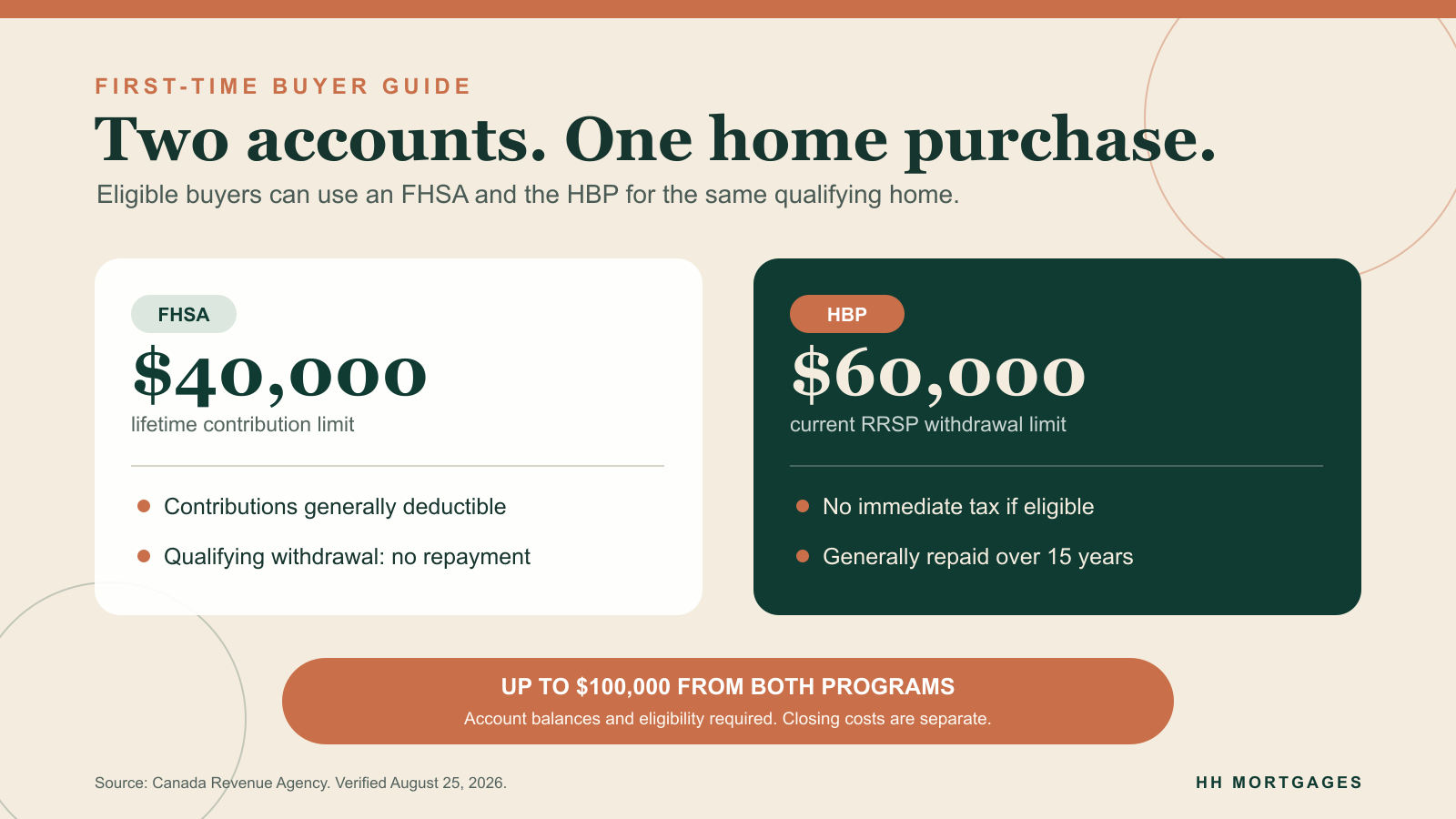
Here is the simple version. An FHSA can give you a tax deduction when you contribute, and a qualifying withdrawal is tax-free with no repayment required. The Home Buyers' Plan, usually called the HBP, lets you withdraw up to $60,000 from your RRSP without immediate tax, but that money generally has to be repaid over 15 years.
Using both can help build a larger down payment. It also takes planning, because the two programs have different rules, forms and long-term effects.
FHSA and HBP at a glance
| Feature | FHSA | Home Buyers' Plan |
|---|---|---|
| Where the money comes from | Your FHSA | Your RRSP |
| Current limit | $8,000 of participation room in the first year the account is opened, with a $40,000 lifetime contribution limit | Up to $60,000 per HBP participation period |
| Tax treatment | Contributions are generally deductible; a qualifying withdrawal is tax-free | An eligible withdrawal is not taxed at the time of withdrawal |
| Repayment | No repayment for a qualifying withdrawal | Generally repaid over 15 years |
| Can it be used with the other program? | Yes, if all FHSA conditions are met | Yes, if all HBP conditions are met |
The limits are not a promise that everyone will have that amount available. Your account balance, contribution room, investments and eligibility all matter.
How the FHSA works
An FHSA is a registered account for eligible first-time home buyers. Your participation room is $8,000 in the year you open your first FHSA, and the lifetime contribution limit is $40,000.
Your own contributions are generally deductible in the year you make them or a future year. If you meet the qualifying withdrawal conditions, you can withdraw the full value of the account tax-free to buy or build a qualifying home in Canada. That qualifying withdrawal does not have to be repaid.
One detail is easy to miss: FHSA participation room starts after you open your first account. If buying a home is part of your medium-term plan, opening the account earlier can give unused room time to carry forward. The amount you can carry forward for participation-room purposes is limited, so check your CRA records rather than estimating it yourself.
Also, an RRSP-to-FHSA transfer is not a second tax deduction. It uses FHSA participation room, and CRA says the transfer itself is not deductible.
How the Home Buyers' Plan works
The HBP lets an eligible buyer withdraw up to $60,000 from their own RRSP to buy or build a qualifying home. The withdrawal is not taxed at that time if the program conditions are met.
Unlike an FHSA withdrawal, HBP money generally has to go back into your RRSP over a 15-year repayment period. If you do not make the required repayment for a year, the shortfall is generally included in your taxable income.
There is a specific 2026 update. CRA says temporary relief was extended for people making their first HBP withdrawal from January 1, 2026 through December 31, 2028. Their 15-year repayment period starts in the fifth year after the withdrawal year. If your first withdrawal is in 2026, your first repayment year is 2031.
That gives you more time before repayments begin, but it does not turn the HBP into free money. You are still taking funds out of retirement savings, and those funds are no longer invested in the RRSP while they are out.
A simple example using both
Let's say one first-time buyer has:
- $40,000 available in an FHSA
- $60,000 available and eligible to withdraw from an RRSP under the HBP
- $25,000 in separate savings
| Source | Amount |
|---|---|
| FHSA qualifying withdrawal | $40,000 |
| HBP withdrawal from RRSP | $60,000 |
| Other savings | $25,000 |
| Total available before closing costs | $125,000 |
This person could have $125,000 available for the purchase before accounting for closing costs and any emergency reserve.
The first $100,000 in this example comes from combining the FHSA and HBP. The FHSA portion would not need to be repaid if it is a qualifying withdrawal. The $60,000 HBP portion would create a future RRSP repayment obligation.
The numbers are illustrative. Account values can rise or fall, not everyone has the maximum room, and the amount available for the down payment should not automatically include every dollar you have. You still need money for legal fees, land transfer tax where applicable, adjustments, moving and surprises after closing.
For the purchase-price side of the calculation, see how much down payment you need in Ontario.
Do both programs use the same first-time buyer test?
Not exactly. The tests are similar, but CRA specifically notes that the first-time buyer definition for opening an FHSA is different from the definition for making a qualifying FHSA withdrawal. The HBP has its own eligibility conditions as well.
For a typical purchase, expect the rules to look at whether you lived in a home that you or, in some HBP situations, your current spouse or common-law partner owned during the relevant current-year and four-calendar-year period. There are also special rules for people with disabilities and certain relationship-breakdown situations.
Do not rely on the label “first-time buyer” alone. Check the current CRA conditions for each withdrawal separately, especially if you previously owned a home, recently moved in with a partner who owns one, separated from a spouse or are buying with someone who is not a first-time buyer.
Five things to check before you withdraw
1. Make sure the home and timing qualify
Both programs require a qualifying home in Canada and a written agreement to buy or build it. You must intend to occupy it as your principal residence within one year. Each program also has timing rules for the withdrawal and acquisition.
2. Use the correct forms
CRA requires Form RC725 for an FHSA qualifying withdrawal and Form T1036 for each HBP withdrawal. Give the form to the financial institution that holds the account and leave enough time for processing.
3. Watch the RRSP 89-day rule
If you contributed to your RRSP during the 89 days before an HBP withdrawal, some or all of that contribution may not be deductible. A last-minute RRSP deposit is not automatically an extra tax benefit.
4. Confirm your actual room and balance
Check your CRA account or latest assessment and speak with the financial institution holding the account. Overcontributing to an FHSA can create a tax of 1% per month on the highest excess amount for each month it remains.
5. Keep money outside the down payment
A larger down payment can reduce the mortgage you need, but using every available dollar can leave you short at closing. Build the closing-cost reserve into the plan before deciding how much to withdraw.
What I would pay attention to
I would treat the FHSA as the cleaner source of funds first, because a qualifying withdrawal does not create a repayment schedule. Then I would compare the benefit of a larger down payment through the HBP with the cost of pulling money out of retirement savings and the repayments that will eventually follow.
I would also coordinate the withdrawal plan with the mortgage plan. The amount of your down payment affects the mortgage size and may affect mortgage default insurance, but approval still depends on income, debts, credit, the property and lender requirements. A bigger down payment does not replace final mortgage approval.
If you are still at the planning stage, read mortgage pre-approval versus final approval before making an offer.
Bottom line
Yes, an eligible buyer can use both an FHSA qualifying withdrawal and the Home Buyers' Plan for the same home. The FHSA can provide tax-deductible contributions and a tax-free qualifying withdrawal with no repayment. The HBP can add up to $60,000 from an RRSP, but it comes with a future repayment obligation.
The best approach is to verify eligibility for each program, confirm your account room and balances, keep enough cash for closing costs and fit the withdrawals into the complete mortgage budget.
Not sure how much to use from your FHSA, RRSP and other savings? Send me a message or book a call and we can go through the numbers together.
This article provides general mortgage and tax information, not personalized financial, tax or legal advice. Program eligibility, tax treatment, mortgage qualification and product availability depend on your circumstances and current CRA, lender and insurer requirements. Consider speaking with a qualified tax professional about your situation.