
Updated: September 10, 2026
Mortgage refinancing can help you borrow against your home or change how you repay your mortgage. But it is only useful if the new arrangement solves a real problem at a cost you can live with.
A smaller monthly payment is not the whole story. Neither is the amount your home has gone up in value.
Before refinancing, I would want to answer three questions: how much money do you actually need, what will changing the mortgage cost, and how will you pay the new balance down?
Refinancing is not the same as renewing
A renewal is the next term of your existing mortgage. Refinancing makes a more substantial change, such as increasing the mortgage to release money from your home. It can happen with your current lender or another lender.
You can explore refinancing around renewal time, but borrowing more is not just a routine renewal with an extra cheque attached. Expect a new lending assessment.
If you only need to choose the next term without adding borrowing, start with the Ontario mortgage renewal guide. The FCAC renewal guidance also explains what to review before your term ends.
How much could you borrow?
For ordinary home-equity borrowing, the usual ceiling is 80% of the home's appraised value, less the mortgage and other borrowing secured against it. That is a starting calculation, not an approval. See the FCAC's home-equity guidance.
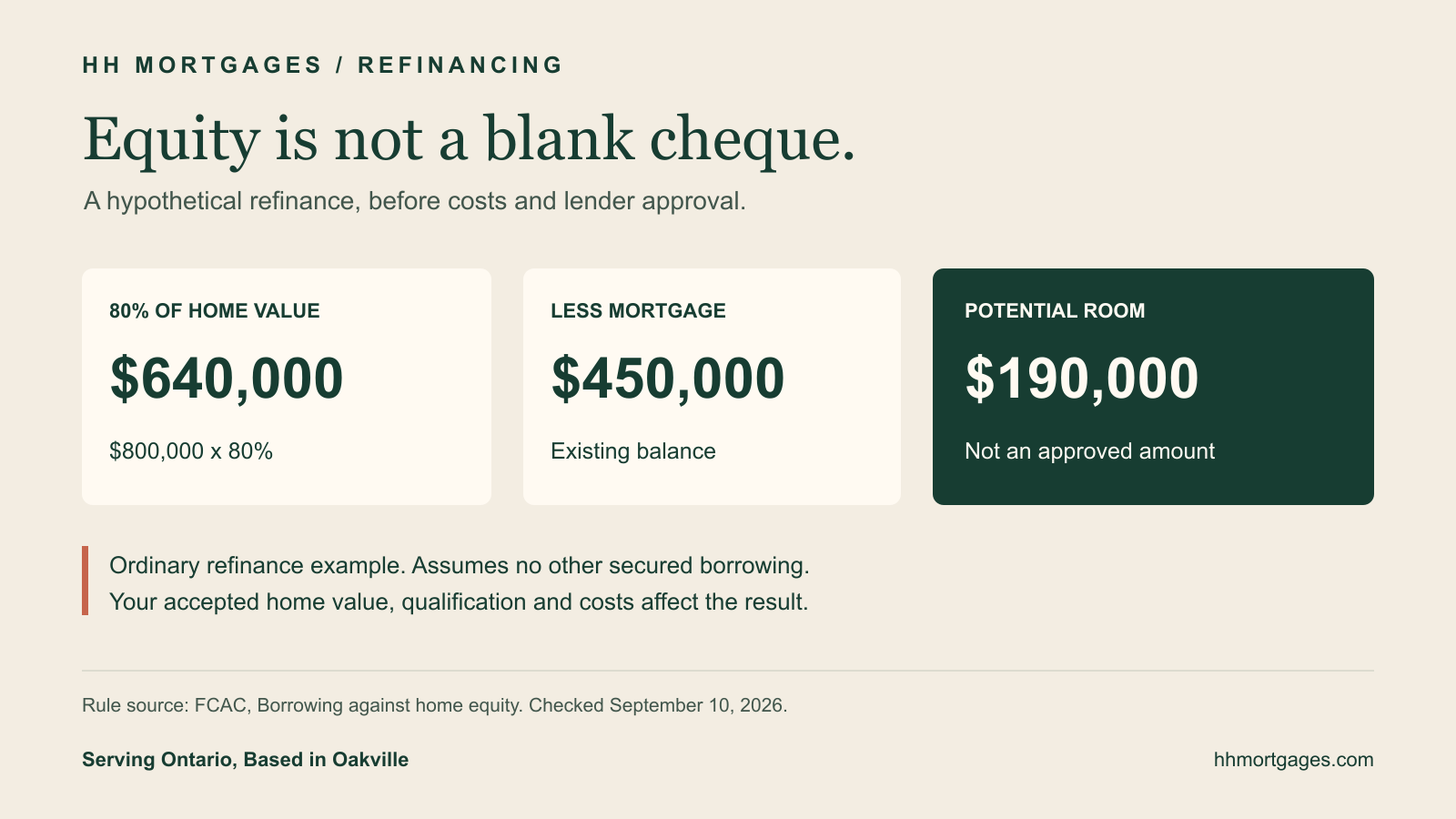
Here is a hypothetical example, assuming no other secured borrowing:
- Home's appraised value: $800,000.
- 80% of that value: $640,000.
- Existing mortgage balance: $450,000.
- Potential room before costs: $190,000.
That does not mean $190,000 will land in your account. Approval, the lender's accepted valuation, existing secured credit arrangements and transaction costs determine what is actually available. Specialized programs can have different rules; this example covers an ordinary refinance.
My starting question would still be: what is the money for? If the project needs $50,000, start there. The maximum is not a spending target.
You still need to qualify
Equity answers one question: how much security is available? Your income and debts answer another: can you carry the proposed payments?
For a typical uninsured refinance at a federally regulated lender, the current mortgage stress test uses the greater of your contract rate plus two percentage points or 5.25%. It tests affordability at a higher rate; it is not necessarily the rate you pay. These are OSFI's current qualifying-rate rules.
OSFI's exception for qualifying uninsured straight switches at renewal does not cover a refinance that increases your loan amount or amortization. Amortization means the scheduled time to repay the mortgage.
Be upfront about anything that has changed since your last application. A new job, different income pattern or additional debt deserves a conversation before you make plans for the money. Ask which documents your lender needs; the mortgage documents checklist is a useful starting point, not a refinance approval checklist.
What does mortgage refinancing cost?
Before comparing offers, request a written payout quote from your current lender for the intended closing date. Ask for an itemized estimate of the new financing costs too.
Depending on the transaction, costs may include:
- A prepayment penalty for ending a closed mortgage early.
- Discharge or administration fees.
- An appraisal, legal work and title-related costs.
- Repayment of a previous mortgage cashback incentive.
An open mortgage can be broken without a prepayment penalty, but other transaction costs may still apply. The FCAC explains early-break costs and alternatives.
Ask which costs are paid upfront, deducted from the proceeds or added to the new loan. A fee added to the mortgage has not disappeared. You are financing it.
Compare the whole mortgage, not just the extra money
Suppose you owe $450,000 and want another $50,000. Replacing that mortgage could mean pricing a new $500,000 loan, before any financed costs. You are not necessarily paying the new rate on only the extra $50,000.
That distinction matters if your existing mortgage has terms worth keeping.
I would ask for a side-by-side comparison over the same period, showing:
- Payments you would make under each option.
- Interest and transaction costs.
- The balance still owing at the end of that period.
- Any assumptions about future rates or repayment timing.
Two payments can look pleasantly similar while leaving you with very different balances. The balance deserves a place beside the payment, not in the fine print.
Be careful with debt consolidation
Moving credit card or other debt into a mortgage may reduce its interest rate. But extending repayment can increase the total interest paid. The FCAC's debt-consolidation guidance flags both the potential benefit and that trade-off.
It also changes the risk. When previously unsecured debt becomes part of a mortgage, your home backs that borrowing. Missed repayments can put the property at risk. The FCAC explains secured and unsecured debt.
My practical question is what happens after the old balances are cleared. Is there room in the budget to repay the added mortgage debt? What stops those other balances building up again?
Debt consolidation can be part of a repayment plan. It cannot replace one.
Should you wait until renewal?
It is worth comparing the timing. Completing the change at the end of your term can avoid the penalty for breaking that term early. It does not automatically remove other costs or guarantee approval.
If the expense can wait, price both options: refinancing now and revisiting it at renewal. Be clear that the second option depends on future rates, property value and qualification, none of which you can lock in simply by planning ahead.
If you are already struggling with payments, contact your lender promptly rather than assuming another loan will solve it.
My bottom line
A useful refinance has a clear purpose, a cost comparison and a repayment plan. Having equity is a reason to explore your options, not a reason to borrow all of it.
Before we talk, jot down your mortgage balance, renewal date, the amount you need and what it is for. That gives us a much better starting point than just asking for a rate.
Not sure whether the numbers make sense? Book a conversation with me and we can go through the options together. I'm based in Oakville and work with homeowners across Ontario.
General information, not personalized financial advice. Qualification and product availability depend on your circumstances, property and lender requirements.