
Updated: August 19, 2026
Your lender’s renewal offer is a starting point, not a decision you have to accept automatically.
Before you sign, compare the new payment, rate type, term, prepayment options, penalties and any cost to switch lenders. Start the review a few months before your maturity date, not when the deadline is a week away.
Staying with your current lender may still be the right choice. The point is to make that choice after you have seen the numbers and understood the conditions.
Why renewal deserves more than a quick signature
A mortgage term is the length of your current contract. Your amortization is the longer schedule for paying the entire mortgage off. When the term ends and a balance remains, you need to renew, switch lenders or pay the balance in full.
Renewal remains a major issue for Canadian homeowners. In its 2026 Mortgage Consumer Survey, CMHC found that renewers were the largest group of recent mortgage consumers. It also found that 35% of renewers experienced more financial pressure because of interest-rate changes, with their payments increasing by an average of $375 per month.
That does not mean your payment will rise by $375. Your result depends on your balance, remaining amortization, new rate and payment frequency. It does show why it is worth calculating your own payment before you sign.
When should you start preparing?
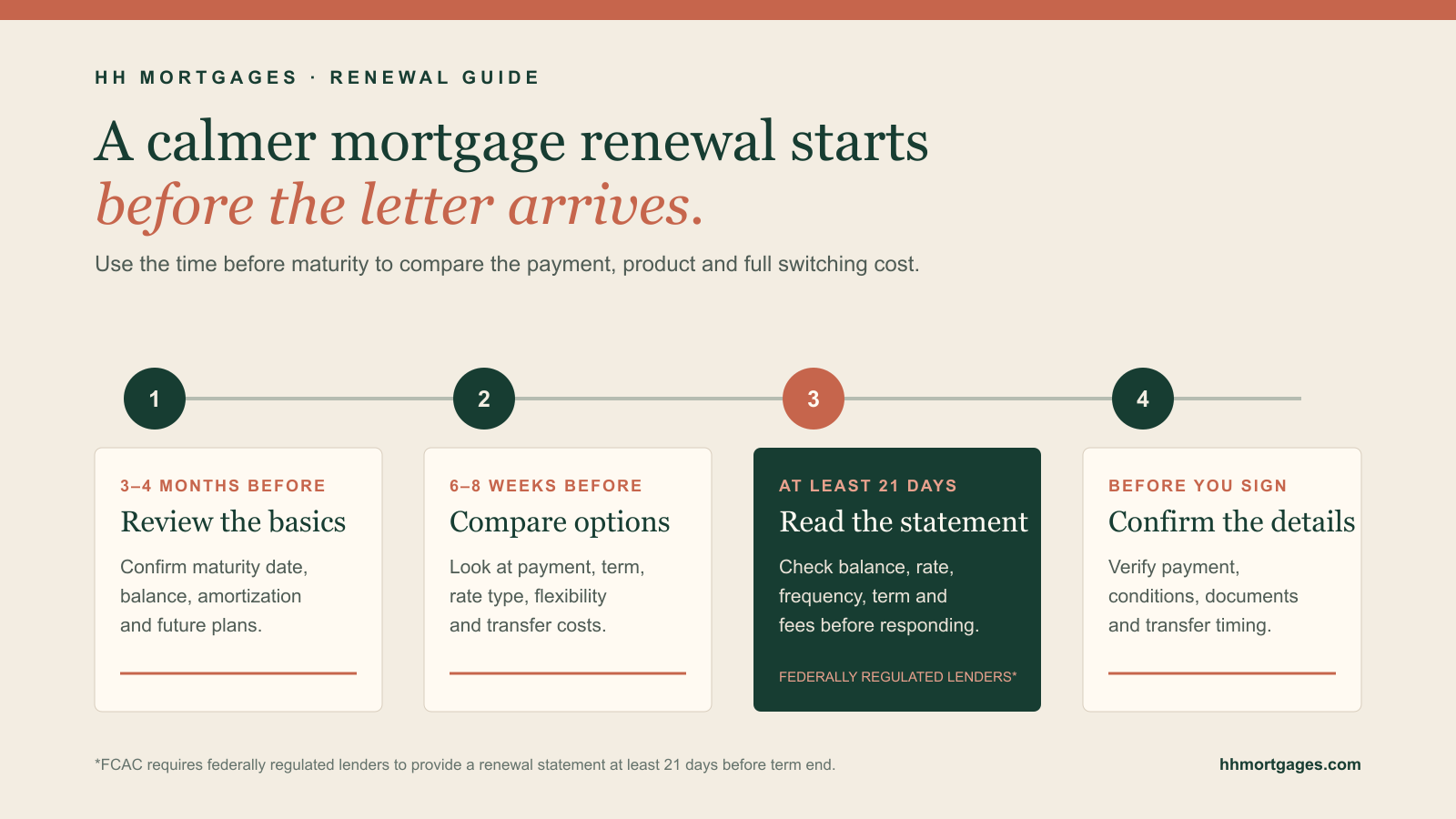
I would start about three to four months before the mortgage maturity date.
- confirm your remaining balance and amortization
- estimate the payment at different rates
- gather documents if you want another lender to review the mortgage
- compare fixed and variable options
- check whether switching costs would cancel out the savings
- negotiate with your current lender without rushing
If your mortgage is with a federally regulated financial institution, such as a bank, it must provide a renewal statement at least 21 days before the end of the term. That statement includes the balance, offered rate, payment frequency, term and applicable charges or fees.
Twenty-one days is a disclosure deadline. It is not the ideal amount of time for shopping around.
Five things to check before signing a renewal
1. Your new payment, not just the new rate
The rate matters, but your monthly cash flow matters more.
Ask for the actual payment based on the remaining balance and amortization. Then look at the rest of your household budget. Property taxes, condo fees, utilities, insurance and other debts do not disappear at renewal.
If the projected payment is uncomfortable, deal with that early. Possible options may include changing the term, reviewing the rate type, making a lump-sum payment or, in some situations, changing the amortization. Extending the amortization can reduce the payment, but it usually increases the total interest paid and may turn the transaction into a refinance that requires different qualification.
2. The term and rate type
A five-year fixed mortgage is not automatically the safest answer, and a variable mortgage is not automatically the cheapest answer.
- Could you sell or move?
- Is predictable budgeting your main priority?
- Would a changing payment create stress?
- Do you expect to make large extra payments?
- Could your income or employment change?
The best structure is the one that fits your plans and risk tolerance, not the one with the most attractive headline.
3. Prepayment privileges and penalties
Check how much you may increase your regular payment or pay as a lump sum without a penalty. Also check how the lender calculates the penalty if you break a closed mortgage before the next maturity date.
This matters if you might move, refinance or receive money you want to put against the mortgage. A slightly lower rate can be less valuable if the mortgage is expensive or restrictive to exit.
4. The full cost of switching lenders
You do not have to renew with the same lender. A different lender may offer a better combination of rate, features and service.
But compare the net benefit, not only the rate. Switching can involve discharge, registration, transfer, appraisal, legal or administrative costs. Some new lenders may cover some of these expenses, but you need that confirmed before making the comparison.
Collateral-charge mortgages can also take more work to transfer, especially if other borrowing is secured by the same charge.
5. Whether the change is a renewal, switch or refinance
These words sound similar, but they can lead to different qualification and costs.
A straightforward switch generally means moving the existing mortgage balance to a new lender without increasing the loan or the remaining amortization. OSFI no longer prescribes its minimum qualifying rate for an uninsured, stand-alone straight switch between federally regulated lenders when neither the balance nor amortization increases.
Here’s the simple version: that change can make it easier for eligible borrowers to shop around, but it does not guarantee approval. The new lender still reviews the application under its own underwriting policies.
If you want to borrow more, consolidate debt, add a home-equity line of credit or extend the amortization, the transaction may be treated as a refinance rather than a straight switch. Expect a fuller qualification review.
A realistic payment example
Let’s say your mortgage balance at renewal is $500,000, with 20 years remaining and monthly payments.
These rates are illustrations, not current quotes:
| Scenario | Illustrative rate | Estimated monthly payment |
|---|---|---|
| Existing mortgage | 2.50% | $2,646 |
| Renewal option | 4.50% | $3,152 |
The estimated increase is about $506 per month.
Now compare two renewal offers on the same balance and amortization:
| Offer | Illustrative rate | Estimated monthly payment | Estimated interest over first 5 years |
|---|---|---|---|
| Option A | 4.50% | $3,152 | $102,303 |
| Option B | 4.25% | $3,086 | $96,460 |
The quarter-point difference is about $66 per month and roughly $5,842 in interest over five years in this example.
That is meaningful, but only if the lower-rate mortgage also fits your needs and the switching costs do not wipe out the benefit.
The calculations use Canadian mortgage-rate conventions with semi-annual compounding and assume the rate stays unchanged for the full five-year comparison. Property taxes, insurance and other housing costs are not included.
Documents to have ready if you want to compare lenders
- your current mortgage statement and renewal or maturity date
- government-issued identification
- recent proof of income
- property-tax information
- home-insurance details
- information about other debts or secured credit
- your mortgage insurance certificate number, if the mortgage is insured
If you are self-employed, have variable income, recently changed jobs or want to increase the mortgage, allow more time. The review is usually less straightforward.
What I would pay attention to
I would compare every option on the same assumptions: same balance, same remaining amortization, same payment frequency and same term length.
Otherwise, a payment can look lower simply because the amortization was extended, or a rate can look better because the mortgage has different restrictions.
I would also decide what flexibility is worth before focusing on the last few basis points. If there is a realistic chance you will move or refinance, portability and penalty wording can matter as much as the rate.
Finally, I would not wait for the renewal letter. Starting early gives you the most useful thing in a mortgage decision: time to compare without pressure.
Bottom line
Do not sign a mortgage renewal just because it is easy.
Confirm the new payment, compare the full product, understand any switching costs and check whether the mortgage still fits your plans. Your existing lender may end up being the right choice, but it should earn that decision.
Not sure how your renewal options compare? Send me a message or book a call and we can go through the numbers together.
This article provides general information, not personalized financial advice. Mortgage qualification, rates, products and switching options depend on the borrower, property and lender requirements.