
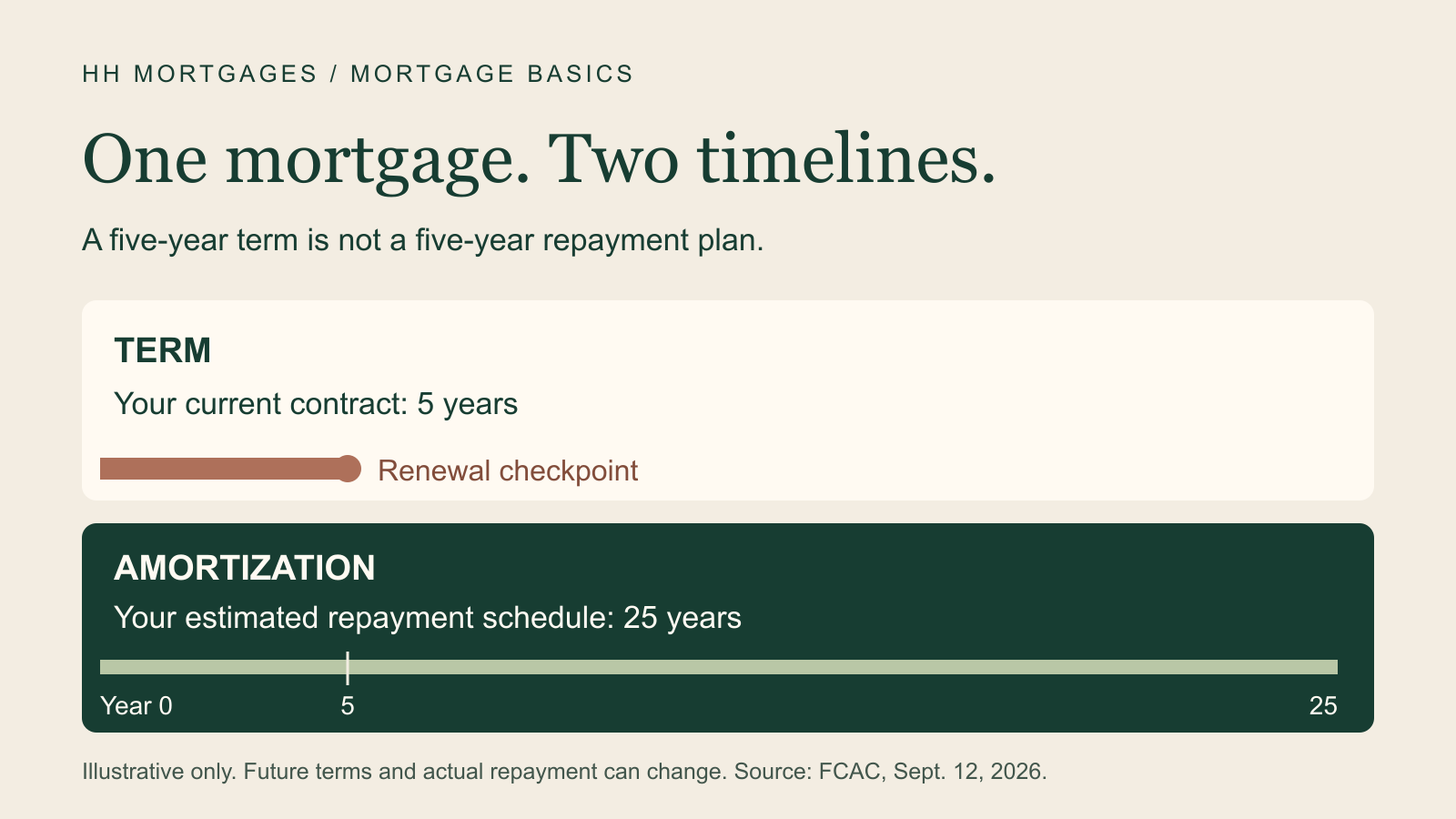
A five-year mortgage does not usually mean paying off your home in five years.
Your mortgage term is how long your current contract lasts. Your amortization is the estimated time needed to repay the loan. You can have a five-year term with a 25-year amortization. Those numbers answer different questions.
If you are buying your first home, or getting used to the Canadian mortgage system, this distinction makes the paperwork much easier to read.
Two timelines, one mortgage
Think of the term as the agreement you are signing now. It sets how long the current contract applies, including its rate arrangement and conditions. A fixed rate stays the same during that term; a variable rate can change.
Amortization is the repayment schedule behind the payment calculation. It estimates how long repayment will take using the current assumptions. It does not promise the same interest rate for all those years.
The Financial Consumer Agency of Canada explains both timelines. Most borrowers need several terms before the balance reaches zero.
What happens when the term ends?
You still owe whatever principal remains. You can repay it, renew with your lender, or explore switching lenders. A renewal is a chance to review the next contract, including the rate and payment. It is not the day the original loan magically disappears.
Our Ontario mortgage renewal guide walks through that decision in more detail.
For a straightforward loan that stays on its original 25-year schedule, five years of payments would leave about 20 years of scheduled repayment. Extra payments, changes to the mortgage and some variable-rate arrangements can alter that picture. Ask for the actual balance and remaining amortization on your statement.
A lower payment can leave a higher balance
Here is an illustrative comparison, with the same five-year fixed term in both cases. Only the amortization changes.
Assume a $625,000 purchase, a $125,000 down payment (20%) and a $500,000 mortgage. The hypothetical rate is 4.50%, compounded semi-annually, with monthly payments. Both options assume lender eligibility, no extra payments and no financed fees. Mortgage default insurance, property taxes, other insurance and closing costs are excluded. This is a calculation example, not a rate offer.
| Over the first five years | 25-year amortization | 30-year amortization |
|---|---|---|
| Monthly principal and interest | $2,767 | $2,521 |
| Mortgage balance after five years | $438,982 | $455,502 |
| Interest paid during those five years | $105,024 | $106,766 |
Original HH Mortgages calculation. Amounts are rounded to the nearest dollar from unrounded calculations; actual lender rounding may differ.
The 30-year schedule reduces the monthly payment by about $246, but leaves roughly $16,520 more owing at the end of the same term.
That extra breathing room may matter to your household. The useful question is what you are exchanging for it. Compare the payment and the balance together, then consider your budget for repairs, savings and other priorities.
This example stops after five years because the next term's rate is unknown. A 30-year amortization does not lock in today's rate for 30 years. FCAC's mortgage selection guide explains why a longer repayment period generally means more interest when other factors are unchanged.
Can everyone choose 30 years?
No. For a purchase with less than 20% down, current federal rules allow an amortization of up to 30 years if at least one borrower meets the first-time-buyer definition or the property is newly built. Otherwise, the usual maximum in this high-ratio purchase category is 25 years. Other insurance and lending requirements still apply.
That “or” matters: an eligible first-time buyer does not have to purchase a new build to meet this particular condition. The federal regulations, section 5, set out the rule. Have your lender or mortgage agent confirm your eligibility, including the applicable first-time-buyer definition.
For an uninsured mortgage, ask which amortizations the lender offers and which you qualify for. A longer schedule is an option to assess, not an entitlement.
Match the contract to your plans
I would start with two questions: how much payment room do you need, and what might change before the term ends?
If a move or another major change is plausible, ask what ending the contract early would cost. Breaking a closed mortgage normally involves a prepayment penalty and may involve other fees. Get a lender-specific estimate before deciding; FCAC explains the costs of breaking a mortgage contract.
If you want a manageable required payment with room to pay extra, review the prepayment privileges. Some contracts allow payment increases or lump sums, within limits. Exceeding those limits can trigger a penalty. Also ask whether a payment increase can later be reversed: FCAC notes that you normally cannot lower it again until the term ends. See its guide to paying off a mortgage faster.
Before signing, ask for these four items on the same comparison:
- The term length and rate type.
- The amortization used to calculate the payment.
- The projected balance when the term ends.
- The rules for extra payments, moving or ending the contract early.
Those details make it easier to judge whether an offer fits your plans. If you want help comparing them, send me a message and we can go through the numbers together.
General education, not an individual mortgage recommendation. Options depend on your circumstances, property and lender criteria. Hanif Hosseini, Mortgage Agent Level 1, M26001653. Mortgage Architects, brokerage licence #12728. Serving Ontario, based in Oakville.