
Updated: September 15, 2026
Yes. Permanent residents and some people who are legally authorized to work in Canada may qualify for a mortgage. You do not always need years of Canadian credit history before a lender will consider your application.
Approval is never automatic, though. Your immigration status is only one part of the file. The lender and, when required, the mortgage insurer will also review your income, debts, credit, down payment, the source of your money and the property itself.
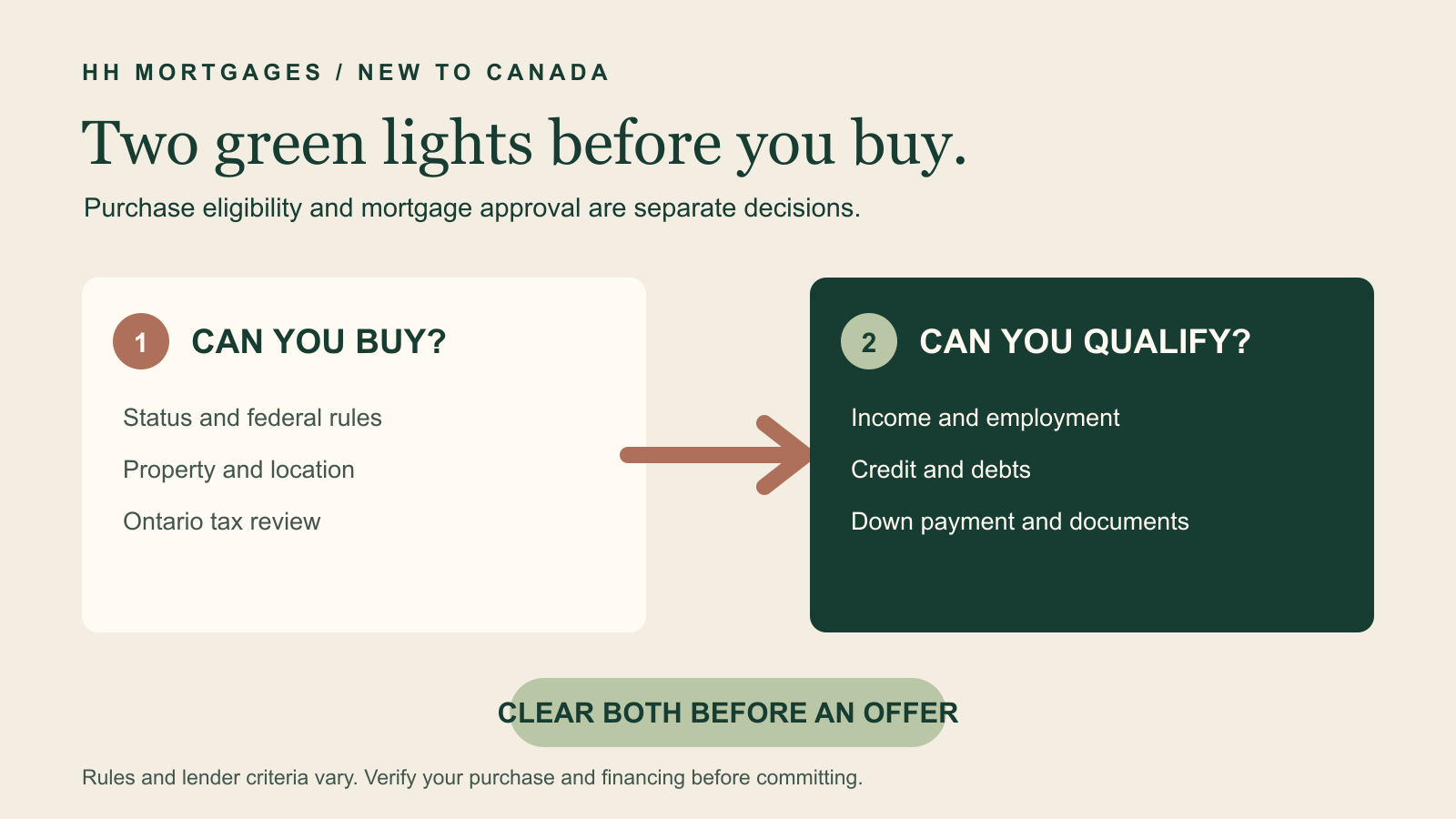
There is one more point that is easy to miss: being allowed to buy a home and being approved for a mortgage are two separate questions. You need a clear answer to both before making an offer.
I moved to Canada about seven years ago, so I understand how unfamiliar the system can feel at first. Here is the practical version I would want a newcomer to see before starting.
First green light: are you allowed to buy the property?
Permanent residents are not treated as non-Canadians under the federal foreign-buyer prohibition. The situation can be more complicated for temporary residents.
Under the current federal regulations, a work permit holder may fit an exception when the permit or work authorization has at least 183 days remaining on the purchase date and the person has not purchased more than one residential property. Other exceptions and property exclusions also exist.
Do not treat that as a do-it-yourself legal test. Ask a real estate lawyer to confirm that you can purchase the specific property before you make a firm offer. The federal regulations and your facts both matter.
If you are buying in Ontario, ask about the Non-Resident Speculation Tax as well. Ontario currently applies a 25% NRST to many purchases by foreign nationals. A permanent resident is not a foreign national for this tax, but simply having a permanent residence application in progress does not make someone a permanent resident at closing.
Exemptions and a later permanent-resident rebate may be available in specific cases. Ontario says the rebate can require permanent residence within four years and an application within 180 days after becoming a permanent resident, along with other conditions. This can be a very large closing-cost issue, so have your lawyer confirm the tax treatment early. The province maintains the current NRST rules and rebate details.
Second green light: can the mortgage be approved?
CMHC says its insured financing is available to eligible permanent and non-permanent residents. Its newcomer program does not set a minimum period of Canadian residency.
For permanent residents, CMHC says access is available to its homeowner mortgage insurance products and the minimum down payment can start at 5%. The actual minimum depends on the purchase price and other insurance rules, which I explain in the Ontario down payment guide.
For non-permanent residents, CMHC requires legal authorization to work in Canada, such as a work permit. The property must have one to four units, at least one unit must be owner-occupied, and the purchase cannot be prohibited by the federal foreign-buyer law.
Those are mortgage insurance rules, not a promise that every lender will approve the same file. Lenders can apply their own policies to employment, permit expiry, property type and documentation. Product availability and pricing can differ.
What if your Canadian credit history is short?
A short Canadian credit file does not always end the conversation.
CMHC says it may consider alternative ways to establish creditworthiness when Canadian history is limited. Examples include an international credit report, a reference letter from a financial institution in your country of origin, or other alternative evidence. For CMHC-insured newcomer financing, at least one borrower or guarantor must have a minimum credit score of 600.
The lender still decides what it will accept. Ask before paying to order or translate a foreign document.
At the same time, build your Canadian credit carefully:
- Pay every bill and credit account on time.
- Keep credit-card balances low relative to their limits. FCAC suggests using less than 30% of your total available credit.
- Avoid opening several accounts just before a mortgage application.
- Check your own Equifax and TransUnion reports for errors. Checking your own report does not lower your score.
- When shopping for a mortgage, keep lender credit checks within a two-week period when possible. FCAC says the credit bureaus treat those mortgage inquiries as one inquiry.
Canada's credit bureaus track Canadian credit activity. Some lenders may also review credit history from another country, but do not assume every lender uses it in the same way. FCAC's credit report guide explains the basics.
Income and employment still need to make sense
Newcomer programs do not remove the normal affordability review. A lender still needs to understand whether your income is stable, documentable and likely to continue.
Expect questions about your employment, base salary, guaranteed hours, probation, bonuses, commissions or self-employed income. The answer will depend on the lender and the strength of the whole application. A larger down payment does not automatically fix income that cannot be verified.
Common starting documents include identification and immigration documents, an employment letter, recent pay statements, bank statements and evidence supporting the down payment. Self-employed applicants may need a different set of income records. Use the mortgage documents checklist to organize a first conversation, then confirm the exact list for your file.
Keep a clean trail for the down payment
If savings are coming from another country, tell the mortgage professional early. The lender will usually need to understand where the money came from and how it reached your Canadian account.
Keep the original account statements, transfer confirmations, currency-conversion records and any gift documentation. Avoid moving the same money through several accounts without a clear reason. Do not send private banking records through an ordinary contact form or email unless you have confirmed a secure submission method.
Also keep money aside for closing costs. Legal fees, inspections, land transfer taxes and other costs are separate from the down payment. For Ontario purchases, our closing-cost checklist explains the usual categories, but a foreign-national tax review must be specific to you.
Newcomers still face the mortgage stress test
At a federally regulated lender such as a bank, you generally need to qualify at the higher of 5.25% or your contract rate plus 2 percentage points. This applies to insured and uninsured mortgages.
The lender also looks at how much of your gross income goes toward housing and total debt. These are called GDS and TDS ratios. You can see what goes into them in the GDS and TDS guide.
A pre-approval can help you understand a working price range, but it is not final approval. The property, updated documents and any changes to your finances still matter. Our pre-approval versus final approval guide explains the difference.
What I would prepare before the first mortgage conversation
Bring enough information to answer six questions:
- What is your current immigration status, and when does the document expire?
- Are you legally allowed to buy the type and location of property you are considering?
- How is your income earned, and what can document it?
- What Canadian and international credit evidence is available?
- How much down payment and closing-cost money do you have, and where did it come from?
- What debts and monthly obligations will continue after the purchase?
You do not need a perfect file before asking questions. An early review can show which documents matter, whether more Canadian credit history may help and what risks to resolve before an offer.
Not sure how your status, income and credit fit together? Send me a message and we can map out the next steps without collecting sensitive documents through the contact form.
General education, not legal, tax or individual mortgage advice. Eligibility, rates and product availability depend on your circumstances, property, lender and insurer criteria. Have a qualified lawyer confirm purchase eligibility and applicable taxes. Hanif Hosseini, Mortgage Agent Level 1, M26001653. Mortgage Architects, brokerage licence #12728. Serving Ontario, based in Oakville.