
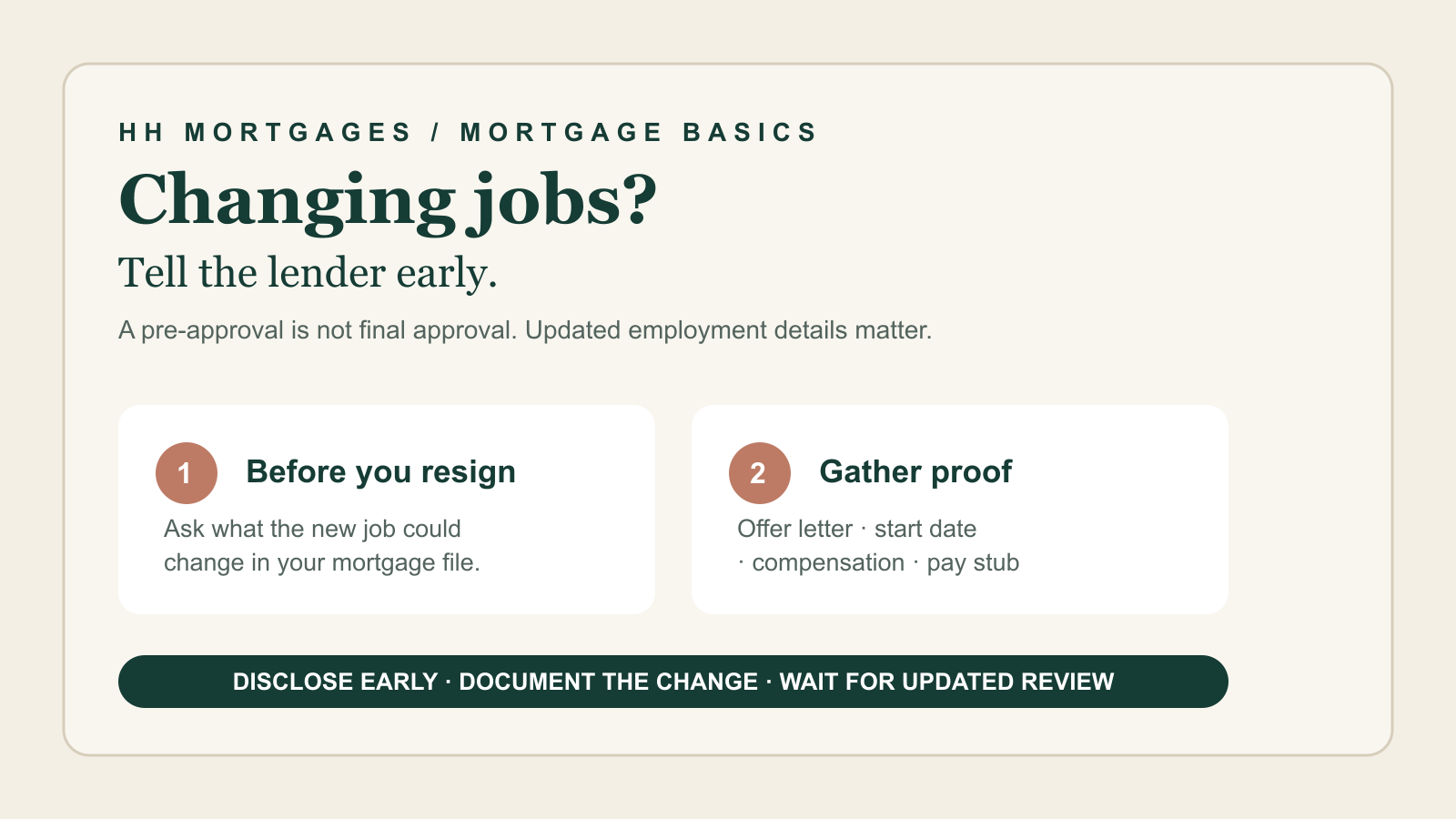
Changing jobs after you receive a mortgage pre-approval can feel risky, especially when an offer has already been accepted. The key question is not whether every job change automatically ends a mortgage application. It is whether the lender can still verify and rely on your income, employment history and overall application at final approval.
Tell your mortgage professional before the change happens. A new employer, new pay structure, a probationary period, self-employment or a gap between jobs can change the documents a lender needs and the amount of income it can use. Silence can create a bigger problem than the job change itself.
Why a pre-approval does not end the review
The Financial Consumer Agency of Canada (FCAC) explains that a pre-approval is not a guarantee of final mortgage approval. The lender still reviews the property, your down payment, debts and other financial information before funding the loan.
Employment is part of that review. FCAC says a lender or broker may ask for proof of your current salary or hourly rate, your position and your length of time with the employer. A job change can make the proof you supplied earlier out of date, even if your new salary is higher.
The practical takeaway is simple: treat a job change as a material update to the application. It does not determine the result by itself, but the lender needs the chance to assess it under its own rules.
Which job changes need an early conversation?
Tell your mortgage professional promptly if you are planning to:
- move to a new employer, even for a similar role
- change from salary to commission, bonus-heavy or hourly income
- move into a probationary or temporary position
- become self-employed or start invoicing through a corporation
- reduce hours, take an unpaid leave or accept a gap between jobs
- add a second job or materially change your work schedule
The details matter. A permanent salaried role with a signed offer may be easier to document than a new role with variable income, but only the lender can decide what it will accept and how it will calculate qualifying income.
What documents might the lender request?
CMHC's mortgage application guidance lists proof of employment, pay stubs or other income proof, your position and employment history among the information a mortgage professional may need. The lender may ask for an updated package after a job change, such as:
- a signed employment offer or employment letter showing the employer, position, start date and compensation
- a recent pay stub from the new employer, when available
- confirmation of whether the role is permanent, temporary, probationary, salaried or hourly
- recent T4s and Notices of Assessment if the lender needs a longer income history
- commission, bonus or overtime history if those amounts are part of the application
- an explanation of any gap, leave or overlap between employers
If you are self-employed, FCAC notes that lenders may ask for Notices of Assessment from the previous two years. A new business can require more discussion because the lender may not treat projected revenue as established personal income.
Use the lender's secure process for documents. Do not send banking statements, tax records or identification through an ordinary website contact form unless the recipient has specifically directed you to an approved secure channel.
What if the new job pays more?
A higher salary can help, but it does not automatically solve the review. The lender may need to confirm when the new income begins, whether the offer is firm, whether a probationary period applies and how much of any variable compensation it can use.
Do not make a purchase decision based on the new salary until the lender has reviewed the actual offer and updated the application. Your mortgage amount also depends on the property, down payment, debts, credit profile and the lender's qualification policies. Read our mortgage pre-approval guide for the difference between an early estimate and final approval.
What if the new job pays less or has a gap?
Lower income, fewer hours or a gap between jobs can reduce the income a lender is willing to use. The lender may ask whether you have other verified income, a co-borrower, additional savings or a different purchase budget. It may also decide that the current file needs a different product or lender.
That is why timing matters. If you tell your mortgage professional before resigning, there may be time to test the new numbers, update the lender and adjust the closing plan. If the lender learns about a material change just before closing, there may be less time to respond.
Five steps before you change jobs
- Ask your mortgage professional what the proposed change could affect before you accept or resign.
- Keep the signed offer, compensation details and start date together.
- Ask how the lender will treat probation, commission, bonuses, overtime or self-employment income.
- Do not take on new debt or move money for the down payment while the update is being reviewed without discussing it first.
- Get written confirmation of the next document and approval steps, then keep the lender updated through closing.
If your closing date is near, ask whether the lender needs a new employment letter, pay stub or confirmation directly from the employer. Requirements vary by lender and product, so a checklist from one bank is not a universal rule.
The bottom line for buyers
A job change before closing is a reason to update the mortgage file early, not a reason to guess. The lender needs current evidence of income and employment before it can decide whether the approved amount and terms still fit. Be direct, keep the documents organized and ask for a revised assessment before you commit to a new budget.
If you are buying or refinancing in Ontario and your employment situation is changing, I can help you review the information a lender is likely to need and compare the available mortgage options.
General education, not individual mortgage or financial advice. Lender requirements, qualification calculations and approval decisions depend on the signed application, property and individual circumstances. Hanif Hosseini, Mortgage Agent Level 1, M26001653. Mortgage Architects, brokerage licence #12728. Serving Ontario, based in Oakville.