
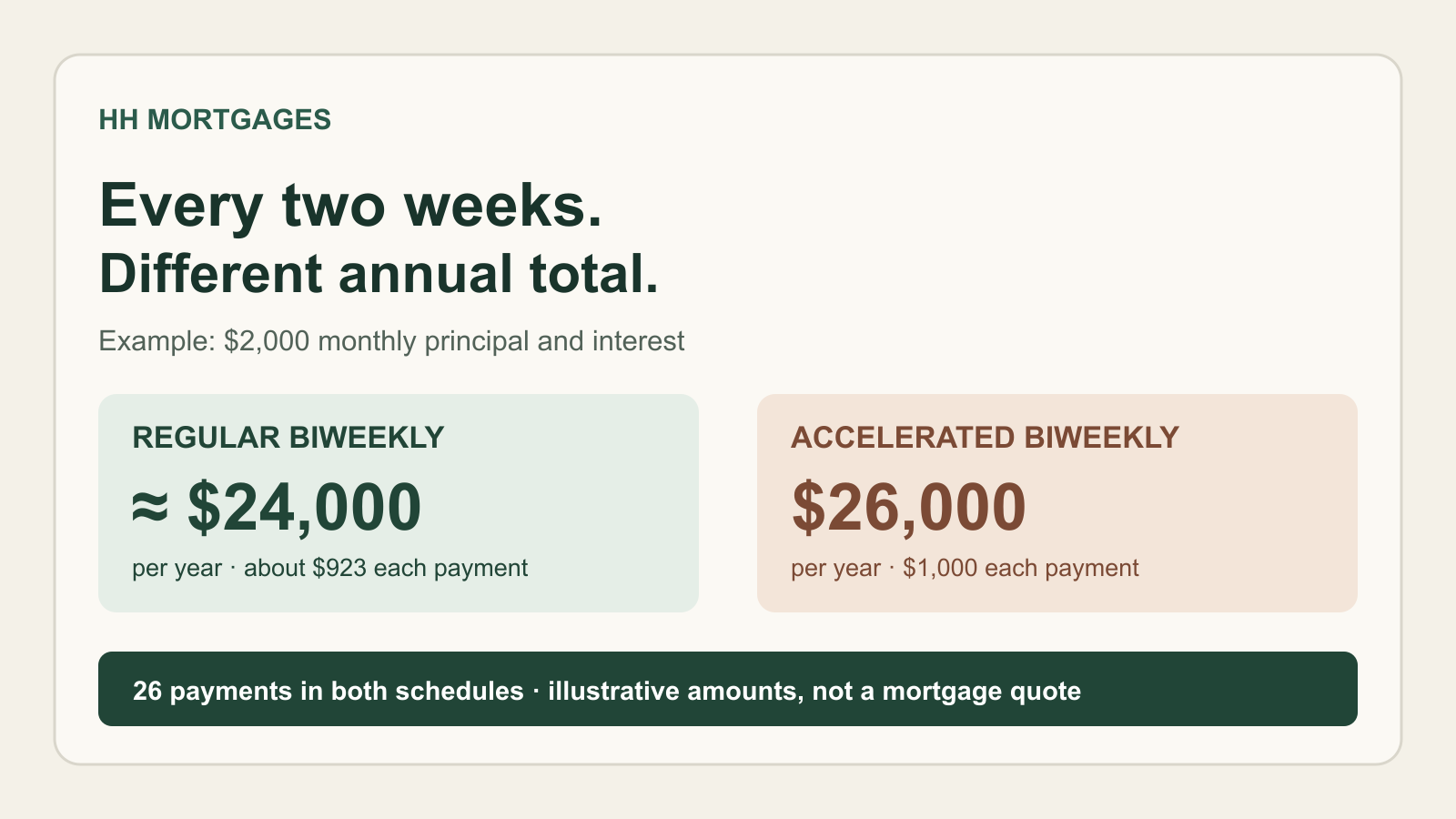
“Biweekly” and “accelerated biweekly” both mean a payment every two weeks. They do not mean the same payment amount. A regular biweekly schedule divides the equivalent of 12 monthly payments across 26 payments. An accelerated biweekly schedule usually takes half the monthly payment 26 times. That adds up to the equivalent of 13 monthly payments in a year.
If you are comparing mortgage offers, ask for the annual total as well as the amount of each withdrawal. That is where the difference becomes clear.
The simple math behind each schedule
The Financial Consumer Agency of Canada (FCAC) describes regular biweekly payments as the monthly amount multiplied by 12 and divided by 26. Accelerated biweekly payments are generally half the monthly amount, also paid every two weeks.
Suppose your principal-and-interest payment would be $2,000 per month. Ignore taxes and optional insurance for this illustration. The comparison looks like this:
- Monthly: $2,000 × 12 = $24,000 in a year.
- Regular biweekly: $2,000 × 12 ÷ 26 = about $923.08 every two weeks, or approximately $24,000 in a year.
- Accelerated biweekly: $2,000 ÷ 2 = $1,000 every two weeks, or $26,000 in a year.
The regular biweekly annual figure is approximate because lenders round each payment to cents. The accelerated schedule takes about $2,000 more over a year in this example. That is one extra monthly payment's worth. It is extra money toward the mortgage, not a special discount from the lender.
A small difference in the size of each withdrawal can be easy to miss: about $77 every two weeks in this example. Over 26 payments, it is a meaningful cash-flow commitment. The example and graphic use the same $2,000 baseline so you can see the arithmetic, not a quote for your mortgage.
Does accelerated biweekly always save interest?
It can reduce the balance faster and therefore lower interest costs over time. FCAC explains that accelerated payments put more money toward a mortgage and can save interest. The actual result depends on your balance, interest rate, remaining amortization, timing, lender calculations and what happens at renewal.
Do not compare only the payment frequency and then assume a fixed dollar saving. Ask your lender or mortgage professional for a side-by-side amortization schedule using the same mortgage amount, rate and start date. Compare the balance after your current term and the projected total interest under each option. Projections beyond the term depend on future rates, so treat them as assumptions rather than promises.
Regular biweekly payments may fit a two-week pay cycle, but their annual total is roughly the same as 12 monthly payments. A regular schedule may change the timing of interest slightly, depending on the lender's method. Its name alone does not create the extra monthly payment that defines the accelerated option.
What about semi-monthly and weekly?
Semi-monthly means twice a month, normally 24 payments in a year. Biweekly means every two weeks, generally 26 payments in a year. The words sound similar, but the calendar and withdrawal amounts differ. FCAC also lists regular and accelerated weekly schedules. Its accelerated weekly formula is one quarter of the monthly payment 52 times, again equivalent to 13 monthly payments over a year.
If you are paid every two weeks, matching mortgage withdrawals to payday can simplify your budget. Still, some calendar months may contain three biweekly withdrawals. Check the first payment date, the withdrawal calendar and how much cash you need between paydays. A schedule that reduces interest is not useful if it regularly strains your essential expenses or emergency reserve.
Can you switch later or make the extra payment another way?
Maybe. Your mortgage contract and lender process decide which payment frequencies you can choose and when you can change them. Ask whether you can move from monthly to biweekly, switch to accelerated payments, or return to a lower scheduled payment if your budget changes. Get any new amount and effective date in writing.
Another approach may be to keep a regular payment schedule and use an allowed lump-sum payment or payment-increase privilege when cash is available. That could give you more control over timing, but privileges and limits vary. FCAC advises checking your contract because payments beyond an allowed prepayment amount can trigger a charge. Our prepayment privileges guide explains the questions to ask before you add extra principal.
Do not assume an accelerated setting automatically carries into a renewal or a lender switch. Confirm the new payment frequency, amount and first withdrawal date in the written documents. It is the actual amount paid and applied to principal that matters, not a label in an online dashboard.
What I would compare before choosing
I would put four numbers on one page: the amount of each withdrawal, the annual total, the balance at the end of the term, and the cash you want available for other needs. Then I would ask whether the extra payments fit your contract and budget.
You do not have to choose the most aggressive schedule to make a good decision. If accelerated biweekly fits comfortably, it can be a simple way to pay more toward the mortgage. If it does not, a regular schedule plus deliberate prepayments may be easier to manage. If the budget is already tight, preserving room for necessary expenses can matter more than the fastest payoff estimate.
If you are comparing mortgage offers or reviewing your current payment setup in Ontario, send me the options you are considering. I can help you compare the annual cash flow and the lender's written terms before you choose.
General education, not a mortgage offer or individual financial advice. Payment options, prepayment rights, interest calculations and approval depend on your lender, contract and circumstances. The $2,000 example is hypothetical and excludes taxes, insurance and lender-specific rounding. Hanif Hosseini, Mortgage Agent Level 1, M26001653. Mortgage Architects, brokerage licence #12728. Serving Ontario, based in Oakville.