
Want to put a bonus, tax refund or extra savings toward your mortgage? First check your prepayment privileges. They tell you how much additional principal you may pay, and when, without a prepayment penalty. The answer is in your mortgage contract, not in a universal Canadian percentage. Two mortgages with similar rates can give you quite different flexibility.
The most useful way to read the fine print is to separate three questions: Can you make a lump-sum payment? Can you increase your regular payment? What happens if you need to pay off the mortgage or break the term entirely?
What is a prepayment privilege?
The Financial Consumer Agency of Canada (FCAC) defines it as the extra amount you can put toward a mortgage beyond regular payments without a prepayment penalty. A closed mortgage may limit that amount. An open mortgage generally allows prepayment without a penalty, although you should still compare its rate and other terms before choosing one.
Prepayment privileges vary by lender and product. Some closed mortgages have no privilege at all. If you are comparing offers, look past a headline such as “10% prepayment” and ask what it means in the actual contract. FCAC says the agreement should tell you whether prepayments are allowed, when, the minimum or maximum amount, and any fee or other condition.
Lump sums and larger regular payments are different tools
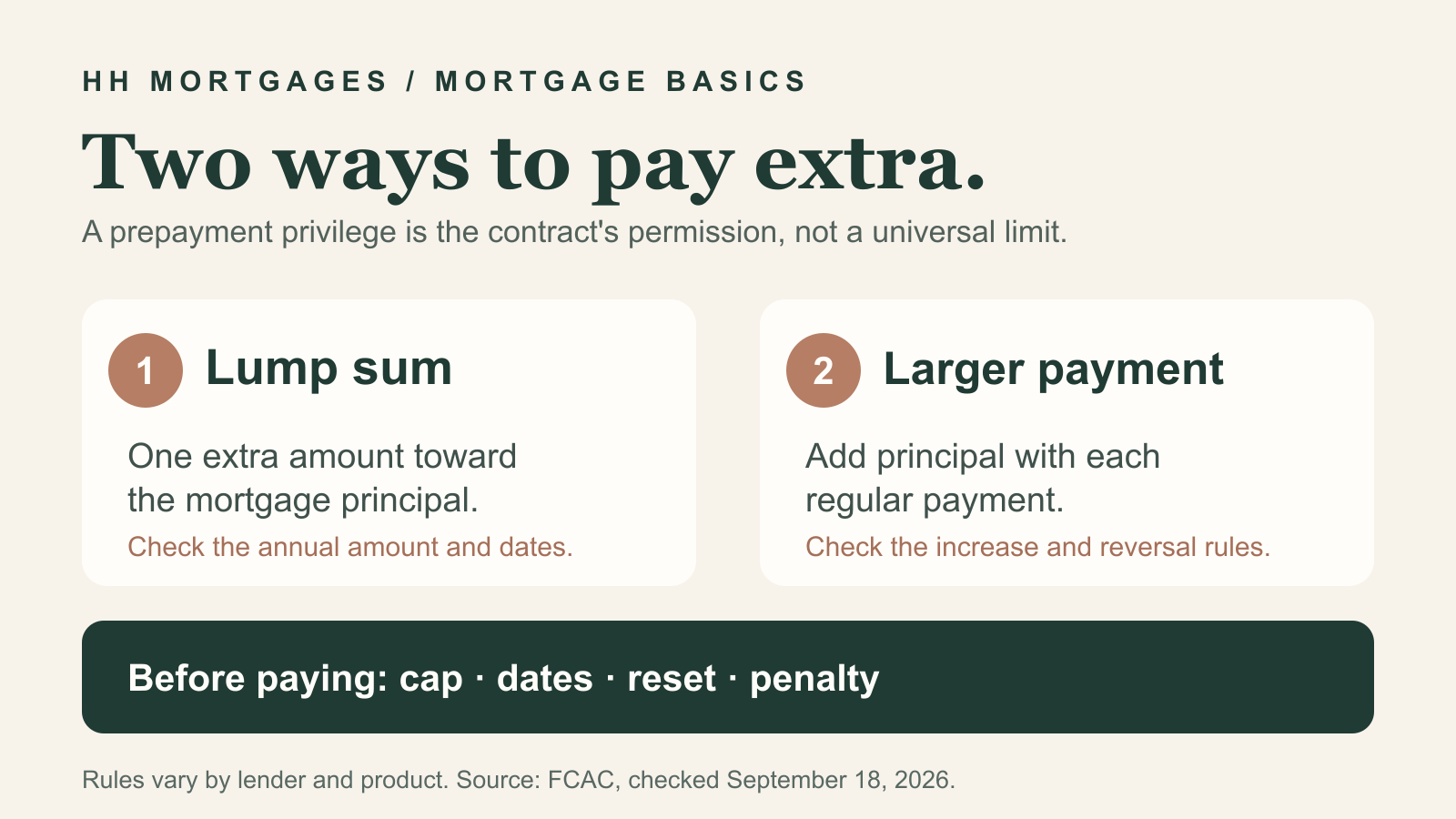
A lump-sum prepayment is an extra amount made on top of your scheduled mortgage payments. Your contract might let you make one or several lump sums within an annual limit, but it may restrict the dates. Some lenders allow them during the term; others specify particular dates. FCAC advises checking both the amount and timing in your contract.
An increase to your regular payment adds principal each payment period. It can be useful if your monthly cash flow has permanently improved. Do not assume the increase is easy to undo. FCAC notes that normally, once you increase a payment, you cannot lower it again until the term ends. Ask your lender what can be reversed if your income or expenses change.
Accelerated weekly or biweekly payments are another way to pay more over a year. They are not the same as merely splitting your monthly payment into more frequent instalments. FCAC says the accelerated option is designed to add the equivalent of about one monthly payment annually. Before changing frequency, ask what the new payment schedule will actually withdraw from your account and how it interacts with any separate prepayment limit.
What does a 10% privilege mean in dollars?
Imagine a hypothetical mortgage that began at $500,000 and permits an annual lump-sum prepayment of 10% of the original mortgage amount. Ten percent of $500,000 is $50,000 for the period defined in that contract. If the balance has since fallen to $450,000, the illustrative cap is still $50,000 because this example explicitly uses the original amount. It is not automatically 10% of today's balance.
That is an example of contract wording, not a standard rule or an offer. Some contracts use different amounts or a different base. They may count a year from the mortgage anniversary rather than January 1, require a minimum payment, or restrict the number of times you can use the privilege. FCAC notes that most lenders limit the amount each year and unused room typically cannot be carried into a later year. Ask the lender to confirm your exact remaining room before sending a payment.
Also ask whether the lump-sum and payment-increase privileges are independent or share a limit. A short label in an offer is not enough to answer that. Your signed agreement and lender's servicing rules control the result.
Does an extra payment lower your monthly payment?
An extra payment reduces the amount of principal outstanding. That normally reduces future interest compared with leaving the balance untouched, assuming the other loan terms stay the same. It does not necessarily lower the required regular payment immediately; it may instead shorten the time needed to repay the loan. Ask the lender for an updated amortization schedule showing the effect on your mortgage.
How useful an extra payment is depends on the rate, remaining balance, term, amortization and what else you need the cash for. The decision is not simply “save interest at any cost.” Keep enough accessible cash for emergencies and near-term expenses. Our guide to mortgage term versus amortization explains why a shorter payoff period and the contract end date are different concepts.
When can a penalty still apply?
On a closed mortgage, paying beyond the permitted extra amount can trigger a charge. So can paying off the entire mortgage or breaking the contract before the term ends, even if you have made ordinary prepayments before. FCAC explains that lenders calculate penalties differently, and that an interest rate differential or three months' interest may be relevant. Do not estimate your own payout cost from a generic rule; request a current lender-specific statement.
If you are planning to sell, refinance or switch lenders, timing becomes especially important. FCAC notes that some lenders restrict lump-sum prepayments close to a full payout. Confirm what you can use before requesting a payout, and compare the cost of acting now with waiting until the term ends. Our refinancing guide and renewal guide cover those decisions in more detail.
Five questions to ask before paying extra
- Is this mortgage open or closed, and does this specific product allow extra payments?
- What are the separate limits for lump sums and regular-payment increases, and what amount is each percentage based on?
- When does the allowance reset, when may a payment be made, and does unused room expire?
- What will happen to my required payment and projected payoff date after the extra principal is applied?
- If I might sell, refinance or switch lenders, what penalty would apply and can I use any privilege before that transaction?
Ask for the answer in writing or use the lender's current mortgage statement and contract. A small difference in rates may matter less to your plans than the ability to pay extra or move without an unexpected charge. If you are choosing or renewing a mortgage in Ontario, I can help compare the flexibility alongside the rate and payment, using the terms of the actual offers available to you.
General education, not individual mortgage or financial advice. Prepayment privileges and charges depend on the signed contract and lender. No interest saving or penalty amount is guaranteed. Hanif Hosseini, Mortgage Agent Level 1, M26001653. Mortgage Architects, brokerage licence #12728. Serving Ontario, based in Oakville.