
You have an accepted offer on the home you're selling. You also have a purchase agreement for your next home. Then you notice the dates: your new place closes before the sale proceeds from your current place arrive.
That gap is the reason to ask about bridge financing. It is short-term borrowing that may let you use some of the equity tied up in your current home to complete the new purchase while you wait for the sale to close. It is not automatic approval, and it does not make a weak purchase budget safe. The useful first step is to put both closing dates, and every payment due between them, on one page.
What does the gap actually look like?
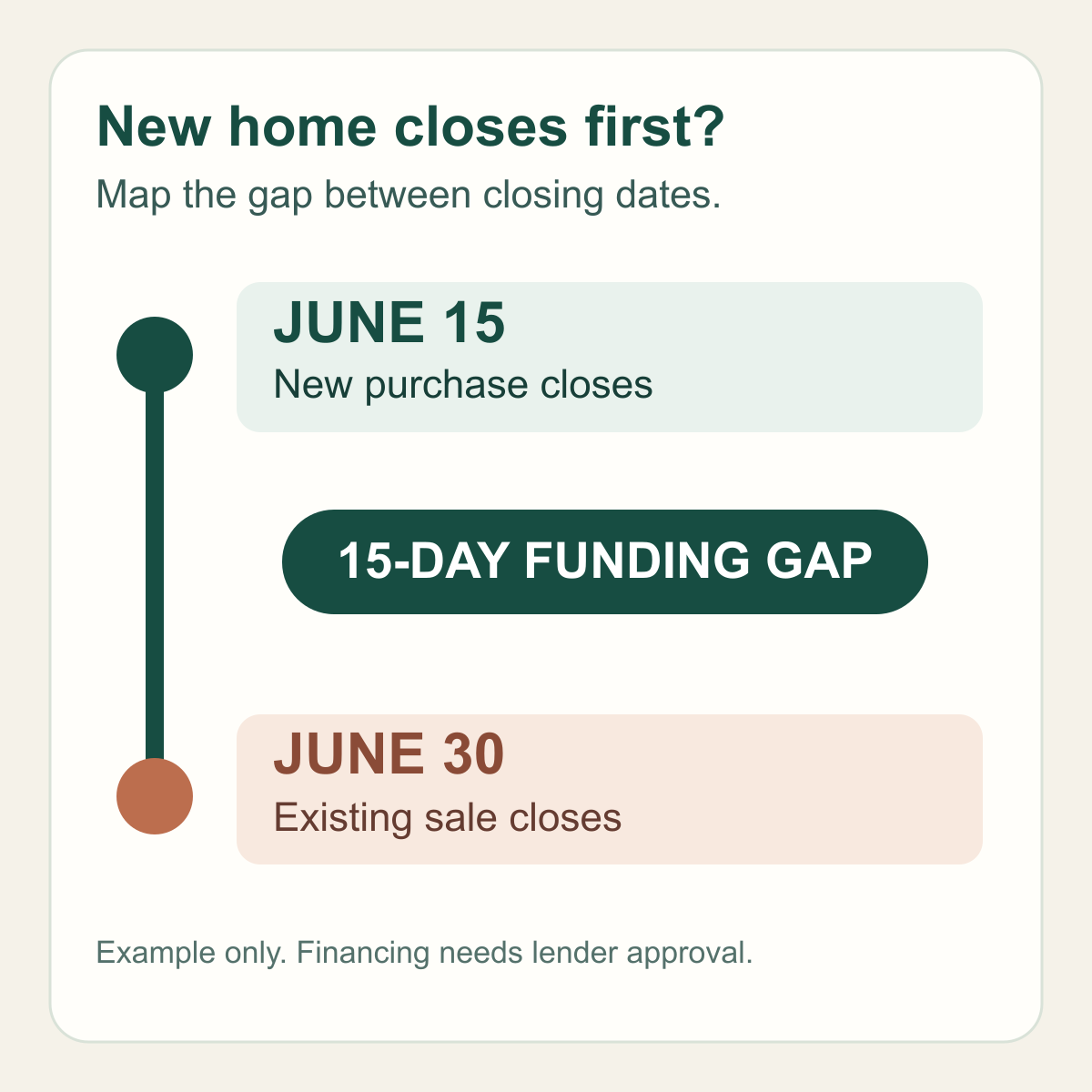
Imagine your new Ontario home closes on June 15 and the sale of your current home closes on June 30. You have a 15-day gap. You may need funds on June 15 for the new home's down payment and closing costs, but the proceeds you plan to use will arrive later.
An approved bridge loan can cover an eligible part of that temporary funding need. When your sale completes, the net proceeds are generally used to repay it. TD's explanation of bridge financing describes this use of home equity, while RBC describes a temporary loan linked to the two transactions.
Do not assume a bridge loan will pay the offer deposit. That deposit may be due long before your purchase closes. Our deposit versus down payment guide explains why they are different cash-flow events. Ask your lender and lawyer exactly when approved bridge funds can be advanced.
Do you need a firm sale of your current home?
Expect the lender to examine both transactions and your ability to repay. RBC says its bridge financing requires a firm sale agreement on the home you own. TD says applicants need the sale agreement for the current home and the purchase agreement for the new one, plus approval for a TD mortgage or Home Equity FlexLine on the new property. Those are examples of two lenders' published conditions, not a universal rule for every Ontario lender or product.
If your current home has not sold, do not build a purchase plan around an assumed bridge approval. Ask your mortgage professional what the actual lender will accept before you commit to a closing date. A purchase agreement by itself is not a substitute for confirmed financing.
How much of your equity can you use?
Equity is not the same as money available in your bank account. The Financial Consumer Agency of Canada (FCAC) defines home equity as the home's appraised value less the mortgage and other debt secured against it. Your net sale proceeds can also be lower than a simple price-minus-mortgage calculation after transaction costs and adjustments.
The lender determines the bridge amount under its own rules, after reviewing the sale price, secured debts, expected costs, purchase funding need and overall application. TD's example notes that estimated closing costs can reduce the bridge amount. Ask for the approved figure in writing. Do not treat an online equity estimate as your available down payment.
What will the bridge cost?
Request a written breakdown of the bridge interest rate, how interest is calculated, any setup or legal charges, the maximum term and the exact repayment process. The cost depends on the amount borrowed, the time outstanding and the lender's terms. A short gap can still be expensive if it comes with fees or if the sale is delayed.
Budget for the overlap too: you may carry the existing mortgage and home expenses while payments and costs begin on the new home. If your buyer's sale does not close as expected, that overlap may last longer. TD specifically flags interest and the risk of carrying two mortgages if the sale falls through. RBC also warns that bridge borrowing has costs and risks. Have a contingency discussion before closing, not after a delay occurs.
There is no single Canadian bridge-loan duration. TD describes a typical maximum of 90 days for its product; RBC describes a different range for its offering. Your approval and agreement, rather than a general article, control the amount of time available.
Does your existing mortgage create another cost?
Possibly. The bridge loan solves a timing problem. It does not decide what happens to the mortgage on your current home when that property is sold. If you must end a closed mortgage before its term ends, FCAC explains that a prepayment penalty and other charges may apply. Ask your current lender for a payout statement and a current penalty quote.
If your mortgage has a portability feature, ask whether transferring it to the new property is possible and how the lender would handle the date gap. Porting a mortgage in Ontario and bridge financing are separate questions. One concerns the terms of the longer-term mortgage; the other concerns temporary cash between closings. You may need to consider both.
Questions to settle before you waive a financing condition
- Are both sale and purchase agreements firm enough for this lender's bridge policy?
- What bridge amount is approved, and which purchase funds must you provide separately?
- On what date will the money be available to your lawyer, and what is the repayment date?
- What are the interest rate, fees, maximum term and cost if the sale closes late?
- Can your budget carry two properties temporarily, and what is the backup plan if the buyer does not close?
- What will it cost to discharge or port your current mortgage?
You can also ask whether aligning the two closing dates would reduce the gap. That may simplify the funding plan, although the dates still have to work for both transactions and your move. Your lawyer can confirm how the money will flow on each closing day; your mortgage professional can confirm what the lender is prepared to finance.
The point is not to make two transactions feel effortless. It is to know, before you are committed, which dollars arrive on which day and what happens if the expected sale proceeds are late. If you are moving within Ontario, I can help you map the two dates and compare the confirmed financing options.
General education, not individual mortgage, legal or financial advice. Bridge availability, amount, timing and cost depend on the lender, agreements, verified equity, credit and property. No approval is guaranteed. Hanif Hosseini, Mortgage Agent Level 1, M26001653. Mortgage Architects, brokerage licence #12728. Serving Ontario, based in Oakville.