
Updated: August 25, 2026
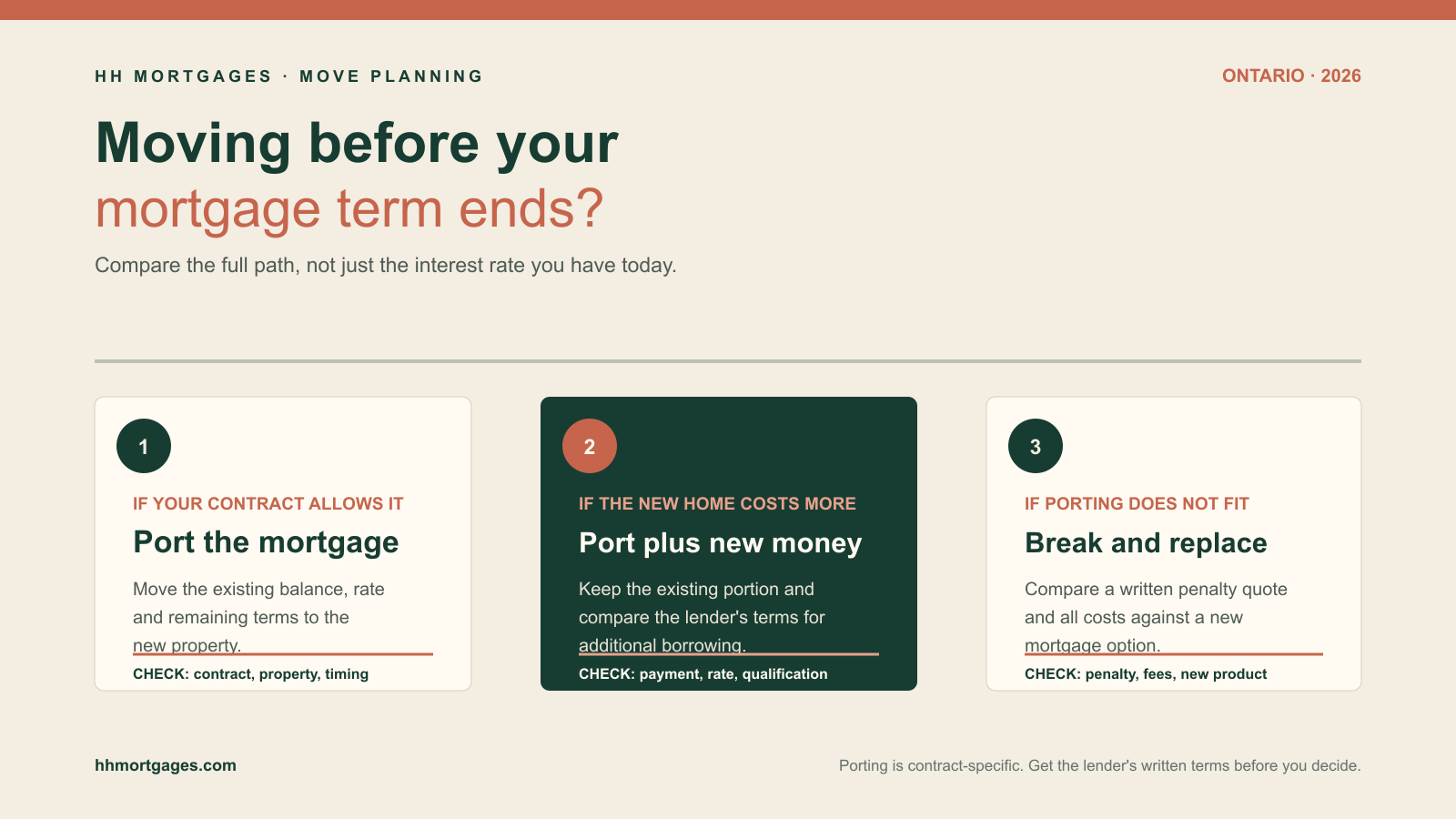
Maybe. If your current mortgage is portable and your lender approves the new purchase, you may be able to move your existing mortgage balance, interest rate and remaining terms to your next home.
Here is the simple version. Porting can be useful when you are moving before your mortgage term ends, especially if your current rate is lower than today's available rates or breaking the mortgage would create a large penalty. It is not automatic, though. The mortgage contract, the new property, the timing, the amount you need to borrow and your current finances all still matter.
What does it mean to port a mortgage?
The Financial Consumer Agency of Canada describes a portable mortgage as one that lets you transfer your existing mortgage when you sell one home to buy another. The balance, interest rate, terms and conditions can move to the new property.
That is different from switching lenders. FCAC says you cannot transfer an existing mortgage to a different lender. If you switch lenders before the end of your term, you normally need to break the current mortgage contract and qualify for a new mortgage.
It is also different from an assumable mortgage, where a buyer takes over the seller's mortgage and property. These terms get mixed up often, so it is worth being precise before you make an offer.
Why homeowners consider porting
Porting may help you avoid breaking a closed mortgage early. A prepayment penalty can cost thousands of dollars, particularly on a fixed-rate mortgage. FCAC notes that lenders may charge this penalty when you break a mortgage contract, pay it off early or transfer it to another lender before the end of the term.
If your existing rate and mortgage features are still attractive, portability can be a useful option. But it should be compared with the full cost of breaking the mortgage and starting again, not treated as an automatic win.
The five things to check before you list your home
1. Is your specific mortgage portable?
Do not assume every mortgage has this feature. Look at your mortgage commitment or contact your lender and ask directly:
- Is my current product portable?
- Can the existing rate, term and balance move to a new property?
- What sale and purchase timing does the contract require?
- Does the lender require a new application, an appraisal or updated documents?
- What happens if the new property costs more or less than my current mortgage balance?
The details belong in your contract and lender policy. A general product name such as “five-year fixed” does not tell you everything.
2. Can you still qualify for the new purchase?
Porting keeps part of an existing mortgage, but it does not remove the lender's need to assess the new deal. Expect the new property, your income, debts, credit, down payment and closing details to be reviewed.
If you need more money for the next home, the extra borrowing is usually treated separately from the existing balance. The lender may offer a top-up, a blended rate or another structure. The result depends on its product rules and your qualification at that time.
For a refresher on what lenders review after you find a property, read mortgage pre-approval versus final approval.
3. Will the new home require more or less borrowing?
This is where many portability conversations become more complicated.
If the new home costs more, you may need additional borrowing. If it costs less and you need a smaller mortgage than the balance you are carrying today, FCAC notes that a prepayment penalty may apply to the part that cannot be moved.
If the extra borrowing changes your mortgage amount, amortization or other core terms, the original rate may not apply to the full new mortgage. Get the lender's proposal in writing and compare the total payment, rate, term and flexibility with your other options.
4. What is the timing window?
Porting normally depends on a defined period for selling the old property and closing on the new one. That period is set by the lender and contract, not by a Canada-wide rule.
This matters if you buy before you sell, sell before you buy or need proceeds from your sale for the down payment. You may need bridge financing, a larger cash reserve or a different plan. Raise the timing question before removing a financing condition.
5. What costs remain?
Porting can reduce or avoid a break penalty, but it does not make a move free. Depending on the transaction, there may still be appraisal, legal, registration, administration, moving and insurance-related costs.
Ask for a written comparison that shows the costs of:
- porting your current mortgage
- porting with extra borrowing
- breaking the mortgage and taking a new one
- waiting until the current term ends, if timing allows
A simple example
Let's say you have a $500,000 mortgage balance with two years left in the term. You are buying a $900,000 home and will have $250,000 available for the down payment from sale proceeds and savings, after setting aside closing costs.
Your new mortgage need is $650,000.
| Item | Amount |
|---|---|
| Current mortgage balance | $500,000 |
| New mortgage needed | $650,000 |
| Additional borrowing needed | $150,000 |
The key question is not simply, “Can I keep my old rate?” It is, “How will the lender structure the existing $500,000 and the additional $150,000, and what will the complete payment and cost be?”
One lender may offer a workable portability solution. Another option may be to break the current mortgage, pay a penalty and use a new product with different pricing or features. The better choice depends on the actual penalty quote, the proposed terms and how long you expect to keep the next mortgage.
What if your current mortgage is insured?
Mortgage portability and mortgage loan insurance portability are related, but they are not the same thing.
CMHC has a separate portability program for eligible CMHC-insured loans. Its requirements include that the original property is sold, the new loan finances the new purchase, the original loan is in good standing and at least one borrower from the original insured loan remains on the new loan.
There may be an insurance premium credit in some situations, but that is not the same as a guarantee that the new mortgage, property or lender request will be approved. Ask your lender to check the insurance certificate number and the exact insurer rules early.
If you are still planning the cash side of the move, start with how much down payment you need in Ontario.
What I would pay attention to
I would ask for the actual mortgage contract and a written penalty quote before deciding that porting is the answer. A low existing rate is valuable, but it is only one part of the decision.
I would also look closely at the new mortgage payment, not just the rate. A larger home can bring different property taxes, condo fees, insurance and maintenance costs. It is easier to spot a tight budget before the offer is firm than after the sale of your current home is committed.
Finally, I would start early. A lender review, appraisal, sale, purchase, lawyer and possible bridge financing all need to fit together. Leaving it until the last week before closing creates unnecessary pressure.
Bottom line
You may be able to port a mortgage in Ontario if your contract allows it and the lender approves the new purchase. It can help you keep favourable mortgage terms and avoid some break costs, but it may not cover every dollar you need for the new home.
Before you list or make an offer, confirm your portability terms, get the penalty quote, compare the full numbers and leave enough time for the lender to review the new property.
Not sure whether porting, breaking or replacing your mortgage makes more sense for your move? Send me a message or book a call and we can compare the options together.
This article provides general information, not personalized financial or legal advice. Mortgage portability, approval, pricing, penalties, insurance and product availability depend on the mortgage contract, borrower, property, insurer and lender requirements.