
Updated: October 2, 2026
Yes. A car loan can affect your mortgage application because the lender looks at the monthly payment, along with your housing costs and other debts, when it checks whether the mortgage fits your income. It does not automatically mean you cannot buy a home.
The timing matters too. Taking on a car payment after mortgage pre-approval can change the numbers the lender originally reviewed. If you are also saving for a down payment and closing costs, paying off a car loan with cash may create a different problem. The useful question is not simply “Should I keep the car?” It is “How does this payment change my application and my available cash?”
Why does a car payment count?
Canadian lenders use debt-service ratios to compare payments with gross income. Your gross debt service ratio (GDS) focuses on housing costs. Your total debt service ratio (TDS) adds other debt payments, which can include a car loan. The Financial Consumer Agency of Canada (FCAC) explains both ratios and lists car loans among the debts lenders consider.
That is why the monthly car payment can matter more immediately to a mortgage calculation than the price you originally paid for the vehicle. The lender will also review the balance, account history and other details. Its decision is based on the whole application, not one ratio in isolation.
FCAC describes 39% for GDS and 44% for TDS as general guidelines. They are not a promise of approval, and a lender may apply different criteria or ask for more information. For a fuller explanation, see our GDS and TDS guide.
What could a new car payment change? A simple example
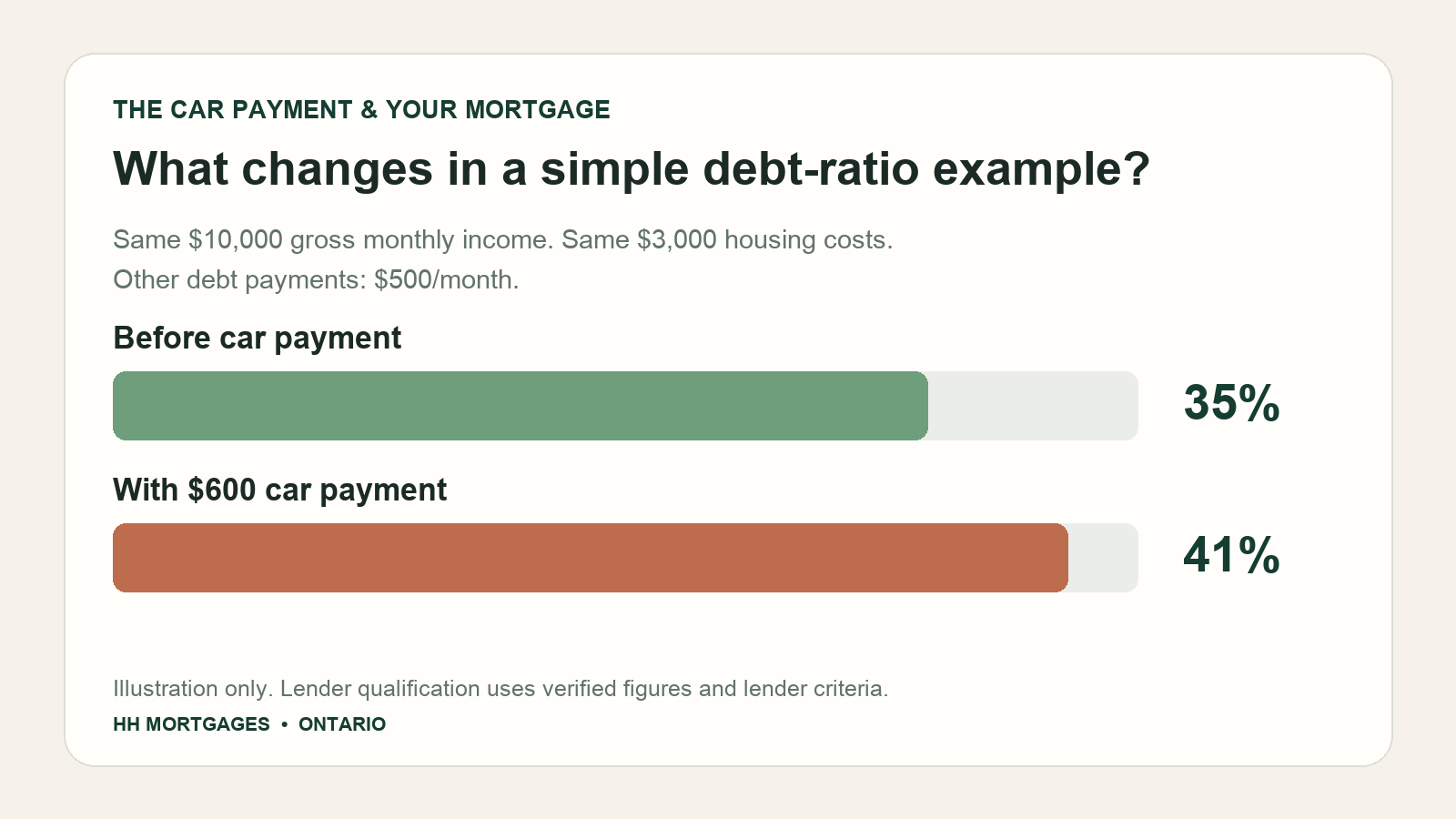
Suppose your gross household income is $10,000 a month. For illustration, the housing costs used in the mortgage calculation are $3,000 a month, and other debt payments total $500. TDS would be 35%: ($3,000 + $500) ÷ $10,000.
Add a $600 monthly car payment, and the same illustration becomes 41%: ($3,000 + $500 + $600) ÷ $10,000. Your income and the home have not changed, but the amount left within a lender's debt-service calculation has.
| Hypothetical monthly amounts | Before car loan | With $600 car payment |
|---|---|---|
| Gross income | $10,000 | $10,000 |
| Housing costs used for qualification | $3,000 | $3,000 |
| Other debt payments | $500 | $500 |
| Car payment | $0 | $600 |
| Illustrative TDS | 35% | 41% |
This is ratio arithmetic, not a mortgage offer. A real lender must confirm which housing expenses, income and debt payments count, what rate applies for qualification, and whether the property and documentation meet its requirements. A smaller car payment will not translate into a fixed amount of extra mortgage for everyone.
What if you already have the car loan?
You do not need to hide it, and you should not assume it ends your application. Be ready to provide the monthly payment, current balance and remaining term if asked. A lender may see the account on your credit report, but a current statement can help clarify the actual obligation.
If the loan is almost paid off, ask your mortgage professional whether documented payoff would change the lender's calculation. Do not spend cash just to improve a ratio before checking the trade-off. You still need funds for the down payment, closing costs and life after closing.
Also separate the loan from the broader cost of owning a car. Insurance, fuel and maintenance may not appear as individual debt payments in TDS, but they affect what you can comfortably afford each month. Qualifying for a mortgage and being comfortable with its payment are related, but different, questions.
Should you buy or finance a car while buying a home?
If you are house-hunting, under a financing condition or waiting to close, speak with your mortgage professional before signing a new car-financing agreement. A pre-approval is an early assessment, not a guarantee of final approval. FCAC says lenders still verify details before they approve the mortgage.
A new payment can prompt the lender to recalculate your debt ratios or ask for updated documents. A large cash purchase can reduce the funds available for your down payment or closing. The right sequence depends on your dates and the lender's requirements. Our guide to changes before mortgage closing covers the wider checklist.
If you are comparing a loan with a lease, ask how the specific lender will treat the proposed monthly obligation. Avoid assuming that a different contract name makes the payment disappear from qualification. Get the lender's answer before you commit.
Four numbers to bring to a mortgage conversation
- The car payment: what you must pay each month, including any proposed new payment.
- The amount still owing: use a current statement, not an old purchase price.
- The remaining payoff date: especially if the loan is close to ending.
- Your cash after a possible payoff: what remains for the home purchase and a sensible reserve.
I would look at those four numbers together. Sometimes the existing loan is manageable. Sometimes delaying a new car purchase gives you more room. Sometimes paying it off is helpful, but only after confirming the lender's calculation and the cash you will still have. There is no one-size-fits-all answer.
If you are planning a home purchase in Ontario and a car payment is part of the picture, book a call. We can review the numbers and the timing before you make an expensive commitment. Please use a secure channel for private financial documents.
General information, not a mortgage approval or personal financial advice. Debt-service guidelines and lender policies vary; actual qualification depends on verified income, debts, credit, property, product and lender requirements. Hanif Hosseini, Mortgage Agent Level 1, M26001653. Mortgage Architects, brokerage licence #12728. Serving Ontario, based in Oakville.