
Updated: September 3, 2026
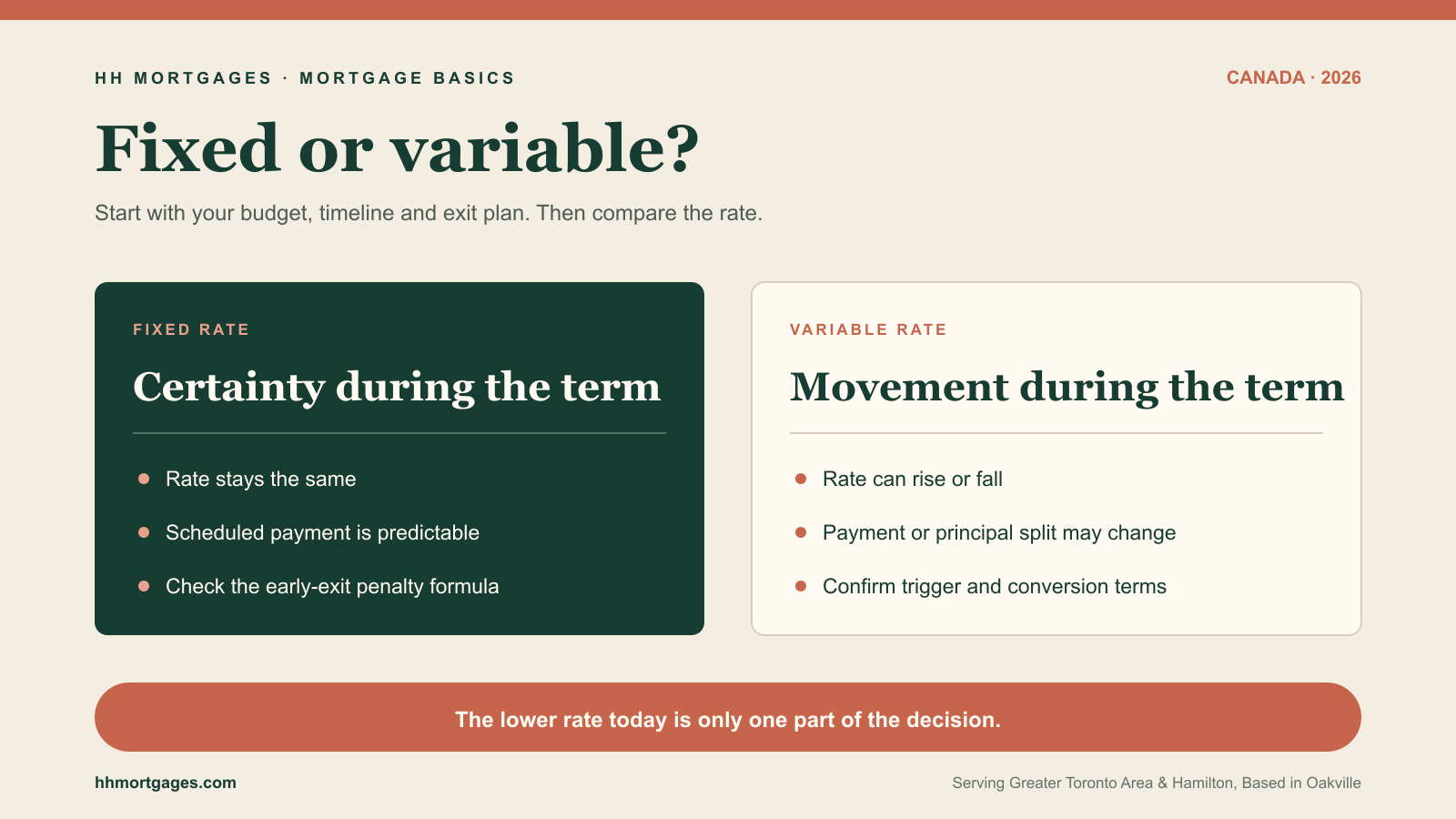
Neither a fixed nor variable mortgage is automatically better. A fixed rate is usually the easier fit when payment certainty matters most. A variable rate may suit someone who can handle changes, understands how the payment works, and is comfortable accepting uncertainty in exchange for potential savings or flexibility.
Here is the simple version: do not make this decision based only on which rate is lower today. Look at your monthly budget, how long you expect to keep the mortgage, what could make you break it early, and what happens to the payment if rates change.
There is one more question many people miss: if the mortgage is variable, does the payment adjust with the rate, or does the payment initially stay fixed? Those are not the same experience.
The basic difference between fixed and variable
With a fixed-rate mortgage, the interest rate stays the same for the full mortgage term. If you choose a five-year fixed term, the rate does not change during those five years. Your scheduled principal-and-interest payment is predictable, assuming you do not change the mortgage. FCAC explains both fixed and variable mortgage interest structures in its consumer guidance.
With a variable-rate mortgage, the rate can move during the term. It is commonly expressed as the lender’s prime rate plus or minus an adjustment. For example, a contract might say prime minus 0.50%. If that lender changes its prime rate, your mortgage rate changes too.
The Bank of Canada’s policy decisions influence variable borrowing costs, but your mortgage is tied to the rate and terms stated by your lender. The lender’s prime rate is not the Bank of Canada’s policy rate.
| Feature | Fixed-rate mortgage | Variable-rate mortgage |
|---|---|---|
| Interest rate during the term | Stays the same | Can rise or fall |
| Scheduled payment | Usually stable | May change, or the interest/principal split may change |
| Budgeting | More predictable | Requires room for rate changes |
| Monitoring | Less day-to-day attention | Worth reviewing as rates and your plans change |
| Breaking the mortgage | Penalty can be significant and depends on the contract | Penalty rules vary; many closed variable contracts use an interest-based calculation |
Not all variable mortgages handle payments the same way
This is where I see people get confused.
An adjustable-payment variable mortgage changes the payment when the interest rate changes. If the rate rises, the payment normally rises. If the rate falls, the payment normally falls. The principal repayment pattern stays more consistent because the payment adjusts.
A fixed-payment variable mortgage may keep the scheduled payment unchanged for a while when the rate changes. Instead, the amount going to interest and principal changes.
If rates rise, more of the payment goes to interest and less goes to principal. At a contract-specific trigger point, the lender may require a higher payment. In some circumstances, the balance may stop declining or may even increase.
Do not rely on the word “variable” alone. Before signing, ask the lender or mortgage agent:
- Does my payment change immediately when the rate changes?
- If the payment stays fixed, what is the trigger rate or trigger point?
- Could the amortization extend?
- When can the lender require a payment increase or lump-sum payment?
A $600,000 mortgage example
Suppose you need a $600,000 mortgage with a 25-year amortization and monthly payments. These rates are hypothetical and are not current quotes.
| Scenario | Illustrative rate | Approximate monthly payment |
|---|---|---|
| Adjustable variable at the start | 4.00% | $3,156 |
| Fixed option | 4.50% | $3,321 |
| Adjustable variable after a 1-point increase | 5.00% | $3,490 |
At the starting rates, the variable payment is about $165 lower than the fixed payment.
But if the variable rate rises from 4.00% to 5.00%, the adjustable payment increases by about $334 per month. It would then be about $169 higher than the illustrative fixed payment.
The point is not to predict which path will happen. It is to test whether your budget can handle the less comfortable path.
If this were a fixed-payment variable mortgage, the scheduled payment might not move immediately. Instead, more of that payment could go toward interest, which can leave a higher balance or longer remaining amortization than expected. The contract determines the actual result.
The example uses standard Canadian mortgage-payment math with semi-annual compounding, monthly payments, no additional borrowing and no prepayments. Your actual payment depends on the lender, rate, amortization, payment frequency, insurance premium and mortgage terms.
What about penalties if you break the mortgage?
The rate matters, but the exit cost can matter just as much.
A prepayment penalty may apply if you break a closed mortgage, transfer it before the end of the term, refinance early, or pay more than the contract allows. This can become relevant after a sale, separation, job relocation, refinance or unexpected change in plans.
For many closed fixed mortgages, the penalty may be the higher of three months’ interest or an interest rate differential, often called IRD. The lender’s formula and the rates it uses can materially change the result.
Many closed variable mortgages use an interest-based penalty, often three months’ interest, but this is not universal. Read the actual contract and ask for a written penalty example before choosing.
If there is a reasonable chance you will move, refinance or sell during the term, compare portability and penalty language, not just the starting rate. Our guide to porting a mortgage in Ontario explains another option that may help when moving.
Can you convert a variable mortgage to fixed?
Some variable mortgages include a conversion feature that lets you move into a fixed rate with the same lender during the term.
That can sound like a perfect safety net, but check the details. A fee or conditions may apply, and the fixed rate available at conversion may be higher than the fixed rate you could have chosen at the beginning. You may also have to accept a particular remaining term or a new term length.
Treat conversion as an option, not a guarantee that you can wait and then receive today’s fixed rate later.
Does the stress test change the decision?
Choosing a variable rate does not mean qualifying only at the lower contract rate.
For an uninsured mortgage at a federally regulated lender, the current minimum qualifying rate is the greater of the contract rate plus 2 percentage points or 5.25%. Other qualification rules may apply depending on the mortgage, lender and transaction.
Your income, debts, down payment, property and credit profile still matter. If you want the qualification side explained separately, read GDS and TDS ratios in Canada and mortgage pre-approval versus final approval.
Five questions I would use to make the choice
1. How tight is the monthly budget?
If an extra $300 or $500 per month would create real stress, certainty may be worth paying for. Do not measure risk only by whether you could technically make one higher payment.
2. How likely are your plans to change?
Think about a possible move, growing family, job change, refinance, separation or sale. The best rate on day one can become expensive if the mortgage is costly or difficult to exit.
3. What exactly happens when rates move?
For a variable mortgage, confirm whether the payment adjusts or stays fixed, how often changes occur, and what triggers lender action.
4. What is the real penalty formula?
Ask for an example using your expected balance and a realistic point in the term. A verbal description such as “three months’ interest” is not enough unless it matches the contract.
5. Will you actually be comfortable with the decision?
A variable rate is not a good fit if every Bank of Canada announcement will make you lose sleep. A fixed rate is not automatically right either if you value flexibility and may need to break the mortgage early.
What I would pay attention to
I would compare three scenarios before deciding:
- the starting payment
- the payment or principal impact after a 1-point rate increase
- the cost of leaving the mortgage early
That gives you a more useful picture than comparing two advertised rates.
I would also make sure the emergency fund remains healthy after closing. A variable mortgage with no room in the budget is a very different decision from the same mortgage with a strong cash reserve.
Bottom line
Choose fixed when stable payments and certainty are the priority. Consider variable when you understand the payment structure, can absorb increases, and are comfortable with rate uncertainty.
Then compare the parts that do not fit in a rate headline: penalty calculation, portability, prepayment privileges, conversion terms and the lender’s treatment of variable payments.
Not sure which structure fits your budget and timeline? Send me a message or book a call and we can compare the numbers together.
This article provides general information, not personalized financial advice. Rates, qualification, payments, penalties and product availability depend on the borrower, property, lender, mortgage contract and market conditions.