
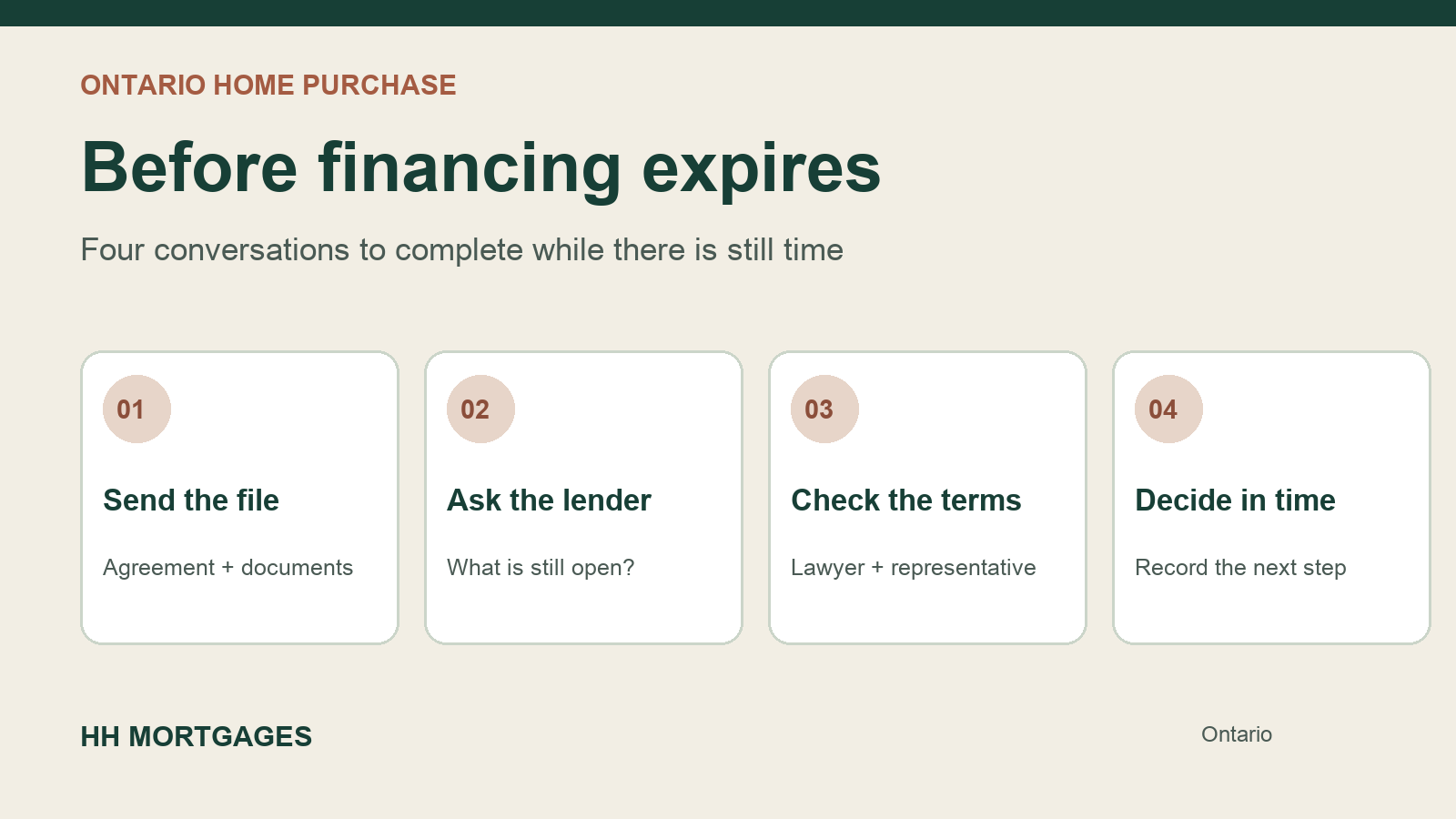
Your offer was accepted, but the financing condition expires soon and the lender has not given you a clear answer. Get the exact status today. Ask your mortgage professional what the lender still needs, tell your real estate representative about the deadline, and speak with your Ontario real estate lawyer about your options under the signed agreement. Do not treat a pre-approval as final approval or let the condition expire while assuming someone else is watching the clock.
The answer is specific to your purchase agreement, the lender's decision and the seller's response. An extension may be possible if all parties agree, but it is not automatic. I can help move the financing file and explain the lender's outstanding items; your lawyer should advise on notices, the condition's wording and the legal consequences of your choice.
Why a pre-approval is not the finish line
A pre-approval can help you estimate a borrowing range before you shop. It does not guarantee a mortgage on the home you choose. The Financial Consumer Agency of Canada (FCAC) says the lender may still check the property and can decline an application even after pre-approval. Your down payment, current debts, income and the property's value all matter to the final decision.
The Real Estate Council of Ontario (RECO) encourages buyers to consider a financing condition when possible and to understand the agreement they sign. A competitive offer does not make the lending process disappear. If you are still at the offer stage, discuss the condition and a realistic deadline with your representative and lawyer before signing. If the offer is already accepted, use the actual deadline in your agreement, not a date from memory.
In the first day after acceptance
Send your mortgage professional the signed purchase agreement and any property details the lender requests. Confirm the purchase price, deposit, planned down payment, closing date and whether your employment, income, debts or source of funds have changed since pre-approval. Ask for one clear list of outstanding documents and who owns each next step. Our mortgage document checklist can help you assemble the usual income and down-payment records, but follow your lender's specific request.
Then ask three questions in writing: Has the lender reviewed the property and the borrower? Is an appraisal, insurer decision, document review or other condition still pending? What is the earliest realistic time for a written decision? A verbal “looks good” is useful progress, but it does not tell you exactly what has been approved. If a commitment arrives, read its remaining conditions with your mortgage professional before assuming funds are ready for closing.
When the clock is running out
Use a simple sequence rather than hoping for a last-minute answer:
- Confirm the deadline and required notice. Have your real estate representative and lawyer read the signed agreement, including the exact time and method for giving any notice.
- Get a lender status update. Ask what is missing, who is working on it and whether a decision is realistically possible before that deadline.
- Discuss the available choices early. Your representative can ask whether the seller would consider a written extension; your lawyer can explain what the contract permits and what happens if the condition cannot be satisfied.
- Document the decision. Keep the lender's written status, any agreed amendment and the advice you received. Only your legal advisers can tell you which notice or amendment is effective for this agreement.
The seller does not have to agree to more time. Nor should you waive a financing condition simply to keep a deal alive when you still cannot confirm how you will pay for the purchase. RECO's competing-offers guidance warns buyers against relying on prequalification as a reason to skip a financing condition. The financial risk of proceeding without the needed financing can be serious; ask your lawyer about your specific exposure before making a decision.
Match the response to the problem
Documents are still being reviewed. Send the requested items promptly and ask for a realistic decision time. If that time passes the contractual deadline, raise the extension question with your representative and lawyer now. No one can promise the seller will accept it.
The property raises a concern. A lender may require an appraisal or decide the property does not meet its standards. If the appraisal is lower than the purchase price, a larger cash contribution or another solution may be needed. Our low-appraisal guide explains the financing gap. Do not assume a different lender can complete the work before the deadline.
The lender declines or offers less than expected. Ask why and what, if anything, could change the decision. FCAC lists possible lender responses such as a lower mortgage amount or a larger down payment, but none is guaranteed. Have your lawyer assess the purchase agreement before you decide whether to seek another lender, request an amendment or take a different contractual step.
A written commitment has arrived, but with conditions. Ask which conditions must be met before funds are advanced. A mortgage commitment and the final closing process are different milestones. Keep your lawyer and mortgage professional aligned on outstanding items and dates.
What about the deposit?
Do not assume the deposit is automatically returned or automatically lost if financing fails. The answer depends on the signed agreement, proper notices, facts and any dispute. A deposit held in a brokerage trust account is not the same as insurance against a buyer-seller disagreement. RECO's deposit insurance explanation says its coverage does not resolve disputes between a buyer and seller over who should receive the deposit. Get legal advice before relying on a general rule or a verbal promise.
The practical goal is to create time for a clear decision. As soon as your offer is accepted, put the deadline on your calendar, send the complete file, and ask for a lender status you can act on. If the answer is still uncertain, bring your representative and lawyer into the conversation before the condition expires.
General information only. Financing conditions, notices, extensions, deposits and remedies depend on the signed agreement and individual circumstances. This is not legal advice or a promise of mortgage approval. Hanif Hosseini, Mortgage Agent Level 1, M26001653, Mortgage Architects #12728. Serving Ontario, based in Oakville.