
Updated: October 1, 2026
You may see “title insurance” on a closing-cost estimate and wonder if it is mandatory. In Ontario, title insurance is not a general legal requirement. But your mortgage lender may require a lender's policy as a condition of its loan. You can also consider a separate owner's policy for your own protection.
Those are different questions. Paying for a policy connected to the mortgage does not, by itself, tell you whether you personally have owner coverage. Ask your lawyer which policies are being arranged, who each policy protects, what each costs and when coverage starts.
What is title insurance?
“Title” means legal ownership of a property. Title insurance is a policy intended to protect against certain losses connected to that ownership or to the lender's interest in it. The Financial Services Regulatory Authority of Ontario (FSRA) explains that the exact protection comes from the policy, including its limits and exclusions.
Possible covered problems can include unknown title defects, certain liens left by a previous owner, errors in public records, encroachments and title fraud. This is a list of possible risks, not a promise that every policy covers every version of them. The policy wording matters.
Title insurance is not the same as mortgage default insurance. Default insurance addresses a lender's loss if an insured mortgage borrower does not repay. Title insurance concerns the legal ownership or security interest in the property. They solve different problems.
If title insurance is not mandatory, why does my lender ask for it?
FSRA says Ontario does not require everyone to buy title insurance. Separately, the Financial Consumer Agency of Canada (FCAC) says your lender may require title insurance in the mortgage contract. Both statements can be true at once: there is no blanket Ontario purchase rule, while a particular lender can make it a condition of financing.
Ask your mortgage professional or lawyer what the lender's instructions actually require for your transaction. If the quote includes title insurance, check whether it is a lender policy, an owner policy or both. Do not assume the same answer applies to every lender or property.
Lender's policy versus owner's policy
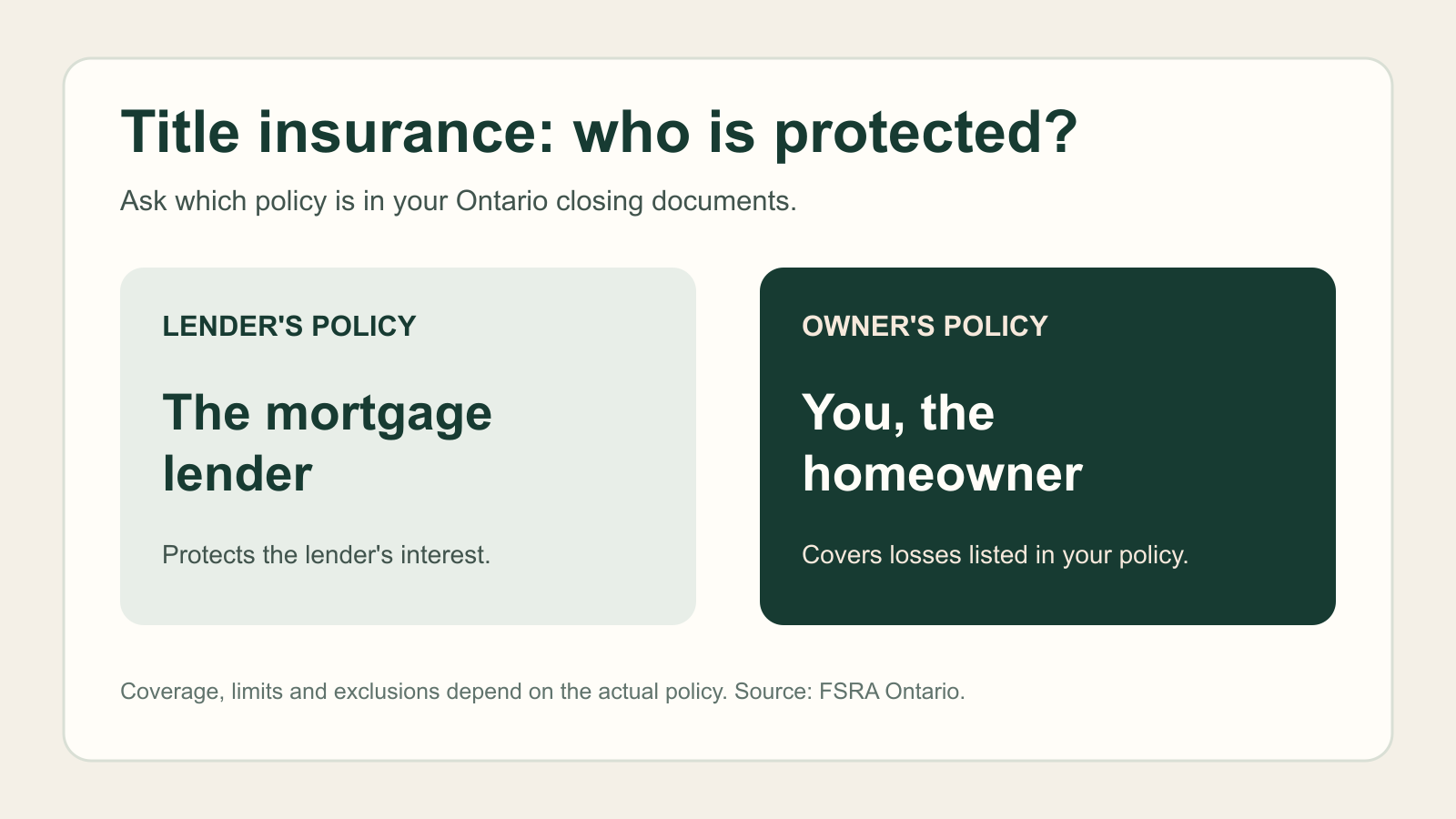
The distinction is who is insured. According to FSRA, a lender's policy protects the lender if the mortgage on the property is invalid or cannot be enforced. Its coverage is usually tied to the mortgage amount. An owner's policy protects the homeowner against covered title-related losses, up to the policy's limit.
That means a lender's policy is not a substitute for checking whether you have owner coverage. Even if you pay an amount at closing, read the documents to identify the insured party. If you want personal protection, ask your lawyer whether an owner's policy is included, what it covers and what it excludes.
FSRA says residential owner coverage generally lasts as long as you own the property. You can usually arrange it when you buy, and it may be available later, although policies for existing owners can differ from policies issued at purchase. Ask about the effective date, especially if coverage is being set up for closing.
What does an owner's policy usually not solve?
Do not treat title insurance as a guarantee against every surprise after you move in. FSRA lists possible exclusions such as defects you knew about before buying, environmental hazards, certain survey or inspection discoveries, and issues unrelated to title. The actual exclusions depend on the policy.
For example, if you are worried about a renovation, property boundary or an issue raised in a status certificate, ask your lawyer the specific question. Do not rely on the phrase “title insured” to settle it. FSRA is explicit that title insurance does not replace legal advice when buying property.
Your lawyer can explain how the title review, survey information, insurance policy and purchase agreement fit together. If an exception or exclusion is important to you, ask for the answer before closing rather than assuming you can make a claim later.
How much does it cost, and when do you pay?
Title insurance is normally paid for with a one-time premium, rather than a monthly mortgage payment. FSRA says the cost of residential coverage varies with the property's value and the insurer. Your lawyer can provide the actual quote for the policy or policies proposed for your purchase.
Add that quote to your Ontario closing-cost plan. Ask whether the estimate includes both lender and owner coverage and whether any other legal or registration costs appear separately. A quoted total without a breakdown makes it harder to know what you are buying.
There is no useful universal price to insert here. Compare the real policy terms and price offered for your property, then decide with your lawyer whether optional owner coverage fits your needs.
Five questions to take to your lawyer
- Which policy does the lender require? Ask for the insured party, coverage amount and effective date.
- Is an owner's policy included? If not, ask what it would cost and which title risks it would address for you.
- What is excluded? Mention any known issue with the property or transaction and ask whether it affects coverage.
- What documents will I receive? Keep the policy, schedule and closing statement where you can find them later.
- What happens if a title problem appears? Ask whom to contact and how the insurer's claim process works.
If a title problem comes to light after purchase, FSRA advises checking the policy and contacting the insurer promptly about its claims process. Keep a copy of the documents and any correspondence. Whether a particular loss is covered is decided under that policy, not by a general blog checklist.
If you are buying in Ontario, I can help you understand the lender's mortgage condition and where the title-insurance cost sits in your financing plan. For policy coverage and legal advice on your property, speak with your real estate lawyer. If you want to go through the mortgage side, book a call. Please use a secure channel for any private documents.
General education, not an insurance recommendation, legal opinion or mortgage approval. A lender may require a specific policy, while owner coverage, cost, limits and exclusions depend on the insurer and transaction. Confirm the actual documents with your lawyer and lender. Hanif Hosseini, Mortgage Agent Level 1, M26001653. Mortgage Architects, brokerage licence #12728. Serving Ontario, based in Oakville.