
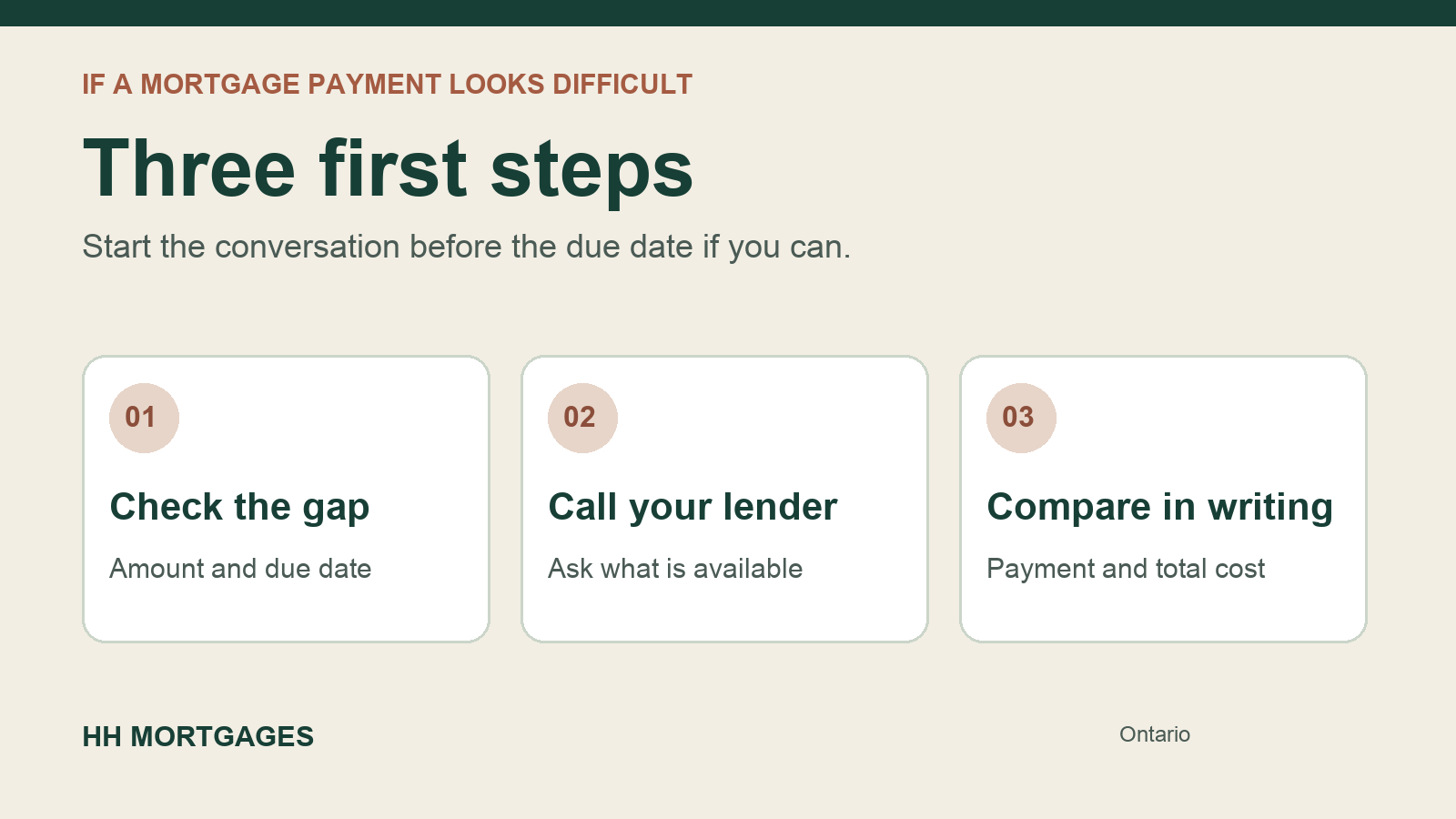
If your next mortgage payment looks difficult, contact your lender before the due date if you can. If the payment has already been missed, call now anyway. Ask what is due, what options are available under your mortgage, and what each option would cost. You do not have to guess your way through it alone.
This is a stressful conversation, but an early call gives you more room to understand the choices. The Financial Consumer Agency of Canada (FCAC) tells borrowers facing financial difficulty to contact their financial institution as soon as possible. The lender, not a general article, can tell you what is available on your particular account.
First, work out the immediate gap
Check the amount and date of the next payment, the balance in the account it comes from, and any income arriving before then. If you have already missed a payment, ask the lender for the exact amount required to bring the mortgage up to date and whether any fee or other charge applies under your agreement. Do not assume the lender has automatically arranged a second withdrawal.
Then make a short, honest list of what changed. Was it a temporary timing problem, a loss of income, a larger ongoing payment after renewal, or an expense that is likely to repeat? The right discussion depends on whether you need a few days, several months, or a longer-term change. Keep enough money for essentials in view as you compare options.
Ask for an agreement before you skip a payment
An agreed payment deferral or relief measure is different from simply letting a scheduled payment fail. FCAC explains that mortgage default can occur when you do not follow the mortgage agreement, including missing a regular payment. Default may eventually lead to enforcement against the property. That does not mean one missed payment automatically causes a sale; the immediate response and process depend on your contract and circumstances.
A late or missed payment can also appear as negative information on a credit report, according to FCAC's credit-report guide. FCAC separately says that when a federally regulated lender agrees to missed payments as part of a mortgage relief measure for an eligible principal-residence borrower at risk, it is expected not to report those agreed missed payments to credit bureaus. That protection should not be assumed for an unapproved missed payment or every kind of lender. Ask your lender how a proposed arrangement will be reported, and get the terms in writing.
What options are worth asking about?
The FCAC's mortgage relief guide describes several possibilities. Availability depends on the lender, mortgage contract and your situation:
- A payment deferral. You delay an agreed number of payments and repay them later. It is not forgiveness; your balance, future payment or amortization may increase.
- A temporary payment arrangement. The lender may agree to a reduced or catch-up payment schedule that fits a short-term problem.
- A longer amortization. Spreading the remaining mortgage over more time can reduce a payment, but generally increases total interest cost. Ask how and when you could return to the original schedule.
- Contract features. Some mortgages offer a skip-payment feature or the ability to re-borrow earlier prepayments. Conditions and costs vary, so check the contract before using one.
These are questions to raise, not options to accept on the spot. A line of credit or credit card used to cover a mortgage payment can turn one pressure point into another. FCAC specifically warns that relying on a home equity line of credit for payments can create further risk.
Get the full cost before agreeing
Ask the lender for the proposal in writing: your current balance, the new payment amount and due date, any new interest rate, the change to the remaining amortization, and the total mortgage cost in dollars compared with staying on the original schedule. FCAC says federally regulated lenders are expected to explain these effects clearly before you consent to a relief measure.
It is also fair to ask what happens when the temporary relief ends. Will the deferred amount be added to the balance? Will payments rise? Is there a realistic route back to the original schedule? A lower payment today may be useful, but only if you understand the cost tomorrow.
When should you get other help?
If you receive a formal default notice, are considering a sale under pressure, or do not understand the legal consequences of a proposal, speak with an Ontario lawyer promptly. If the debt problem extends beyond the mortgage, an accredited credit counsellor or licensed insolvency trustee may help you assess the wider picture. For a problem with how a bank handled your request, use its complaint process; FCAC explains the complaint routes.
My role as a mortgage agent can be to help you understand what your current mortgage says and whether another financing route is realistic. I cannot promise that refinancing will solve a payment problem, particularly if income or equity has changed. I would start with the current lender's written options, then compare any alternative against the full cost and your ability to keep up afterward.
The most useful first step is a direct call, even if you are already behind. Write down the name of the person you speak with, what they offered, the deadline to respond and when the written terms will arrive. A clear record makes the next decision easier.
General information only. Relief eligibility, fees, credit reporting and enforcement depend on your lender, contract and circumstances. This is not legal or debt-counselling advice. Hanif Hosseini, Mortgage Agent Level 1, M26001653, Mortgage Architects #12728. Serving Ontario, based in Oakville.