
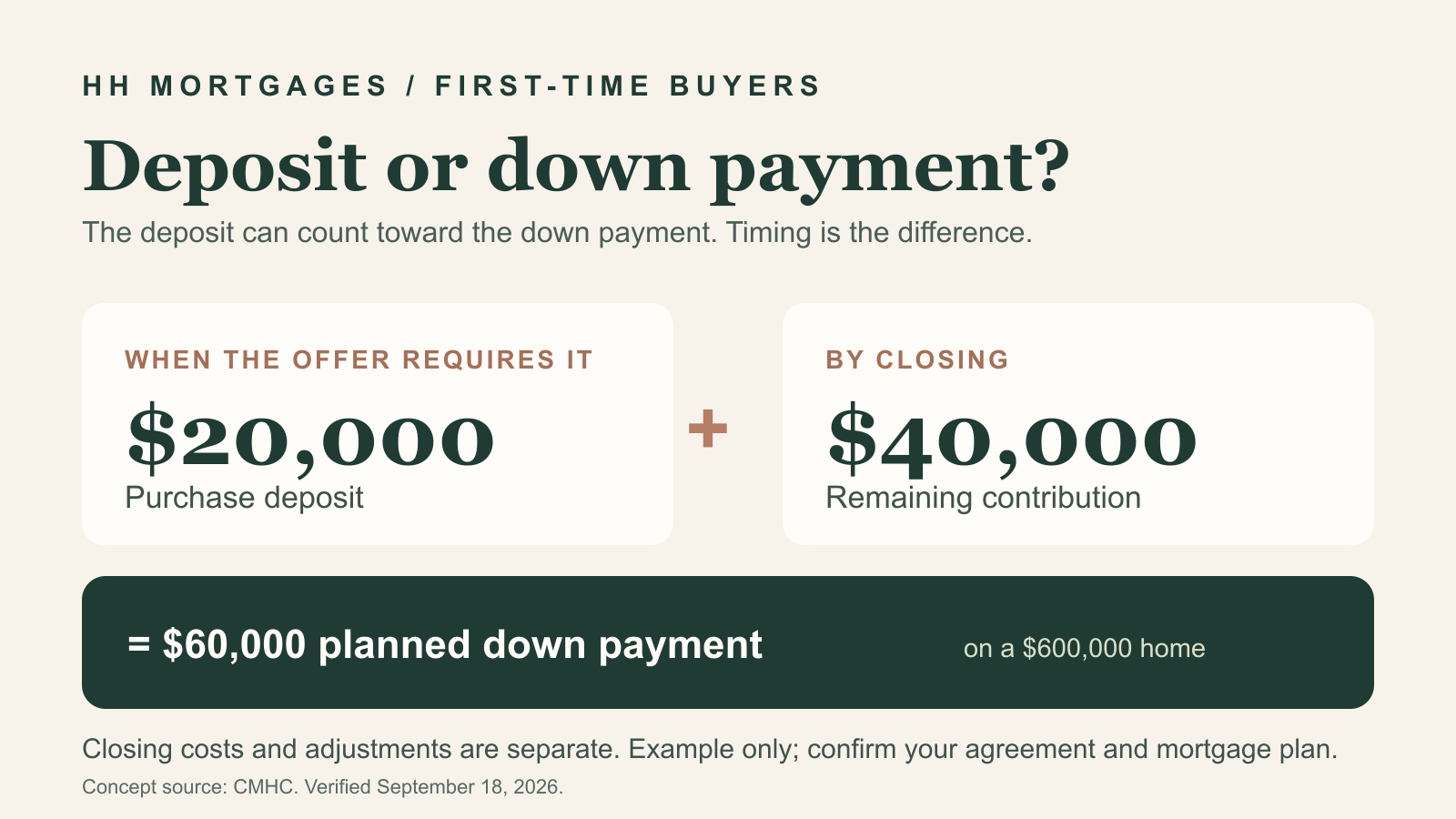
Your deposit and down payment are connected, but they are not two separate charges for the same purchase. The deposit is money you pay early under the purchase agreement. It can form part of your total down payment, which is your contribution toward the purchase price that the mortgage does not finance. The practical catch is timing: you may need the deposit shortly after your offer is accepted, while the rest of your contribution is generally arranged for closing.
If you have saved enough for the overall down payment but cannot access the proposed deposit in time, you have a problem to solve before you sign an offer. Here is how to think about the two amounts.
What is a home-purchase deposit?
A deposit shows that you are committed to the purchase. CMHC explains that it can form part of your down payment, but is paid at the offer stage. In an Ontario resale transaction, the accepted agreement specifies the deposit amount, deadline, payee and other terms. Your real estate agent and lawyer can explain exactly what your agreement requires.
Deposit funds are commonly held in trust by a real estate brokerage or lawyer until the transaction is completed, subject to the agreement. Ontario's real estate regulator, RECO, requires brokerages to disclose the terms for money they hold in trust. Confirm the correct payee and delivery instructions through a trusted channel before sending money. Do not rely on a last-minute email alone for payment details.
There is no single deposit amount or timing rule to assume for every offer. What matters to your transaction is the wording you agree to. RECO warns that failing to deliver an agreed deposit can have serious legal and financial consequences; it does not automatically cancel the deal.
What is the down payment?
Your down payment is the part of the purchase price paid from your own or other eligible funds rather than the mortgage. The Financial Consumer Agency of Canada describes it as the amount deducted from the home's price when calculating the mortgage financing needed. The lender must also accept and verify the source of those funds.
The minimum down payment depends on the purchase price and mortgage program. A lender may require more than the minimum, and a smaller down payment will typically mean mortgage default insurance is required. Our Ontario minimum down payment guide explains that calculation. The minimum is a mortgage rule; it does not tell you how much cash your particular purchase agreement will require as a deposit.
The deposit is usually credited toward the purchase price at closing. It can therefore count toward the cash contribution you planned as your down payment, rather than being added on top of it. Ask your lawyer to confirm how the deposit and any adjustments appear on the closing statement for your transaction.
A simple cash-flow example
Suppose the home price is $600,000 and you plan a $60,000 down payment. Your accepted offer calls for a $20,000 deposit. In a straightforward closing calculation, the $20,000 deposit is credited to the purchase price, leaving $40,000 of your planned down payment still to provide by closing. You do not need $20,000 plus another $60,000 for the same $60,000 contribution.
The numbers are only an illustration. The mortgage lender still has to approve the application and accept the source of your funds. Your lawyer's final statement can include adjustments and other amounts. You also need money for closing costs such as legal fees and applicable land transfer tax; those are separate from the down payment. Use our Ontario closing-cost checklist to budget beyond the purchase price.
The timing matters as much as the total. You need access to the $20,000 deposit by the deadline in your offer. The remaining $40,000 and closing costs must be ready according to your lender's and lawyer's instructions. If part of the money is still in investments or will arrive from family, plan the withdrawal and paperwork before making the offer.
What if the purchase does not close?
Do not assume you automatically get the deposit back because financing falls through. The signed agreement and the reason the transaction failed matter. RECO advises buyers to consider a financing condition where possible, and to understand the terms they sign. RECO also explains that its consumer deposit insurance does not settle a buyer-seller dispute over who is entitled to a deposit. A release or court direction may be needed for money held in a brokerage trust account when entitlement is disputed.
This is a legal question about your agreement, not something a mortgage pre-approval can decide. Have your real estate lawyer explain the deposit and condition wording before you commit, particularly if your financing or property review is still uncertain. A mortgage pre-approval is not final approval.
Keep the deposit easy to verify
The deposit may leave your account before your mortgage file is complete. Keep the accepted agreement, proof of payment and deposit receipt, along with account statements showing where the money came from. CMHC lists both down-payment source evidence and deposit records among documents a mortgage professional may request. Exact requirements vary by lender.
If family money will fund your deposit or later down-payment balance, disclose the plan early. A gift has its own eligibility and documentation rules. Our gifted down payment guide explains the gift letter and money trail. Send bank records only through the lender's or brokerage's approved secure process, not an ordinary website contact form.
Before you make an offer, confirm three numbers with your real estate agent and mortgage professional: the deposit due and when it must be available; the total down payment the mortgage plan requires; and the additional cash needed to close. Those are related parts of one purchase budget, but they happen at different points in time. If you are planning a purchase in Ontario, we can review the mortgage side of that cash plan before you commit to a deposit you cannot readily deliver.
General education, not individual mortgage or legal advice. Deposit rights depend on the signed purchase agreement and circumstances; seek your lawyer's advice. Mortgage requirements depend on the lender, insurer, borrower and property. Hanif Hosseini, Mortgage Agent Level 1, M26001653. Mortgage Architects, brokerage licence #12728. Serving Ontario, based in Oakville.