
Yes, a family gift can help with a mortgage down payment in Canada. The important word is gift. The lender needs to know who provided the money, where it came from and that you do not have to pay it back. The lender and mortgage insurer, if one is involved, must also accept that particular source of funds for your application.
If a parent has offered to help, tell your mortgage professional before the money moves. That gives you time to confirm the gift is eligible and collect the right paperwork. A large transfer with no explanation is much harder to sort out when your closing date is close.
Is a gifted down payment allowed?
CMHC lists a non-repayable gift from a relative among the traditional down-payment sources for its Purchase mortgage insurance product. Canada Guaranty's standard Downpayment Advantage program allows funds gifted by a close family member. This does not mean every person, mortgage product or lender follows exactly the same rule. Confirm the donor's relationship to you and the mortgage program before relying on the gift.
The gift can cover part of the down payment or, where the specific lender and insurer permit it, all of the required amount. Your income, credit, debts, property and available cash for closing costs still need to pass the usual review. A gift is help with one part of the file, not a substitute for mortgage approval.
If the money must be repaid, say so. A family loan is not a gift, even if the repayment terms are informal. The lender needs to assess the debt and its effect on affordability. Some specialized programs may consider borrowed down payments, but their rules differ. Calling a loan a gift on a form or letter is not a workaround.
What does a gift letter need to say?
Ask the lender for its preferred form. CMHC says a family member contributing to the down payment should sign a letter confirming the gift's purpose and that it is non-repayable. A lender may also want the donor's name and relationship to you, the amount, and the date or expected date of transfer. TD describes these items in its guidance for parents helping a buyer.
The letter does not, by itself, prove the money arrived. Be prepared to show the transfer into your account and the account statement showing the deposit. The lender may request more information about where the donor's funds originated. Exact document and timing requirements vary, so follow the instructions for your mortgage rather than downloading a generic letter and assuming it will be enough.
Keep the money trail easy to follow
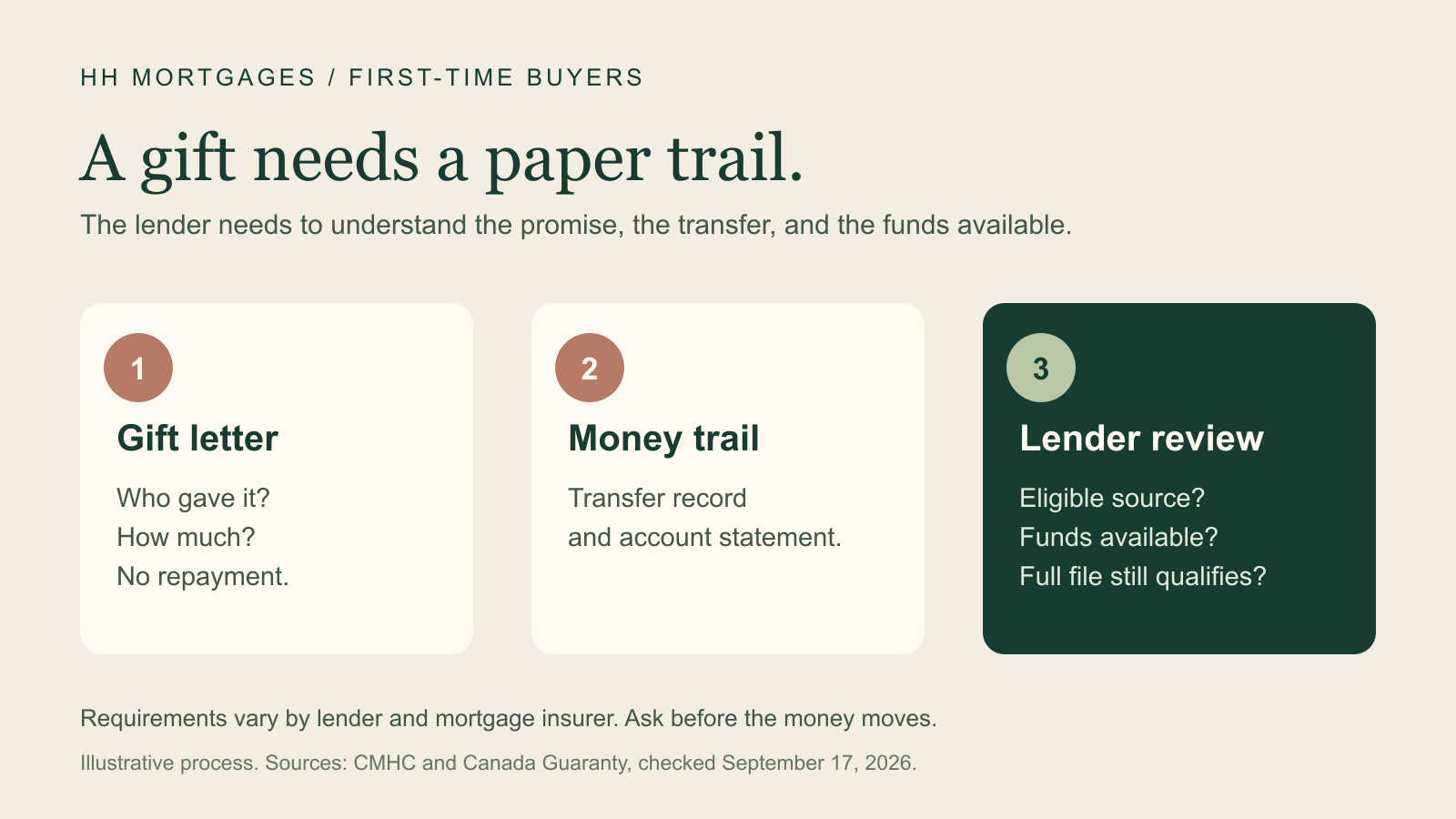
A practical file has three parts:
- The promise: the signed gift letter identifies the donor, recipient, amount and non-repayable purpose.
- The movement: a wire confirmation, bank record or other transfer evidence shows how the funds reached you.
- The landing: your account statement shows the gift deposited and available for the purchase.
CMHC also says mortgage professionals may ask for recent financial statements covering the past several months to establish the down payment. Keep complete records, including the account name and transaction date. Do not move the same gift through several accounts just to make it look seasoned. If it already moved through multiple accounts, explain the path and keep the corresponding statements.
For a gift sent from outside Canada, tell the lender early. You may need the original account and transfer records, currency-conversion evidence and additional source-of-funds documents. Do not assume that a Canadian bank deposit alone answers every question. Ask how documents in another language should be handled before paying for a translation.
Send sensitive statements through the lender's or brokerage's approved secure process. The ordinary contact form on this site is for an initial question, not banking records or identification documents.
A simple example
Suppose you are buying a $600,000 home. Under CMHC's current standard Purchase rules, the minimum down payment for a qualifying one- or two-unit homeowner purchase is $35,000: 5% of the first $500,000 ($25,000) plus 10% of the remaining $100,000 ($10,000).
Imagine you have $15,000 in savings and a parent offers a $20,000 non-repayable gift. Together, that is $35,000. The arithmetic meets the example's minimum, but it does not approve the mortgage. The lender still needs to accept the gift, verify both sources of money, assess the rest of your application and confirm the property. You also need separate cash for closing costs. With less than 20% down, mortgage default insurance will typically be required.
Our Ontario minimum down payment guide explains the purchase-price calculation. The Ontario closing-cost checklist covers expenses that sit outside the down payment.
What I would check before you make an offer
I would start with five questions:
- Who is giving the money, and does that relationship meet the lender and insurer's rules?
- Is it genuinely non-repayable, with no side agreement or expected monthly payment?
- When will it arrive, and can we show a clear transfer and account trail?
- Do you still have enough verified funds for the deposit and closing costs?
- Does the full mortgage application work after income, debts, credit and the property are reviewed?
The mortgage documents checklist can help you organize the rest of the file. A pre-approval is not final approval, so bring up the gift before you rely on a purchase budget or waive any condition.
Family help can be a real advantage. A clean explanation, the right letter and a traceable transfer make that help easier for the lender to assess. If you are planning to use a gift, send me a short note about the amount and the donor's relationship to you. We can work out which documents to prepare through a secure process.
General education, not individual mortgage, tax or legal advice. Gift eligibility and documentation depend on the lender, insurer, borrower and property. Hanif Hosseini, Mortgage Agent Level 1, M26001653. Mortgage Architects, brokerage licence #12728. Serving Ontario, based in Oakville.