
You have an accepted offer and a mortgage plan that fits your budget. Then the lender's property valuation comes back below the price you agreed to pay. The mortgage may need to be recalculated, even if your income and credit have not changed.
A low appraisal does not automatically end the purchase. It does mean you need a clear answer about the lender's supported value, the mortgage amount it will offer, and any extra cash you would have to bring to closing. Ask those questions before assuming the original approval still works.
Why the lender looks at the property
A lender assesses both the borrower and the property securing the loan. The Canada Mortgage and Housing Corporation (CMHC) explains that determining property value is an essential part of a purchase or refinance application. If the valuation does not support the mortgage amount requested, the lender may offer less financing.
The lender may use an appraisal or another valuation method, depending on its policy and the property. An appraisal is an opinion of value for the lending decision. It is not a home inspection, a guarantee of the property's condition, or a promise about what the home will be worth later. The price in your purchase agreement is what you agreed to pay the seller; it does not force the lender to finance the same amount.
How much extra cash could you need?
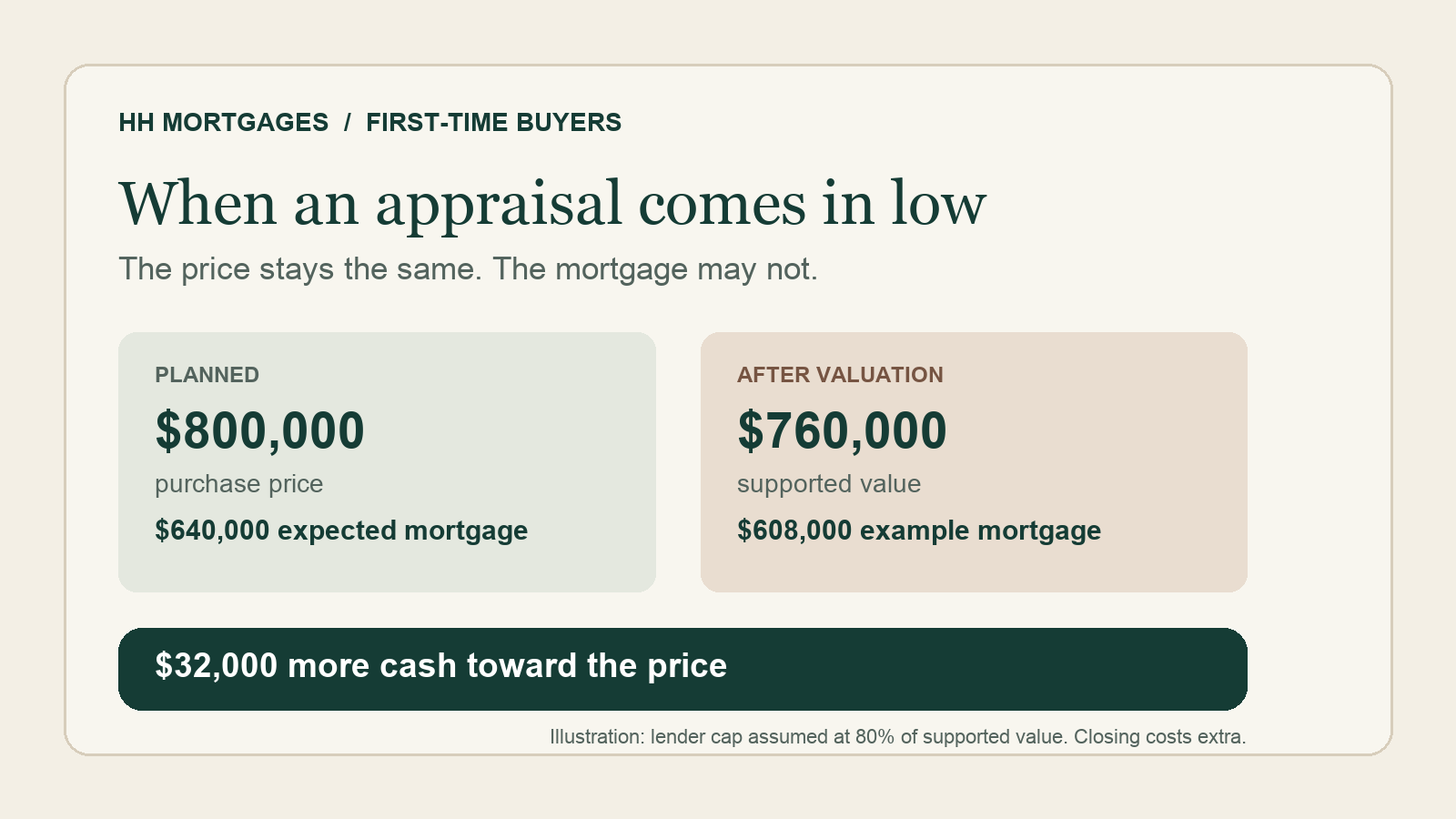
Here is an illustration, not a lender quote. Suppose you agree to buy a home for $800,000 and plan a $160,000 down payment. You expect to borrow $640,000. Now suppose the lender supports a value of $760,000 and, for this example, will lend no more than 80% of that supported value.
That cap would be $608,000 ($760,000 × 80%). To close at the agreed $800,000 price with that mortgage, the buyer would need $192,000 toward the purchase price ($800,000 − $608,000), which is $32,000 more than planned. Closing costs would still be separate.
This is a simple way to see the cash gap. The actual amount depends on the lender's valuation, loan-to-value policy, mortgage insurance eligibility where relevant, and the rest of the application. Do not assume you can borrow the shortfall through a new loan without telling the mortgage lender; new debt can change qualification. The FCAC's guide to buying a home also reminds buyers to budget for costs beyond the down payment.
What can you do after a low valuation?
Ask for the lender's exact numbers first. Find out the supported value, maximum mortgage, expected down payment and timing. A quick headline such as “the appraisal is $40,000 low” does not by itself tell you the cash required.
Review whether information is missing or wrong. Through your mortgage professional, ask whether the lender will consider a documented factual error, omitted property feature, recent comparable sale, or another valuation. The lender decides whether and how to reconsider. A second opinion is not a guaranteed higher value.
Discuss the purchase price with your real estate representative. The seller may or may not agree to a change. Any amendment to the agreement should be handled by the appropriate real estate and legal professionals.
Rework the financing only after checking the full cost. More down-payment cash, another lender or a different mortgage structure may be possibilities, but each has eligibility, time and cost implications. A family gift, for example, needs an acceptable source and documentation; see my guide to gifted down payments. Your lawyer can help you understand the contract and closing obligations.
If the offer includes a financing condition, speak with your real estate representative and lawyer about its wording and deadline. If it does not, get legal advice promptly about your obligations. The Real Estate Council of Ontario (RECO) recommends considering a financing condition where possible and cautions buyers to plan for costs such as an appraisal. A mortgage pre-approval does not settle the property's valuation; my pre-approval versus final approval guide explains the distinction.
What I would check before the offer
I would ask how quickly the lender can review the property, when any valuation is likely to happen, and how long the financing condition lasts. I would also keep a realistic cash buffer. That matters especially if the offered price stretches the savings you have available beyond the down payment.
If a valuation comes in low, I would not jump straight to “find another $32,000.” I would first confirm the lender's numbers and the actual deadline, then put the financing, real estate and legal options side by side. That keeps the decision tied to the contract and your real cash position.
A lower appraisal is a financing problem to solve, not a verdict that you made a bad offer or a guarantee that the sale will fall through. If you want to map out the numbers before making an offer, send me a message and we can look at your budget and questions together.
This is general Ontario mortgage information, not a commitment to lend or legal advice. Lender, insurer and contract terms vary. Consult your lawyer about your agreement and deadlines.