
Updated: October 1, 2026
You find a home you like. The seller has a mortgage with terms you would rather keep than replace. Can you take over that mortgage when you buy the property?
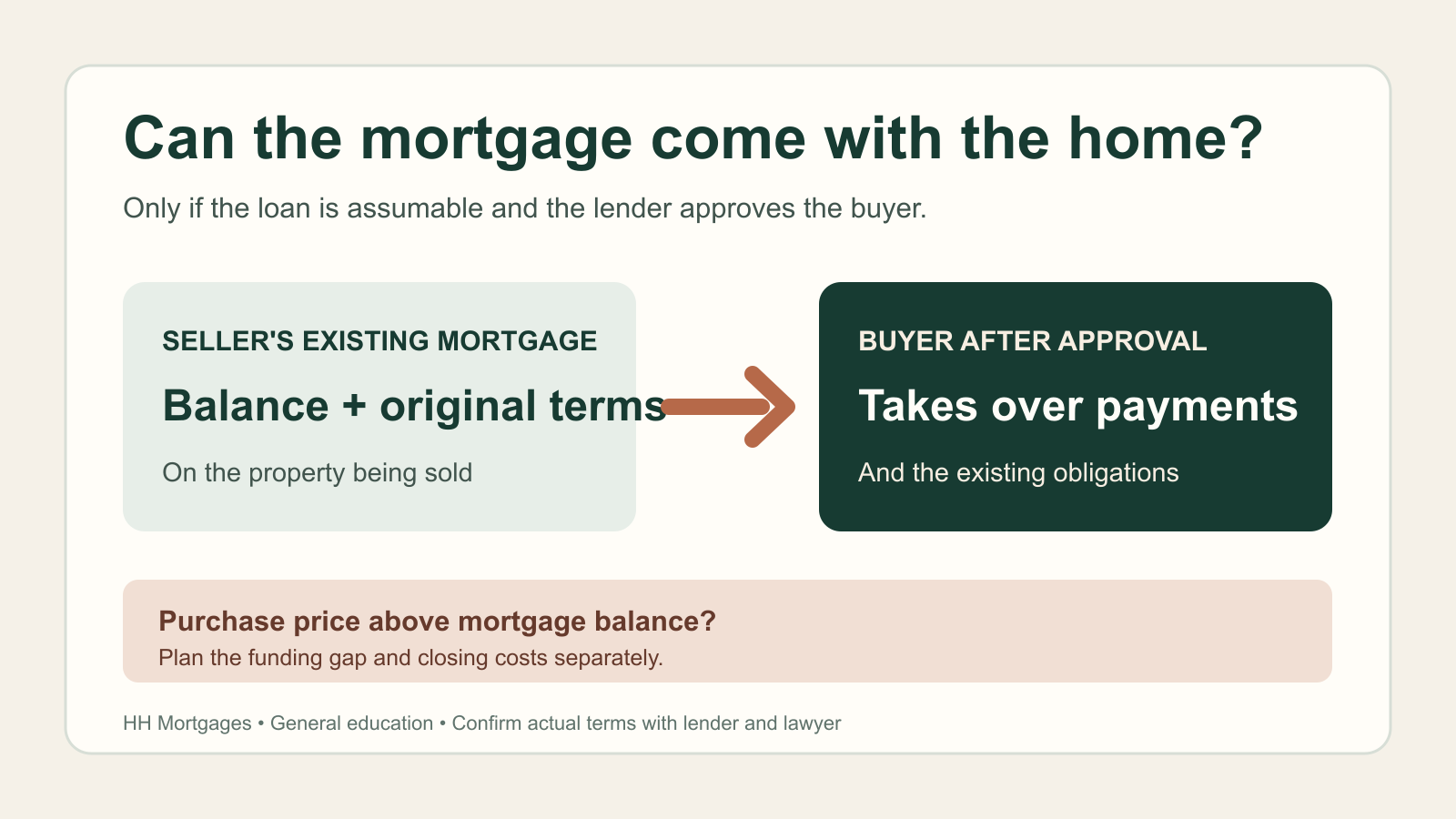
Possibly, if the mortgage is assumable and the lender approves you. An assumable mortgage lets the buyer take over the seller's existing mortgage and property under the original mortgage terms. It is not an automatic transfer, and the advertised mortgage rate alone does not tell you whether the deal works.
Start with the lender's written answer. Then compare the remaining balance with the purchase price, review every contract term, and have your lawyer confirm what happens to the seller's obligation after closing.
What does assuming a mortgage mean?
When a buyer assumes a mortgage, the buyer takes over the remaining payments and the terms and conditions of the seller's mortgage, subject to lender approval. The Financial Consumer Agency of Canada (FCAC) says the original mortgage terms must stay the same.
That means you should look beyond the interest rate. Ask for the remaining balance, rate, term end date, payment amount, amortization remaining, prepayment privileges, restrictions and any assumption fee. Your lender and lawyer can tell you which documents actually govern the proposed transfer.
An assumption is different from porting your own mortgage. With a port, a seller tries to carry their own mortgage to a different property. With an assumption, the buyer takes over the seller's mortgage on the property being sold. You do not get the seller's mortgage merely because the seller is moving.
Can any buyer take over any mortgage?
No. First, the contract and lender must allow the mortgage to be assumed. FCAC says the option is typically available on most fixed-rate mortgages, but not on variable-rate mortgages or home equity lines of credit. Treat that as general guidance, not a promise about a particular product. Ask the lender to check this exact mortgage.
Second, the lender must approve the buyer. The lender will review the buyer under its requirements. A seller's previous approval does not carry over to you. If you already have a mortgage pre-approval, it is still not approval to assume this mortgage or to buy this property. FCAC is clear that pre-approval does not guarantee final approval.
Do this before you treat assumption as a condition you can easily satisfy. Ask how long the lender's review may take and what it needs from you. Your real estate lawyer can help make sure the purchase agreement and closing timeline reflect that uncertainty.
What if the mortgage balance is smaller than the purchase price?
This is often the part a rate headline leaves out. Imagine a hypothetical home with a $700,000 purchase price and a $480,000 mortgage balance. The difference is $220,000, before closing costs. Taking over the $480,000 mortgage does not fund the whole purchase.
You would need an acceptable way to cover that gap and the closing costs. That could involve your own available funds or financing that the applicable lender or lenders agree to. Do not assume you can add the difference to the existing mortgage while keeping every original term. Ask the lender what it permits, what new borrowing would cost, and whether the combined plan can close on time.
The example is just subtraction: $700,000 minus $480,000 equals $220,000. It is not a mortgage offer, down-payment calculation or approval. Your purchase price, mortgage balance, other financing and closing costs will be different.
Does a favourable rate make assumption the best choice?
Not necessarily. A lower rate on the existing mortgage may be attractive, but the remaining term could be short. You may face a new rate at renewal sooner than you expect. The payment schedule, prepayment limits, fees and any borrowing needed to cover the purchase-price gap can change the total cost.
I would compare two written paths: assume the existing mortgage plus the approved plan for the gap, and arrange a new mortgage for the purchase. Put the cash needed to close, payments, fees, balance at the end of the comparable period, and renewal timing side by side. If the time periods differ, say so; a single monthly payment is not a fair comparison.
There can also be a seller-side reason to explore assumption. FCAC notes that a seller with years left in a term may consider it to avoid a prepayment fee. Whether that works depends on the actual contract and lender approval. Ask the lender for the seller's payout and assumption scenarios in writing rather than assuming a penalty disappears.
Could the seller still be responsible after the sale?
Potentially. FCAC warns that in some provinces the seller may remain personally liable after an assumption if the buyer stops paying. It also says some lenders may release the seller when they approve the buyer. The result is not safe to infer from the word “assumable.”
If you are selling in Ontario, ask your lawyer and lender to confirm in writing whether you will be fully released and what the closing documents must say. Do not rely on a verbal assurance from the buyer or on an informal line in the listing. The legal effect of your transaction needs a property-specific review.
The buyer should also ask exactly which obligations they are taking on. The original terms remain in force, and the buyer becomes responsible for the mortgage contract after an approved assumption. Review the documents with independent legal advice before signing.
Five questions to ask before making the plan
- Is this specific mortgage assumable? Ask the lender to confirm the contract, process, deadline and any fee.
- Will the lender approve this buyer? Ask what financial and property information it needs, and when it expects to decide.
- How will the purchase-price gap be covered? Map the actual cash and approved financing needed at closing, including Ontario closing costs.
- What do the remaining terms cost? Compare payment, rate, term end, renewal timing, privileges, fees and balance with a new-mortgage option.
- Is the seller released? Have the lender and lawyer confirm the answer and the required documents in writing.
If any answer is missing, you do not yet have a complete financing plan. An attractive old rate can be worth investigating, but it is not a substitute for approval, enough funds to close or a clear release for the seller.
If you are weighing an assumption against a new mortgage for an Ontario purchase, book a call. I can help you organize the lender questions and compare the borrowing side. Your lawyer should review the transfer and release documents. Please use a secure application channel for private financial documents, not the ordinary website contact form.
General education, not an individual mortgage offer, legal opinion or financial advice. Assumability, buyer approval, fees, additional financing and seller release depend on the mortgage contract, lender and transaction. The $700,000/$480,000 example is hypothetical and excludes closing costs. Hanif Hosseini, Mortgage Agent Level 1, M26001653. Mortgage Architects, brokerage licence #12728. Serving Ontario, based in Oakville.