
Updated: September 22, 2026
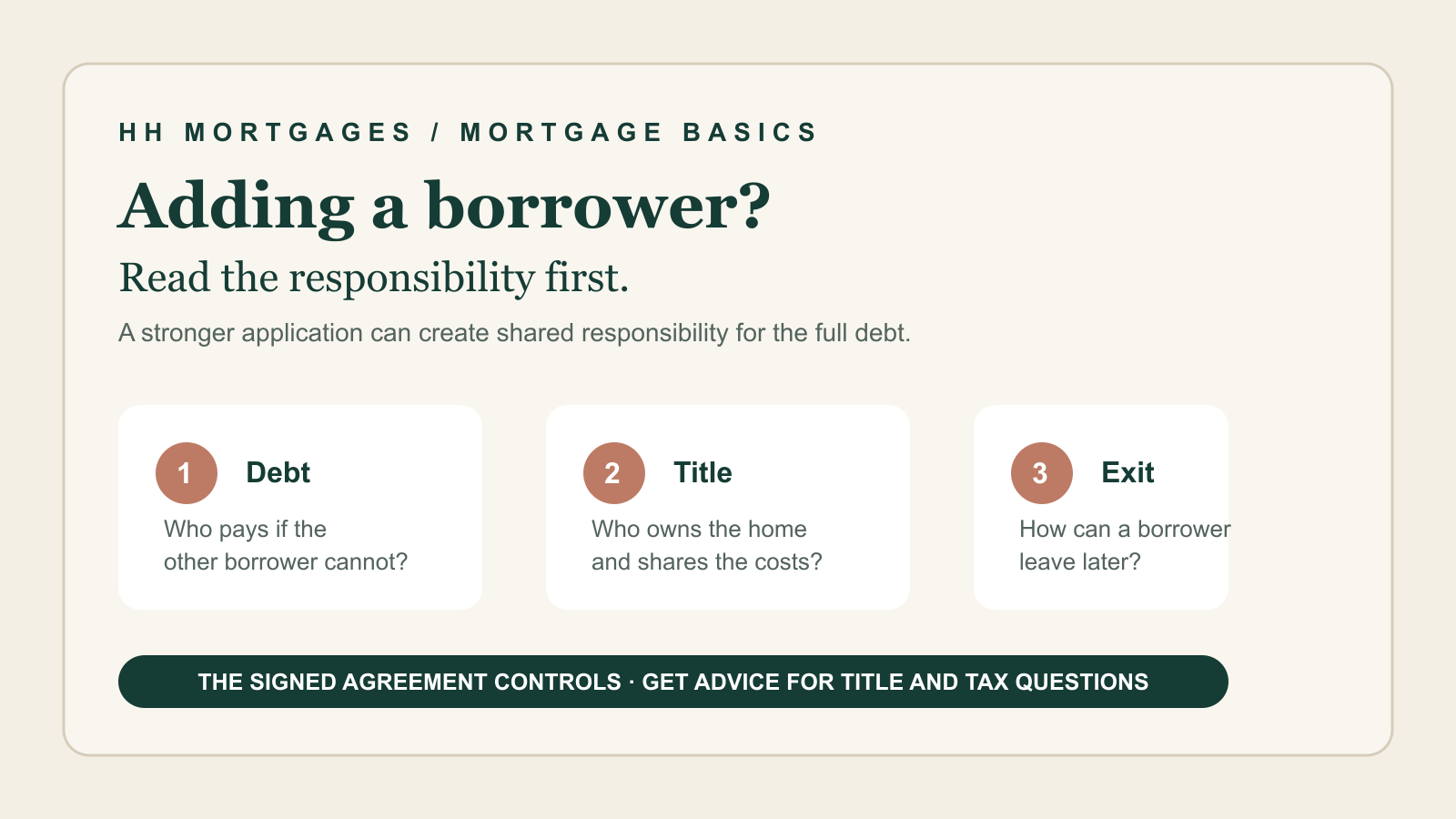
In Canadian mortgage conversations, co-signer often means joint borrower. The key point: a person who signs the mortgage with you can be responsible for the unpaid balance, even if the plan is for you to make every payment. Adding a parent, partner or another family member may help an application, but everyone needs to understand the obligation before signing.
The words people use in conversation can be loose. Read the lender's actual documents and ask who is borrowing, who will own the property, and what happens if someone wants to leave the arrangement later.
What does a co-signer or joint borrower do?
In consumer guidance, a co-signer is commonly treated as a joint borrower. The Financial Consumer Agency of Canada (FCAC) says a joint borrower is someone who signs a mortgage, loan, credit card or line of credit with another person. For a mortgage with a federally regulated financial institution, the joint borrower becomes equally responsible for repaying the unpaid balance.
That means the lender may look to any borrower listed in the agreement for the full debt if payments are not made. A person who contributes no money to the purchase can still carry the responsibility created by the mortgage documents.
For example, imagine a $600,000 mortgage with a parent added as a joint borrower. The family may plan for the parent to make no payments. That plan does not turn the parent's potential responsibility into $0, or automatically split the debt into $300,000 portions. The signed agreement controls.
The exact terms, ownership structure and lender process vary. Ask for the documents in advance and have each person obtain independent legal advice if the arrangement is complicated or the ownership does not match the borrowing.
Why would someone add another borrower?
The additional borrower may strengthen an application by adding verified income, assets or a credit history. A lender may also require a co-signer when the primary applicant does not meet its guidelines alone. FCAC's mortgage preparation guidance lists income, expenses, debts, credit history and the amount borrowed among the information lenders consider.
Adding someone is not a guarantee of approval. The lender still reviews the property, down payment, debt obligations and each person's financial information. The additional borrower's own debts can affect the application, and the mortgage can affect that person's ability to qualify for future borrowing.
Read our guide to GDS and TDS ratios for an explanation of how housing costs and other debts are assessed together.
Does a co-signer become an owner of the home?
Do not assume an answer from the word “co-signer.” Ask the lender how it will structure the borrowing, and ask your Ontario real estate lawyer who will be registered on title and what ownership interest each person will have. The mortgage obligation and registered ownership both need to be clear before anyone signs. Ontario's co-ownership guidance recommends legal help with title registration.
Before anyone signs, ask:
- Who will be registered on title?
- Who is responsible for the down payment, taxes, insurance and repairs?
- What happens if the home is sold or refinanced?
- How will an ownership share be valued if one person wants to leave?
- What happens if a borrower dies, separates, becomes disabled or stops contributing?
These are legal and ownership questions as well as mortgage questions. A mortgage professional can explain the lending side, but the people involved should obtain legal and tax advice for their own situation.
What happens if the main borrower misses a payment?
The missed payment can affect every borrower connected to the account. FCAC advises joint borrowers to understand their responsibility, receive account information and consider whether they could repay the loan if the other borrower did not.
For a federally regulated lender, joint borrowers generally have rights to information about the borrowing and ongoing statements, unless they consent to another arrangement. Keep copies of the agreement, statements and any written plan for contributions. A private understanding between family members does not remove the lender's rights under the mortgage contract.
If a payment problem is developing, tell the lender and the other borrowers early. Waiting until a default has grown can reduce the available options and damage more than one person's credit history.
Can a co-signer be removed later?
Do not promise anyone that they can simply be removed after closing. The signed mortgage does not include an automatic exit simply because the family's original plan has changed. A lender may require a new application, updated income documents, a property review or a refinance before releasing a borrower. The remaining borrower must qualify under the lender's rules at that time.
The same issue applies if the family expects the co-signer to leave after a short period. Ask the lender what event would trigger a review, what costs could apply and whether the new mortgage would have a different rate, term or amortization. A future release is a possibility to investigate, not an automatic feature.
Documents and conversations to prepare
The CMHC mortgage application checklist notes that a mortgage professional may request proof of employment, income, assets, the down-payment source and current debts. Each borrower should be ready to provide the information the lender requires through its secure process.
Before the application is submitted, write down:
- Why the additional borrower is being included and how long the arrangement is expected to last.
- Who will make the regular payment and how a shortfall will be handled.
- How repairs, taxes, insurance and other ownership costs will be divided.
- What would happen if the property is sold, refinanced or one person wants out.
- Which legal, tax and insurance questions need separate professional advice.
Do not send sensitive financial records through an ordinary website contact form. Use the lender's or brokerage's approved secure process.
Is adding a co-borrower the right answer?
Sometimes the arrangement solves a qualification problem. Sometimes it adds a long-term risk that does not fit the family's plan. Compare the full application with and without the additional borrower, and ask what happens at renewal, refinance and sale. A lower purchase budget, a larger down payment, paying down other debt or waiting for a stronger application may be worth considering too.
If a family member wants to help with the down payment instead, that is a different conversation. Our gifted down payment guide explains what a lender may ask to see. A gift and a shared mortgage obligation should not be treated as interchangeable.
If you are considering a mortgage with a family member in Ontario, send me a message and we can walk through the lender questions together. Each person should still understand the contract and obtain independent legal or tax advice where needed.
General education, not individual mortgage, legal or tax advice. Co-borrower responsibilities, title, qualification and release options depend on the lender, signed documents and individual circumstances. Hanif Hosseini, Mortgage Agent Level 1, M26001653. Mortgage Architects, brokerage licence #12728. Serving Ontario, based in Oakville.