
Updated: September 30, 2026
A cash-back mortgage gives you money near the start of your mortgage. That can be useful when buying a home leaves your cash stretched. But it is not automatically a discount. The mortgage may have a higher interest rate, and you may have to repay some or all of the cash back if you break the contract early.
The useful question is not “How much cash do I get?” It is “What does this offer cost compared with an otherwise similar mortgage without cash back?” Ask for that comparison in writing before treating the upfront amount as free money.
How does mortgage cash back work?
Cash back is an optional feature of some mortgages. The lender gives you a portion of the mortgage amount in cash, subject to its offer and conditions. The Financial Consumer Agency of Canada (FCAC) says this can help with purchase costs such as legal fees.
The timing, amount and permitted uses depend on the lender's written terms. FCAC also says a cash-back mortgage usually has a higher interest rate and that the additional interest may cost more than the cash you receive. “Usually” matters: compare the actual offers in front of you rather than assuming every lender prices the feature the same way.
Cash back does not change the basic need to qualify for the mortgage. The lender still reviews your income, debts, down payment, credit and property. A promising headline amount is not an approval or a substitute for a complete budget.
The three numbers to compare
Put the cash-back offer and a no-cash-back offer side by side using the same mortgage amount, amortization, term and payment frequency. Then ask for three numbers:
- Cash received: How much will reach you, and when? Check whether the lender limits what you can use it for.
- Extra borrowing cost: How much more interest would you pay over the current term? Ask for the payment amount and the projected mortgage balance at the end of that term as well. Include any fee difference.
- Early-exit cost: If you sell, refinance or switch before the term ends, would any cash back be repayable? Ask for the exact clause and a written illustration, alongside any prepayment charge and other fees.
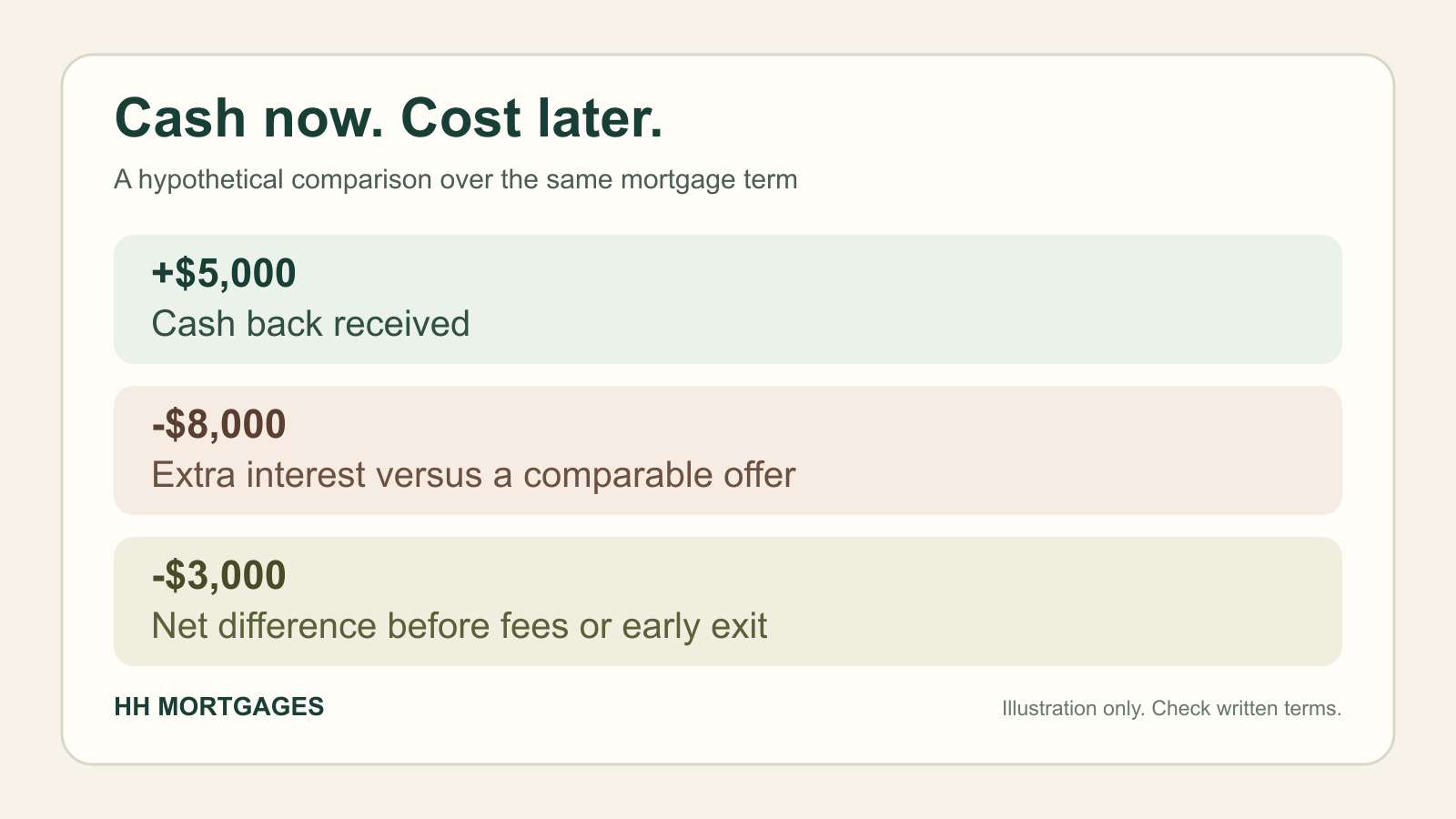
Here is a simple hypothetical illustration, not a current mortgage quote. Suppose one offer gives you $5,000 cash back but costs $8,000 more interest over the same term than a comparable offer without cash back. Ignoring timing, taxes and any fee difference, you would pay $3,000 more net for the upfront cash. If the first offer also has a repayment obligation when you leave early, the outcome could be worse.
That arithmetic is a starting point, not a substitute for the lender's full amortization schedules. Check both ending balances, the total of payments made during the term, fees and the value of getting money sooner. A lower monthly payment by itself does not tell you which offer costs less.
Can you use the cash back for your down payment?
Do not count on it. FCAC says a lender may restrict how cash-back funds are used and gives the down payment as an example of a use that may not be allowed. Confirm the permitted use and when the cash becomes available before you plan your purchase funds around it.
You also need money for costs beyond the down payment. Legal fees, land transfer tax and other items can arrive near closing. Our Ontario closing-cost checklist helps you list them, but the amount and due date for your purchase need their own review. A cash-back offer may help with an eligible cost; it cannot make an otherwise unaffordable purchase safe.
If you are comparing options before an offer, ask the lender or mortgage professional to separate the down payment, deposit, closing costs and cash-back payment on a timeline. “Cash at closing” and “cash after funding” can feel very different when a lawyer needs funds before the transaction completes. Use the lender's written payment date, not an assumption.
What if you sell or refinance early?
The cash-back agreement may add a second cost to breaking a mortgage. FCAC's guidance on breaking a mortgage says you may have to repay cash back, in addition to possible prepayment and other charges. How much is repayable, and when, is a question for the actual contract.
This matters if you might move, refinance, separate from a co-borrower, or switch lenders during the term. Life does not always follow a five-year spreadsheet. A cash-back offer can still be suitable, but you should know the exit terms before you accept it. Our open-versus-closed mortgage guide explains why repayment flexibility deserves attention alongside rate.
Ask the lender for a written estimate of the cost of leaving after one, two and three years, if those are plausible for you. The lender may not be able to predict a future interest-rate-based penalty exactly, but it can explain the formula and the cash-back repayment rule. Keep the offer sheet and mortgage agreement together so you can compare them later.
What I would ask before saying yes
I would ask for the cash-back and no-cash-back versions on the same page. I would want to see the rate, payment, interest over the term, balance at renewal, fees, permitted use of the cash, and the early-exit clause. If the comparison uses different terms or amortizations, I would ask for it to be redone on equal assumptions.
I would also ask what problem the cash solves. If it covers a specific eligible closing expense without stretching the budget, it may be worth examining. If it mainly makes a higher-cost mortgage look easier to start, I would slow down and compare alternatives. There is no universal answer because the offers, your cash needs and the chance of leaving early differ.
If you are weighing two mortgage offers in Ontario, book a call to review the two offers. I can help you line up the costs and questions before you choose. Please use a secure application channel for any private financial documents rather than the ordinary website contact form.
General education, not an individual mortgage offer or financial advice. Rates, cash-back amounts, permitted uses, approval, early-exit repayment and other charges depend on the lender's written terms and your circumstances. The $5,000/$8,000 illustration is hypothetical and does not include timing or fee differences. Hanif Hosseini, Mortgage Agent Level 1, M26001653. Mortgage Architects, brokerage licence #12728. Serving Ontario, based in Oakville.