
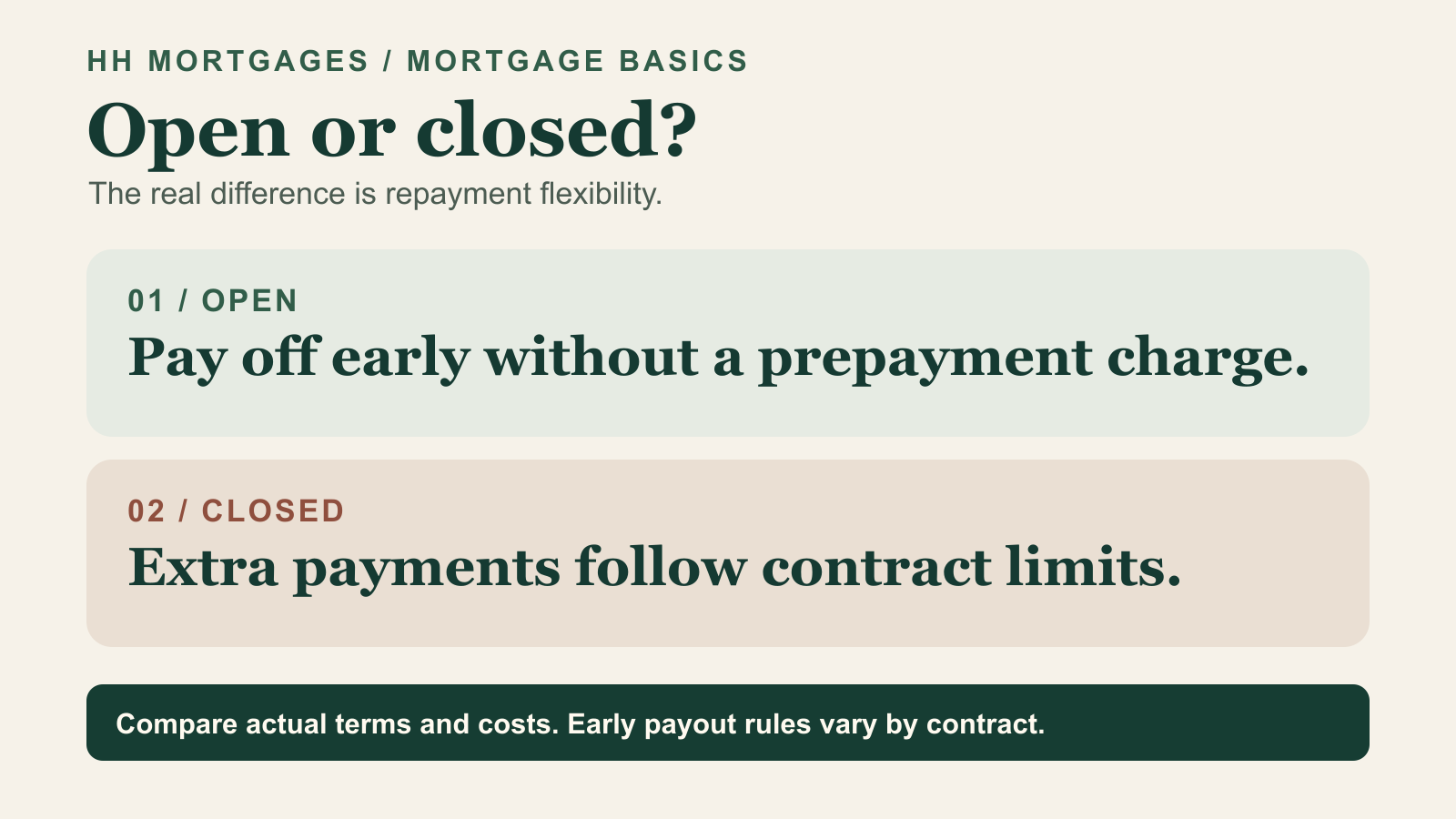
If you may sell your home, refinance or pay off a large part of your mortgage before the term ends, ask about open versus closed before you focus on the rate alone. An open mortgage gives you broad repayment flexibility. A closed mortgage usually has a lower rate for a comparable term, but paying more than its allowed prepayment amount or ending it early may trigger a charge.
The right choice depends on what you are actually likely to do, when you might do it and what each contract costs. You do not have to guess from the words “open” and “closed.” Ask for the terms and a written comparison.
What does an open mortgage let you do?
With an open mortgage, you can generally make extra payments or pay off the mortgage without a prepayment charge. That can matter if a home sale, a planned payout or another major change is close. The Financial Consumer Agency of Canada (FCAC) says open mortgages typically have higher rates than closed mortgages with similar terms. That is a general comparison, not a quote for your own application.
“Without a prepayment charge” does not mean “without costs.” You still pay interest while the balance is outstanding. You also need to ask about any discharge, administrative or other transaction costs that may apply to your particular plan. Get the lender's payout statement and timing requirements before committing to a sale or switch.
What does a closed mortgage restrict?
A closed mortgage usually limits how much extra principal you can pay during the term without a charge. The limit, timing and method are in your agreement. Some contracts let you increase regular payments or make a lump-sum payment within a stated privilege. Others offer less room. FCAC's prepayment guide says the privileges and charges should be explained in the contract for federally regulated lenders.
If you pay beyond the allowed amount, refinance, transfer to another lender or pay off the mortgage before the term ends, a prepayment charge may apply. Selling the property may also lead to a payout before the term ends. Do not assume that selling automatically waives the charge. Ask the lender for an estimate based on your balance, planned date and contract. Our prepayment privileges guide explains the questions to ask about your annual room.
Open or closed is a different choice from fixed or variable
These labels answer different questions. Open versus closed describes how freely you can repay or end the mortgage. Fixed versus variable describes how the interest rate behaves during the term. You still need to examine both choices, along with the term length, payment options and any conditions for moving the mortgage.
Do not assume that a variable rate makes a mortgage open, or that a fixed rate makes it closed. Look at the actual product and agreement. If you are comparing rate types too, read our fixed versus variable guide.
When might paying for flexibility make sense?
Imagine you expect to sell in several months, but you do not yet know the date. A lower closed-mortgage rate could look attractive on a quote. If the sale causes an early payout, though, you may face a charge. An open mortgage could cost more in interest while you hold it, yet spare you that particular charge. Which costs less depends on the offers, balance, holding period and contract terms. There is no universal winner.
Now imagine you expect to keep the home through the full term and make only modest extra payments. A closed mortgage with enough prepayment privileges may give you all the flexibility you need. You would not want to pay a higher rate for an open mortgage without a realistic use for it.
I would put the decision on one page: what you might do, when, how likely it is and what each lender says it would cost. If a sale is only a vague possibility, say that. If a payout date is firm, say that too. The comparison changes when the timeline changes.
Five questions to ask before you sign
- What is my likely timeline? Will you keep the home, sell, refinance or make a large lump-sum payment before the term ends?
- What is the closed mortgage's exact prepayment room? Ask about the amount, reset date, payment-increase option and whether unused room carries forward. Do not assume it does.
- What would an early payout cost? Ask for the calculation method and a written estimate for a realistic date. Estimates can change with the date and balance.
- What does the open option cost while I keep it? Compare the actual quoted rate, payment and projected interest over the period you expect to hold the mortgage. A rate difference by itself is not a complete dollar comparison.
- Are there other ways to handle a move? A portable mortgage may be an option in some contracts, but a transfer to a new property is subject to lender terms and approval. Our porting guide explains why the word “portable” is not a guarantee.
Ask your mortgage professional to compare the two written offers using the same balance, dates and assumptions. If your plans change later, contact the lender before you act so you know the current payout terms. You can also ask for a written statement of the charge and other amounts payable.
The practical answer
Choose based on a plausible plan, not on the cheapest-looking rate or the comforting sound of “flexible.” An open mortgage may be useful when an early payout is genuinely likely. A closed mortgage may fit when you expect to keep it and its prepayment rights cover your plans. I can help you turn that uncertain timeline into a comparison you can actually use.
If you are buying, renewing or considering a move in Ontario, tell me what you are planning. We can compare the contract details before you sign.
General education, not a mortgage offer or individual financial advice. Rates, charges, prepayment rights, portability and approval depend on the lender, contract, property and your circumstances. Hanif Hosseini, Mortgage Agent Level 1, M26001653. Mortgage Architects, brokerage licence #12728. Serving Ontario, based in Oakville.