Renewing Your Mortgage in 2027? Start 120 Days Early (Here’s the Plan)
On this page
Before I was a mortgage agent, I spent years in procurement in Tehran. The first lesson of that job: the first quote is never the one you sign. You ask around, you compare, and you negotiate.
A mortgage renewal is exactly the same game. Most people just don’t know they’re playing it. The renewal letter shows up, it looks official, and the easiest thing in the world is to sign it.
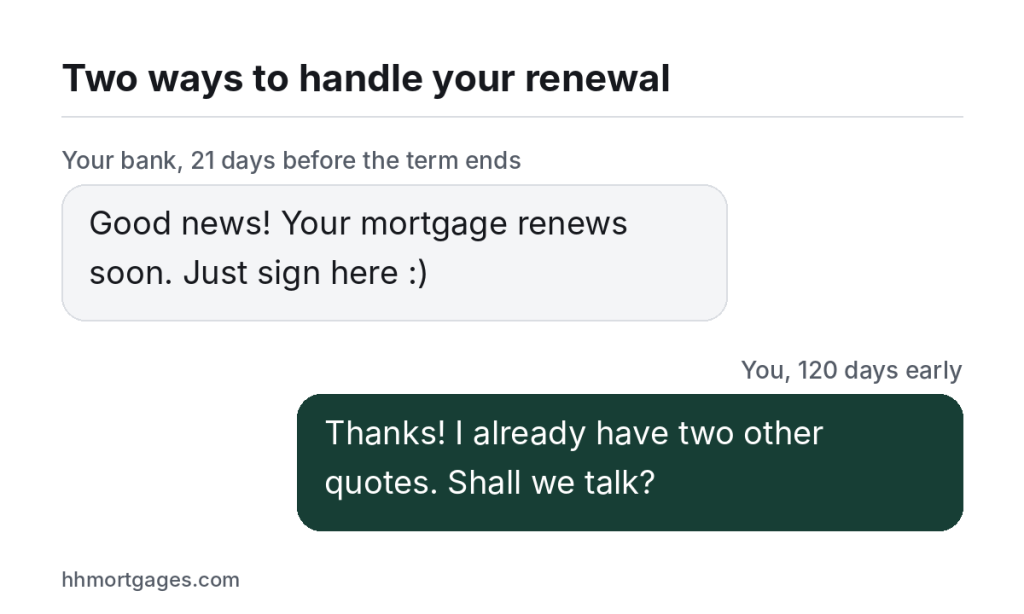
If your mortgage renews in 2027, this is worth getting right. Many people renewing now locked a five-year term in 2021 or 2022, when rates were much lower, and CMHC has said those borrowers are the most exposed to higher payments. The good news: about 120 days gives you plenty of time to do this properly. Here’s the plan I’d follow if it were my own mortgage.
Step 1: Find your four numbers
Pull up your last annual mortgage statement or your lender’s app and write down:
- the date your term ends
- your balance
- your remaining amortization (how many years are left to pay it off)
- your current payment
That’s your scorecard. Every offer gets compared against it.
Why the rush? Federally regulated lenders only have to send your renewal statement 21 days before your term ends, according to the Financial Consumer Agency of Canada. Three weeks is not a lot of time to shop around. It’s barely enough time to find the letter under the flyers.
Step 2: Run your new payment before the bank does
Open our renewal calculator, plug in your balance and remaining years, and try two or three rates. Five minutes, and no more surprises.
An example with made-up numbers: a $450,000 balance with 20 years left costs about $2,380 a month at 2.5% and about $2,780 at 4.25%. That’s roughly $400 more every month, or about the cost of feeding two very spoiled dogs. (I would know. Hi, Joey and Maya.)
Your numbers will be different. That’s exactly why it’s worth running them now, while you still have time to plan.
Step 3: Decide what you need from the next few years
The rate is the headline, but your life is the story. Before comparing anything, ask yourself:
- Might you move or sell soon? Then penalties and portability matter more than a tiny rate difference.
- Want to pay it off faster? Look at the prepayment privileges, not just the rate.
- Need money for a renovation or to clear other debt? That’s a refinance, not a simple renewal, and lenders assess it differently.
- How much payment change can you live with? That’s the real question behind fixed versus variable.
Step 4: Get at least one outside quote
Your current lender’s offer is the opening bid, not the final answer. Iranians have a word for this: taarof. The first offer is the polite one, and nobody really expects you to accept it. Treat your renewal letter the same way.
Something many people missed: in November 2024, OSFI changed its rules so that if you have an uninsured mortgage and you switch lenders at renewal, without borrowing more or stretching your amortization, you don’t have to pass the stress test again. Insured mortgages already worked this way. In plain English: moving your mortgage got a lot easier.
Switching can still come with costs, like legal or discharge fees, though some lenders cover part of them. So compare the whole package: rate, term, prepayment rules, how the penalty is calculated, and fees. My guide on comparing offers beyond the rate goes deeper.
Step 5: Check for a collateral charge
If your mortgage is registered as a collateral charge, moving it usually means a new registration and a lawyer. Still doable, but the cost and timing change. Here’s what to check.
Step 6: Don’t let “do nothing” decide for you
Some renewal letters roll you into a new term automatically if you don’t respond. Read it the day it arrives, note the reply deadline, and confirm your choice in writing.
Your 120-day game plan
- 120 days out: find your four numbers, run the calculator, decide what you need.
- 90 to 120 days out: get at least one outside quote and ask about holding a rate.
- 60 days out: when your lender’s offer arrives, compare it and negotiate.
- 30 days out: decide, and give the new lender time to process a switch.
Want a second pair of eyes? Send me your renewal date and current terms, in English or Persian. I’ll get back to you the same business day, with no pressure and no sales script.
General education for Ontario readers, not individual mortgage or legal advice or a promise of funding. The payment example uses made-up numbers. Rates, terms, fees, qualification and timing depend on the lender, the application and the property. Hanif Hosseini, Mortgage Agent Level 1, M26001653. Mortgage Architects, brokerage licence #12728. Serving Ontario, based in Oakville.