
The lower interest rate is worth your attention. It is not the whole decision. Two mortgage offers can quote similar rates yet leave you with different payments, costs if you move, and options for paying the balance down.
Before you choose, put both offers on the same page. Compare the term, rate type, amortization, payment, prepayment rules, break penalty, portability and registration type. Ask for any fees in writing. Then look at the differences through the lens of your own plans, not a generic “best mortgage” ranking.
Start with an apples-to-apples payment comparison
A rate comparison only works when the other assumptions match. Ask each lender or mortgage professional to calculate the payment using the same mortgage amount, amortization and payment frequency. Compare the same term length and rate type where possible.
For example, a five-year fixed offer and a three-year variable offer are different products. A smaller monthly payment might also come from a longer amortization rather than a better price. The Financial Consumer Agency of Canada (FCAC) explains that a longer amortization generally lowers the payment but increases interest paid over time.
If the offers include different fees, ask for a written breakdown of the amount due at closing and any costs added to the mortgage. Do not compare one advertised rate with another offer's all-in payment.
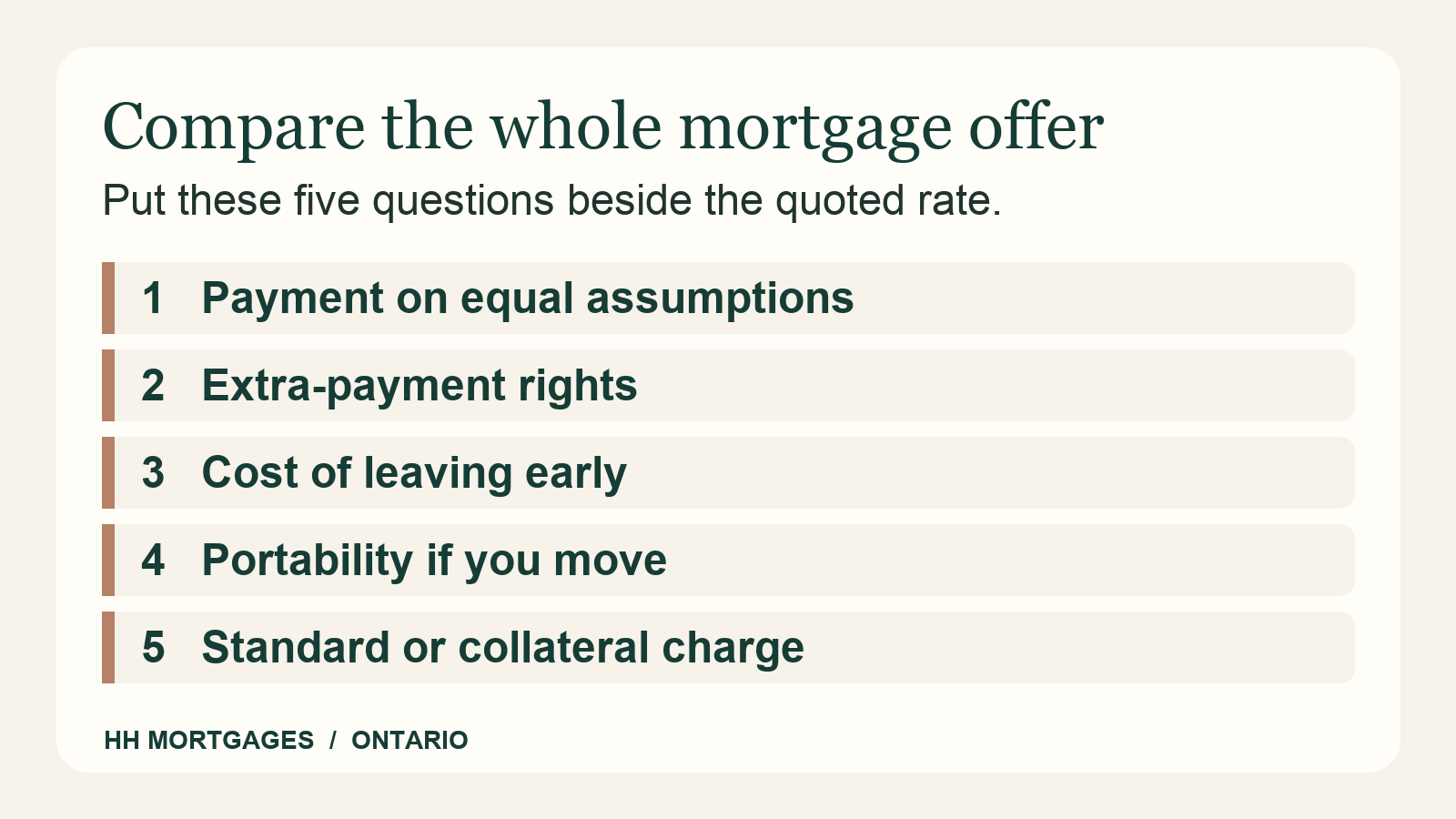
The five questions I would put beside each offer
| Question | Why it matters |
|---|---|
| What is the term, and is the rate fixed or variable? | This determines how long the contract conditions apply and how the rate or payment may change. |
| How much can I pay extra, and when? | Prepayment privileges vary by contract. A useful privilege fits the extra payments you actually expect to make. |
| What would it cost to leave early? | A sale, refinance or lender switch during the term may trigger a prepayment penalty and other fees. |
| Can I move this mortgage to another property? | Portability may help if you sell and buy, but eligibility, timing and lender approval still matter. |
| Is the registered security a standard or collateral charge? | The structure can affect what the charge secures and the work or cost of switching lenders later. |
The FCAC mortgage-choice guide describes these features and their future consequences. You do not have to master every contract term. You do need a clear answer to the ones that could change your next decision.
Look closely at the cost of leaving early
Imagine two offers that meet your budget today. You might sell the home in two years because of a job move. In that case, the lower-rate offer may still be the right one, but only after you understand its early-exit terms. Ask both lenders for their penalty method and a scenario estimate using the same possible exit date and balance.
The exact future penalty cannot be promised in advance: it depends on the contract and circumstances at the time. FCAC says prepayment penalties can cost thousands of dollars, and its guidance explains that lenders may calculate them differently. Ask what happens if you sell, refinance, transfer to another lender or pay a large lump sum.
An open mortgage generally allows extra payments without a prepayment penalty, while a closed mortgage can restrict them. That does not make an open mortgage automatically better; its rate may be higher. Our open versus closed mortgage guide walks through the trade-off.
Match flexibility to a real plan
“More flexible” only helps when it solves a plausible problem for you. If you expect a bonus, inheritance or another lump sum, compare the amount and timing of each offer's prepayment privileges. Check whether unused privileges carry forward; many do not. Our prepayment guide explains what to ask before you count on an extra payment.
If a move is possible, ask whether the mortgage is portable and what conditions apply. A port still requires lender review of the new property and your application. It may not remove every cost. See our Ontario mortgage-porting guide for the practical timing questions.
Finally, ask how the mortgage will be registered. A collateral charge can secure more than the original mortgage. That may suit some borrowing plans, but it can make a future lender switch more involved. The FCAC comparison of standard and collateral charges is a useful starting point; our collateral-charge guide covers the switch question in more detail.
Ask for one written comparison before you sign
Send this request to the person presenting the offers:
A request you can copy: “Please compare these offers using the same mortgage amount, amortization and payment schedule. Show me the payment, fees due now, prepayment privileges, early-exit penalty method, portability rules and registration type for each one. Please flag any condition that could change the quoted rate or approval.”
The FCAC's mortgage-rights guidance sets out information federally regulated lenders must disclose. Rules and documents can differ for other lenders, so ask to see the actual commitment and agreement. If a line is unclear, have it explained before you sign.
I would also tell the mortgage professional about a possible move, planned extra payments or a need to keep cash available. Those details can change which trade-offs matter most. A good comparison gives you a decision you can explain in your own words, even if the lowest quoted rate is the one you choose.
General education, not individual mortgage, legal or financial advice. Features, costs, qualification and approval depend on the lender, product, contract, verified application and property. No particular rate, saving or approval is guaranteed. Hanif Hosseini, Mortgage Agent Level 1, M26001653. Mortgage Architects, brokerage licence #12728. Serving Ontario, based in Oakville.