
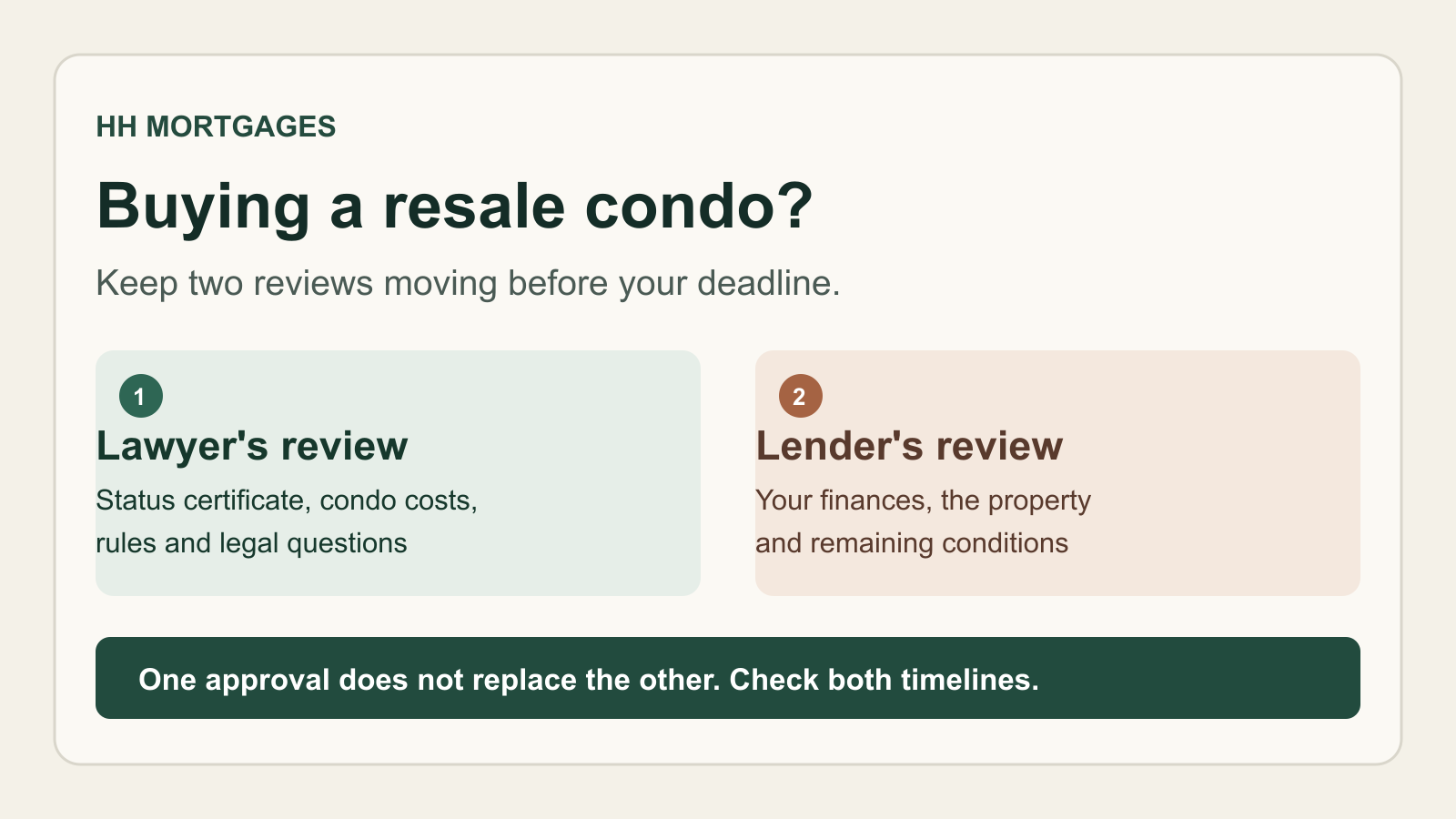
If you are buying a resale condo in Ontario, the status certificate helps you understand the unit and the corporation behind it. Your lawyer should review it with you. Your lender still has a separate job: deciding whether to finance you and the property. One review does not replace the other.
The useful question is not simply “Do I have the certificate?” It is “What does it say, who has reviewed it, and what does my lender still need before my financing and document-review deadlines?”
What is a status certificate?
A status certificate is a package of information about a resale condo unit and its condominium corporation. According to the Condominium Authority of Ontario (CAO), it may include the corporation's governing documents, current budget and audited financial statements, a statement about the reserve fund, the unit's common expenses, any arrears, special assessments, insurance information and litigation. It is a starting point for questions, not a promise that the building will have no future costs.
The reserve fund is money the corporation sets aside for major repairs and replacements. A special assessment is an extra charge the corporation may levy when it needs funds beyond regular common expenses. These details matter to your budget even if the mortgage payment itself looks affordable.
Anyone can request a certificate. The CAO says a corporation must provide it within 10 days after the request and payment, and the standard charge can be no more than $100 including applicable taxes. Ask your agent or lawyer who is requesting it, when, and who will receive the full package. A rush option may exist, but the corporation must still offer the statutory $100 route within 10 days. Check the CAO's current guidance if timing or cost affects your offer.
What should your lawyer help you examine?
Your lawyer can explain the legal and practical meaning of the documents for the unit you want to buy. I would ask them to flag:
- Monthly common expenses: What is the current amount, what is included, and is an increase disclosed?
- Reserve fund and major work: What does the latest information say about planned repairs, funding and potential future costs?
- Special assessments and arrears: Is an extra charge disclosed for this unit? Are its common expenses up to date?
- Rules and use: Do the declaration, by-laws or rules affect a plan that matters to you, such as renting, renovations or pets?
- Insurance and litigation: Are there issues you need to understand before you commit?
This is a discussion with your lawyer, not a five-box legal test. The CAO recommends legal review because the documents can change the value or suitability of a purchase for you. A low condo fee by itself is not proof of a healthy reserve fund, just as a high fee does not automatically mean a problem.
Where does the mortgage review fit?
A mortgage preapproval looks mainly at your finances before you choose a specific property. It does not guarantee final approval. The Financial Consumer Agency of Canada (FCAC) says the approved amount depends on the property's value and your down payment, and the lender checks that the property meets its standards. Those standards vary by lender.
Tell your mortgage professional early that the property is a condo. Send the current condo-fee amount and any material changes your lawyer identifies. Common expenses affect the cost of owning the unit and may affect your qualification. The FCAC includes condo fees in housing-cost calculations; your lender or insurer will apply its own current policy to your file.
Ask a direct question: Does this lender need the status certificate or any other condo documents for its property review? Some files may need more information. Do not assume every lender has the same document list, or that a lawyer's approval of the certificate means the lender has approved the mortgage. Likewise, a mortgage approval does not mean someone has checked whether the condo rules work for your plans.
If a special assessment, fee change, insurance issue or significant repair appears, send that information to your mortgage professional promptly. They can ask the lender whether it affects the file. Avoid guessing at the lender's response from the certificate alone.
Keep the two reviews on the same timeline
The condo corporation may use its full 10-day period to provide a certificate. Your offer may have a shorter deadline for financing, document review or both. The exact conditions and dates depend on your agreement. Have your real estate agent and lawyer review them before you sign, and ask your mortgage professional what information the lender needs and when.
For example, imagine your certificate arrives two days before a condition expires. Your lawyer identifies a possible extra charge, while the lender is still reviewing the property. You now have two open questions, not one completed approval. Ask your lawyer and agent about the agreement and available options before the deadline, and ask your mortgage professional for a clear status from the lender. Do not waive a condition merely because a preapproval letter exists.
Our guide to financing condition deadlines in Ontario explains what to ask when final approval is still outstanding. If a lender asks for a valuation and it comes in low, our appraisal guide explains the separate cash-gap question.
The practical checklist
Before you become firm on a resale condo purchase, make sure you know who has ordered the certificate, when the full package arrived, what your lawyer found, what the lender still needs, and the deadlines in your agreement. Put those answers in writing where you can find them. If an issue is unresolved, get advice from the professional responsible for it before you decide.
I can help with the financing side and coordinate the lender's document questions. Your lawyer handles the legal review and your agent can help with offer logistics. If you are buying a condo in Ontario, tell me where you are in the process. We can identify the financing questions early enough to be useful.
General education, not legal advice, a mortgage offer or an approval guarantee. Requirements depend on your lender, insurer, property, agreement and circumstances. Have an Ontario real estate lawyer review the condo documents and your purchase agreement. Hanif Hosseini, Mortgage Agent Level 1, M26001653. Mortgage Architects, brokerage licence #12728. Serving Ontario, based in Oakville.