
Yes, it is possible to qualify for a mortgage while you still have student loans. The student-loan balance is not an automatic “no.” What matters is how the payments, your other debts, your income and your credit history fit together for a particular lender.
If you are thinking about buying a home soon, start with the monthly payment and the amount you would still have available for a down payment and closing costs. Paying off a student loan as fast as possible is not always the best first move.
How do student loans affect the mortgage calculation?
Lenders look at the cost of the new home and the debts you already carry. The Financial Consumer Agency of Canada (FCAC) specifically lists student-loan payments among debts considered in the total debt service (TDS) calculation. TDS compares monthly housing costs plus other monthly debt obligations with gross income.
That means a student-loan payment can reduce the room left for a mortgage payment. It does not tell the whole story. A borrower with a student loan, steady income and manageable other debts may have a stronger application than someone without a student loan but with expensive credit-card or vehicle payments.
Lenders also review the credit report, the property and the rest of the application. FCAC recommends checking your credit report before you shop for a mortgage, both to understand what lenders may see and to spot errors. For a plain-English explanation of the two ratios lenders use, see my GDS and TDS guide.
A simple monthly-payment example
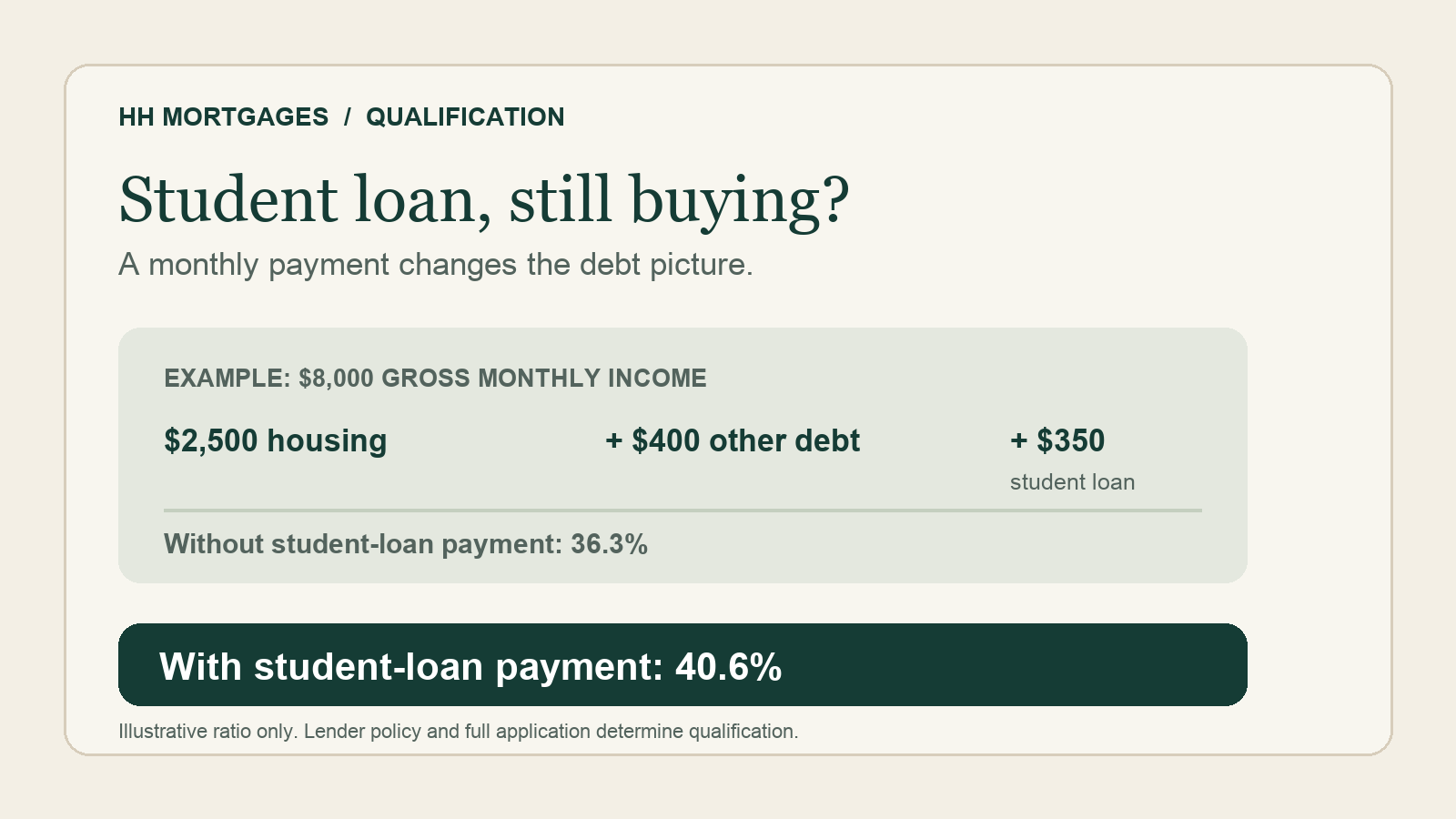
Suppose a household has $8,000 in gross monthly income. A proposed home's qualifying housing costs are $2,500 a month, there are $400 in other monthly debt payments, and a student loan requires $350 a month.
The example TDS is ($2,500 + $400 + $350) ÷ $8,000 = 40.6%. Without the student-loan payment, the same calculation would be 36.3%. The student loan adds about 4.4 percentage points to this example's total debt ratio.
These numbers do not predict an approval. A lender may calculate qualifying housing costs differently from the actual payment, and loan or insurer policies can vary. The example simply shows why the monthly obligation, not only the outstanding balance, deserves attention. Do not use a single online ratio as a substitute for a full mortgage review.
What if the student loan is not in repayment yet?
Tell the mortgage professional about it anyway. A paused or not-yet-due payment is not the same as a debt that has disappeared. Ask the lender what payment it will use to assess your application and what proof it needs.
Government student loans and bank student lines of credit have different repayment terms. The FCAC's student-debt guidance explains that provincial loan rules vary and that student lines of credit have terms set by the financial institution. Check your current statement and repayment schedule rather than relying on a number you remember from school.
If your required payment will change soon, mention the change early. The key is to give the lender an accurate picture of the obligation it is assessing. Do not hide a loan because the current payment is zero or expect every lender to treat a deferred loan identically.
Should you pay off the student loan before applying?
Sometimes reducing a monthly debt payment helps qualification. But using savings to clear a loan can also shrink the cash available for your down payment, deposit, land transfer tax and other closing costs. FCAC advises buyers to consider the full cost of homeownership, not only the mortgage payment.
Before paying a large lump sum, compare two complete scenarios: keep the loan and preserve cash, or pay it down and use a smaller cash reserve. Ask how much the required monthly payment would actually change after a partial repayment. Some loans do not automatically lower the scheduled payment when you pay extra; the agreement controls. If you are planning a purchase, get the lender's treatment of both scenarios in writing before moving the money.
A small credit-card balance or vehicle payment might also affect the monthly picture. The best repayment order depends on each debt's required payment, cost, terms and your cash needs. Avoid taking on new debt to create the appearance of a larger down payment.
What should you prepare?
Bring the current student-loan or line-of-credit statement, required payment, balance and any notice that repayment terms are changing. You will also need income evidence, other debt details and a clear record of your down-payment funds. My mortgage documents checklist can help you gather the rest.
If you are early in the home search, ask for a review using your real student-loan information, not a guess. A mortgage pre-approval is a useful starting point, but the final decision still depends on the complete application and the property.
Student debt may change what you can borrow; it does not automatically rule out buying a home. If you want to see how the payment and down-payment trade-off plays out in your own budget, send me a message and we can go through the numbers together.
This is general mortgage information for Canadian readers. It is not a commitment to lend, individualized financial advice or a statement of any lender's policy. Qualification and repayment terms vary.