
Rates dropped. Your neighbour just switched lenders and is very happy about it. You open your banking app, find the "estimate my prepayment charge" button, and the number that comes back is… a lot.
Before you decide that number is unfair, or that switching is obviously worth it, it helps to know where it comes from. It is less mysterious than it looks.
Quick answer
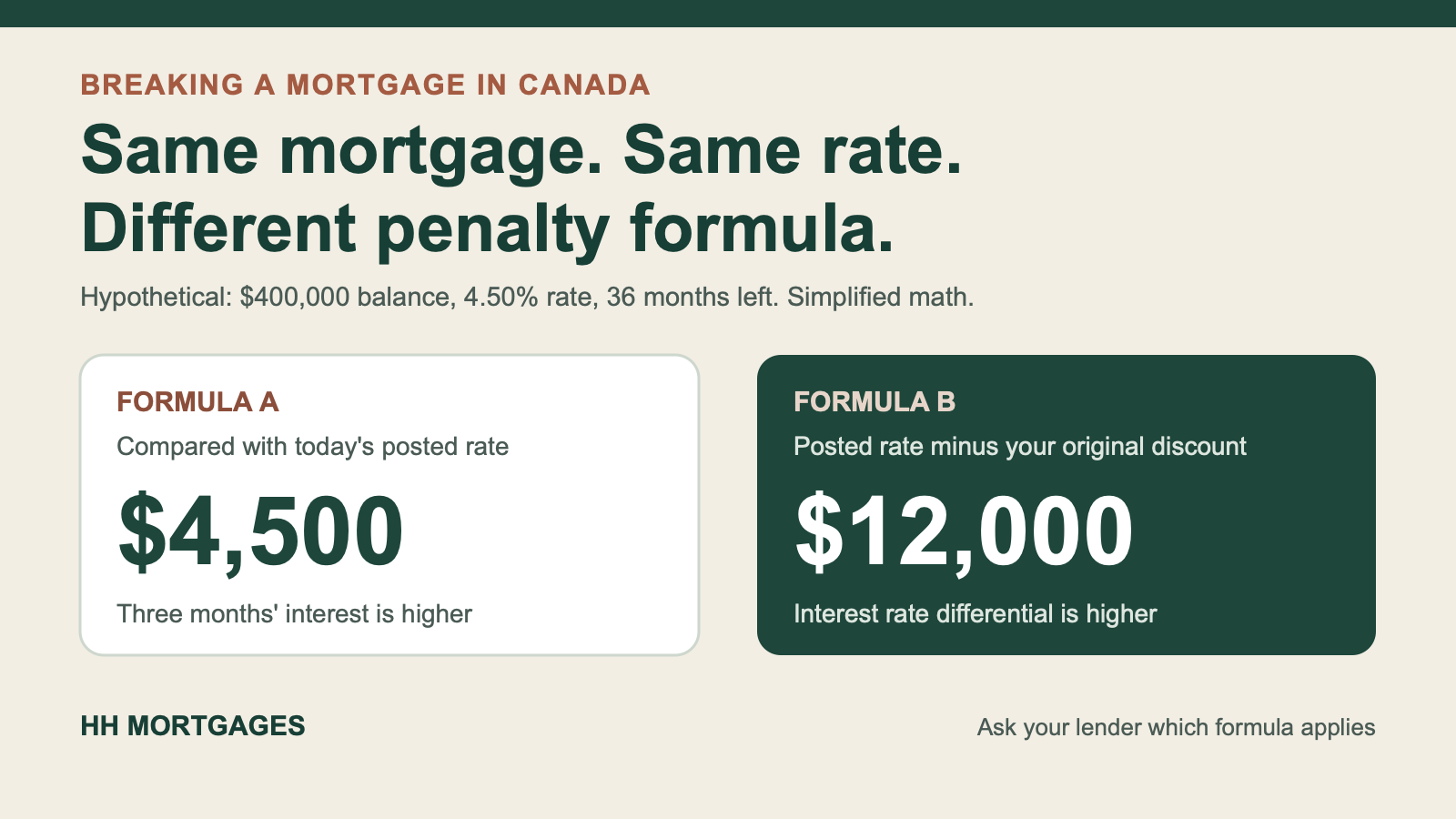
On a closed mortgage, the penalty is usually the higher of two numbers: three months' interest, or the interest rate differential (IRD). Three months' interest is easy to estimate. The IRD is where the big surprises live, because lenders don't all calculate it the same way.
Number one: three months' interest
This one is simple. Roughly:
Your balance × your rate ÷ 4
$400,000 at 4.50% works out to about $4,500. It doesn't care what rates have done since you signed. Boring, predictable, fine.
Number two: the IRD, the one that bites
The IRD is the lender's way of saying: "You promised to pay me 4.50% for three more years. If I have to lend this money out again at a lower rate, you cover the gap."
So the lender compares your rate with a comparison rate for the time you have left. The bigger the gap, the bigger the penalty. That's it.
The catch is which comparison rate. Canada's federal consumer agency lists two common choices:
- Option A: the lender's current posted rate for a term close to what you have left.
- Option B: that same posted rate minus the discount you got when you signed.
Option B sounds like a tiny technical detail. It is not.
Same mortgage, two formulas
Here's a made-up but realistic example. You're two years into a five-year fixed:
- Balance: $400,000, with 36 months left
- Your rate: 4.50%
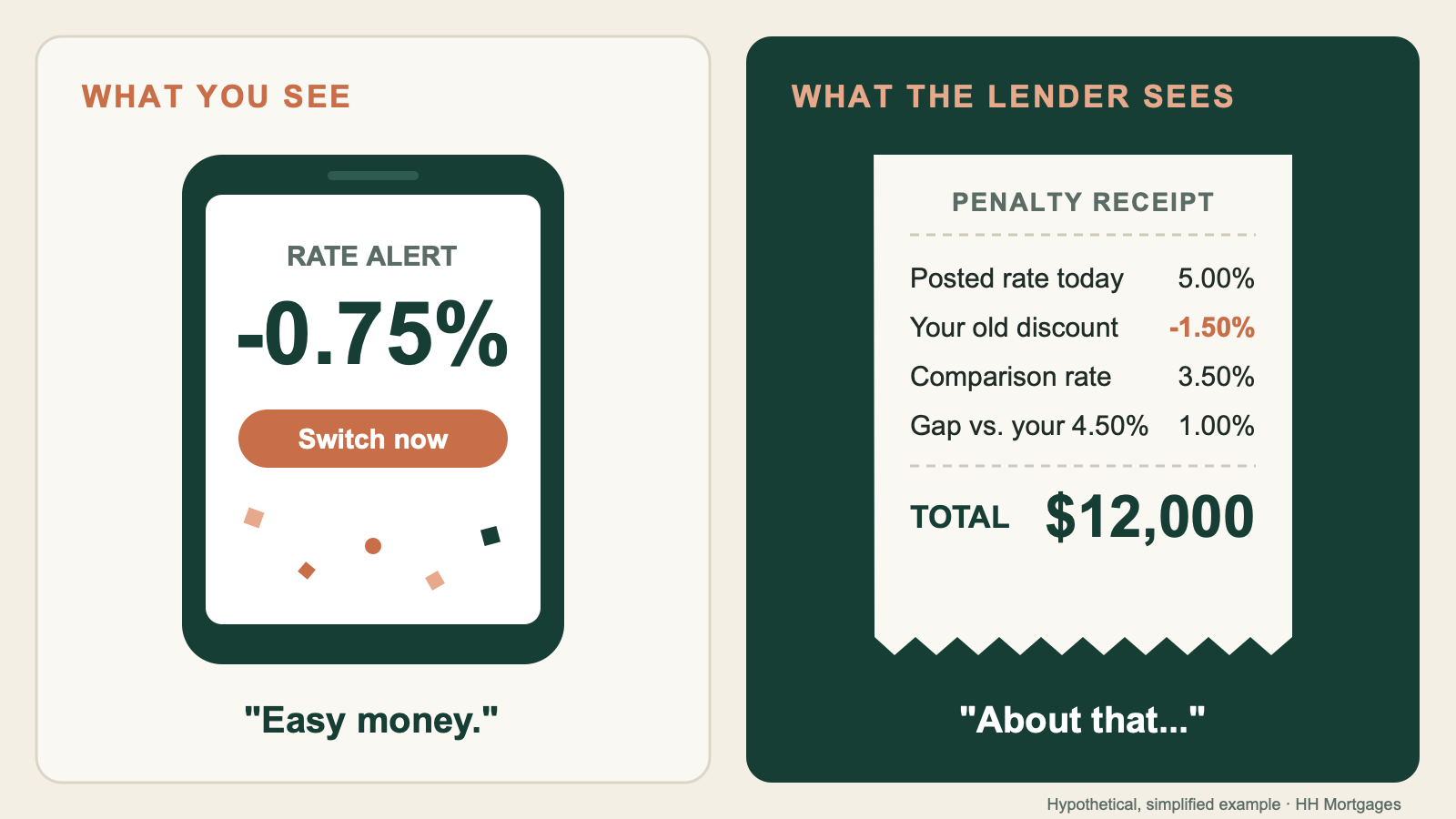
- When you signed, the posted five-year rate was 6.00%, so you got a 1.50% discount
- Today, the lender's posted three-year rate is 5.00%
| Option A | Option B | |
|---|---|---|
| Comparison rate | 5.00% (today's posted) | 3.50% (5.00% minus your 1.50% discount) |
| Gap from your 4.50% | None | 1.00% |
| IRD (simplified) | $0 | $400,000 × 1% × 3 years = $12,000 |
| Three months' interest | $4,500 | $4,500 |
| You'd pay | $4,500 | $12,000 |
The number to remember
$7,500. That's the difference between the two columns. Same borrower, same balance, same rate. The only thing that changed was the formula in the fine print.
That's why I read the penalty clause before I get excited about a rate. A deal that's 0.10% cheaper but uses Option B can cost you far more than it saves if you ever need to break it. And five years is a long time. People move, change jobs, have kids, split up, or just find a better rate.
Try it with your own numbers
This is a rough estimator using the same simplified math as the table. It's a way to see the shape of your penalty, not a quote.
Penalty estimator
Simplified estimate for a closed fixed-rate mortgage. Not a quote.
Penalty = the higher of three months’ interest or the IRD (rate gap × balance × years left). Savings assume monthly payments and Canadian semi-annual compounding. Real lender calculations differ, and fees are not included. Ask your lender for a written figure.
Is breaking actually worth it?
The penalty is only half the question. The other half is how much you'd save.
Stick with the example: you could get 3.75% instead of 4.50% for the remaining three years. With about 23 years left on the amortization, that saves roughly $8,700 in interest over those three years.
- Penalty of $4,500? Switching probably makes sense, once you add the other costs.
- Penalty of $12,000? You'd pay more to leave than you'd save by leaving.
And there are other costs. Ask about:
- administration, appraisal and discharge fees
- paying back any cash back you received
- legal and setup costs on the new mortgage
- whether you still qualify with a new lender today
Five ways to pay less (or nothing)
- Use your prepayment room first. A penalty on a smaller balance is a smaller penalty. Some lenders block prepayments right before a payout, so ask first. More in my prepayment privileges guide.
- Port it. Selling and buying? You may be able to take your mortgage with you. See porting a mortgage in Ontario.
- Blend and extend. Some lenders will mix your old rate with today's rate for a new term, no penalty, maybe a fee.
- Wait. If your renewal is close, the cheapest move is often patience. Here's how to use the renewal window well.
- Know the five-year rule. On a term longer than five years (a 7- or 10-year fixed), federal law generally caps the charge at three months' interest once five years have passed, for individual borrowers.
What to ask your lender
The online calculator is a start, not the answer. Ask for the real number in writing. Copy this if it helps:
Copy and send
Hi, I'm considering paying out my mortgage early. Could you send me a written penalty estimate that shows the method used, the rates used in the calculation, any discharge or administration fees, and the date the estimate is valid until? Please also confirm how much prepayment privilege I have left this year. Thanks!
If your lender is a bank, it has to explain how it calculates the charge, and banks that follow the industry code will give you a written statement when you confirm a payout.
What I'd actually do
If I were thinking about breaking, I'd get the written penalty, add every fee, and set that next to the real interest saving, not the rate difference. If the saving doesn't clearly win, I'd look hard at blending or waiting.
If I were choosing a mortgage, I'd ask about the penalty formula before the rate. Nobody plans to break their mortgage. Plenty of people do anyway.
Want a second pair of eyes on your penalty statement, or on a new offer's fine print? Send me a message and we'll go through the numbers together.
The fine print
- All figures here are hypothetical and simplified. Real IRD calculations account for your shrinking balance and may discount future amounts, so actual numbers differ.
- Your signed contract controls the calculation. Variable and fixed products, and different lenders, can use different methods.
- Disclosure rights described here apply to federally regulated lenders such as banks. Credit unions and other provincially regulated lenders may follow different rules.
- The five-year rule comes from section 10 of the federal Interest Act and does not apply to corporate borrowers. Confirm how it applies with your lender or lawyer.
- General education, not individual mortgage or financial advice. No saving is guaranteed.
Where these facts come from
- Financial Consumer Agency of Canada: Prepayment penalties
- Financial Consumer Agency of Canada: Breaking your mortgage contract
- Financial Consumer Agency of Canada: Mortgage prepayment, know your rights
- Justice Laws: Interest Act, section 10
Hanif Hosseini, Mortgage Agent Level 1, M26001653. Mortgage Architects, brokerage licence #12728. Serving Ontario, based in Oakville.